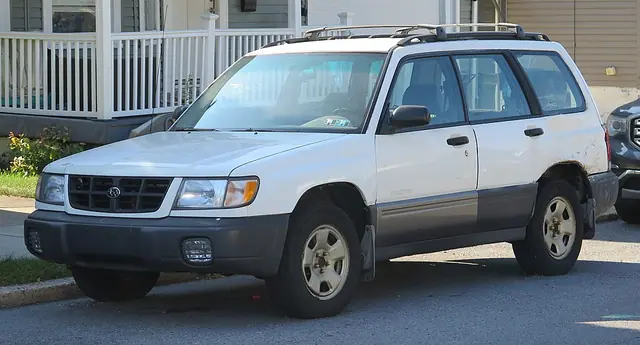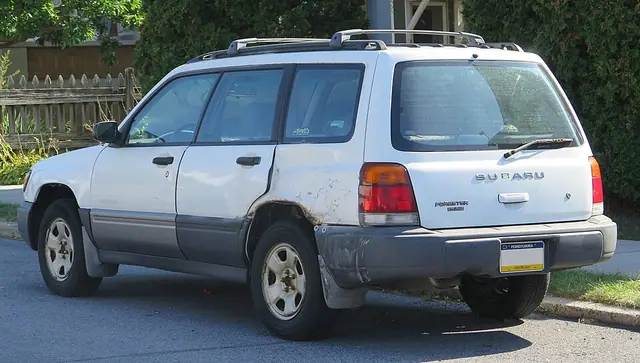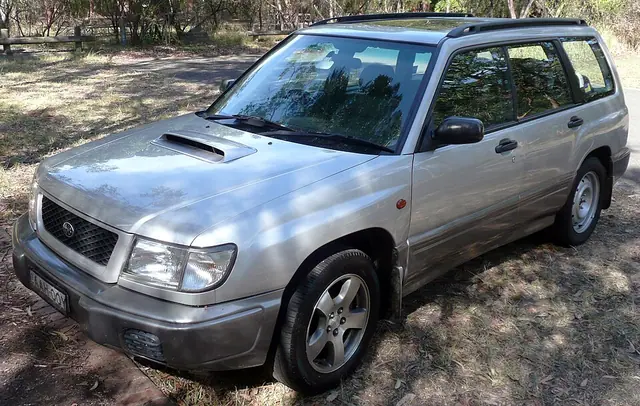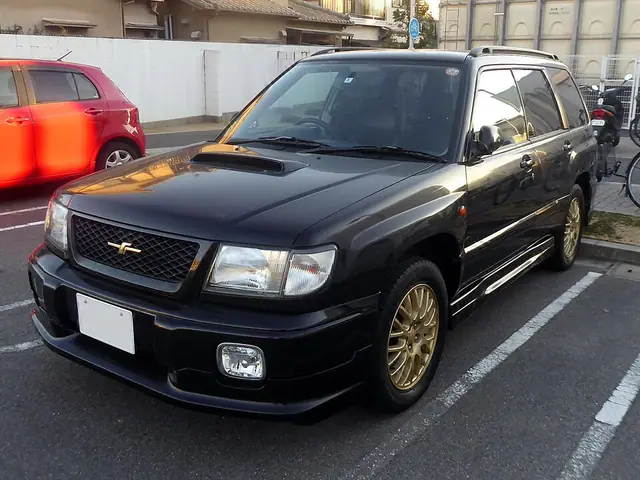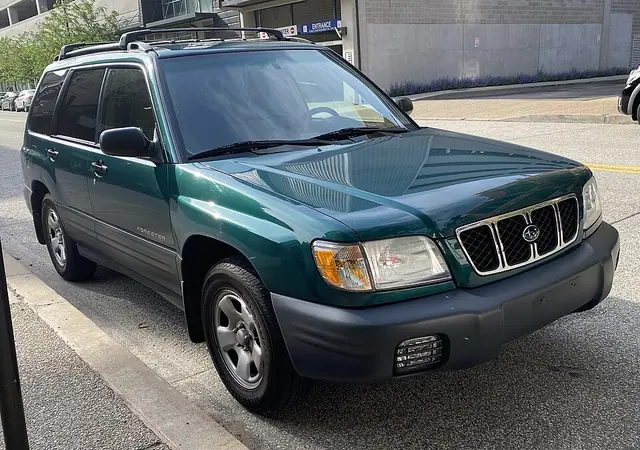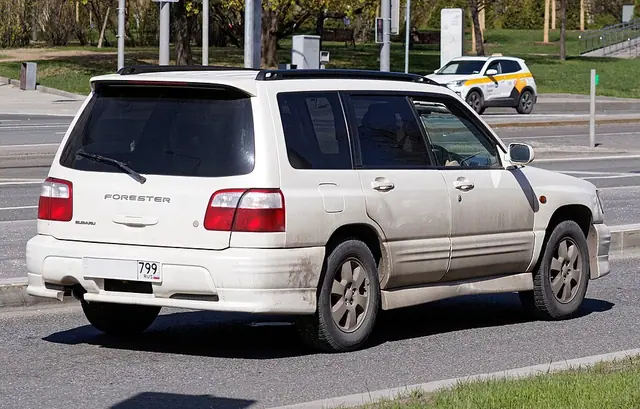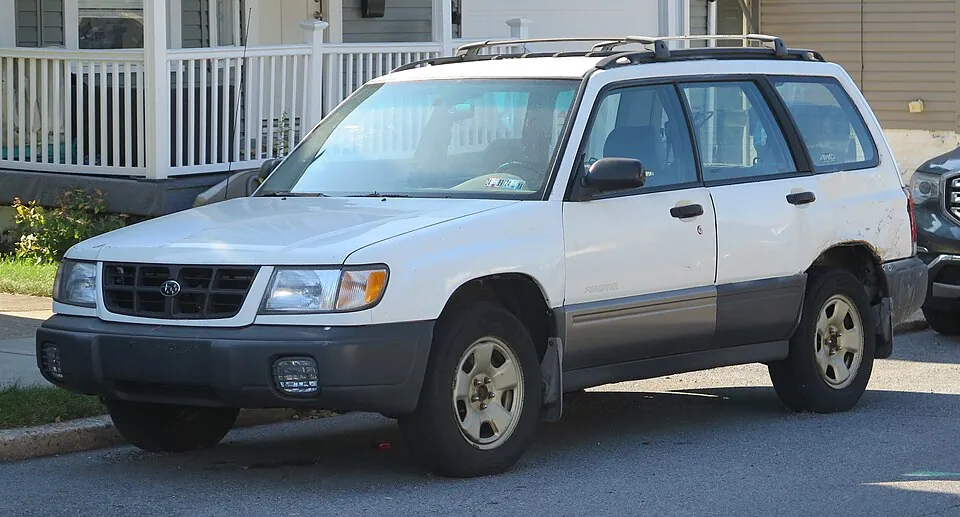
The Forester is one of the first crossovers: instead of an off-roader's heavy chassis it had a monocoque body and the engineering of the Impreza passenger car, but also more ground clearance, a higher seating position and permanent all-wheel drive. Subaru advertised it with the words "SUV tough, car easy". More than half a million first-generation cars were built, and the model is still in production today, in its sixth generation.
Story
This page covers the first generation (1997–2002); later ones are briefly mentioned at the end. By the mid-1990s Subaru had already had success with the Legacy Outback (Grand Wagon in Japan), a raised estate with all-wheel drive. The next step was a smaller car based on the Impreza, but taller and roomier, to compete with new small SUVs such as the Toyota RAV4. It was shown as the Streega concept in November 1995 at the Tokyo Motor Show. Before sales began, Subaru demonstrated its endurance: on 30 October 1996 the Forester set a world record average speed of 180.082 km/h over 24 hours at the Indianapolis track, certified by the FIA and ACCUS.
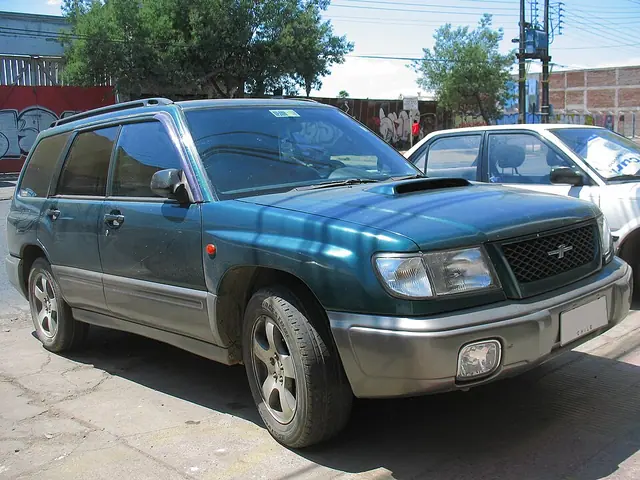
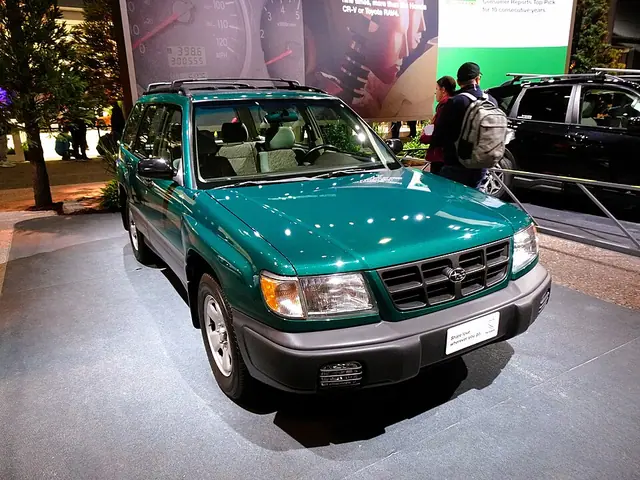
Production began in December 1996 at the Yajima plant in Gunma Prefecture, and sales in Japan in February 1997. In Japan the Forester was initially offered only with a 2.0-litre turbocharged engine with 250 hp, and it was advertised as a recreational vehicle with sports performance. It was also the first Subaru with side airbags. In July 1997 a naturally aspirated version with 135 hp was added, whose manual gearbox also had a two-range transfer box, and from September 1998 a 2.5-litre engine as well. The Forester reached the USA in July 1997 as a 1998 model, with a 2.5-litre engine and 165 hp, and Europe in September 1997. In Japan it replaced the Impreza Gravel Express estate.
Unlike conventional off-roaders, the Forester had a boxer engine mounted low and longitudinally, so its centre of gravity was low; according to the English Wikipedia, in the USA it did not need to carry the rollover warning label required on many off-roaders. Versions with an automatic gearbox split power 60:40 between the front and rear wheels, with an electronically controlled multi-plate clutch that sent more power to the rear when needed, while manual versions had a split close to 50:50. A weakness of the first generation was the head gaskets of the 2.5-litre engine, which were prone to early failure; the problem was only solved in the next generation.
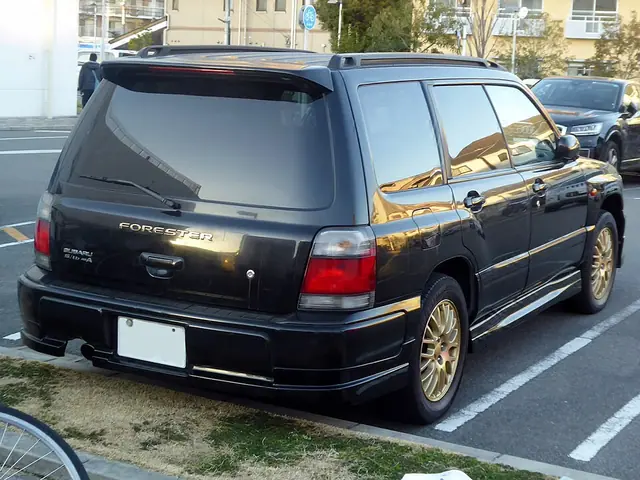
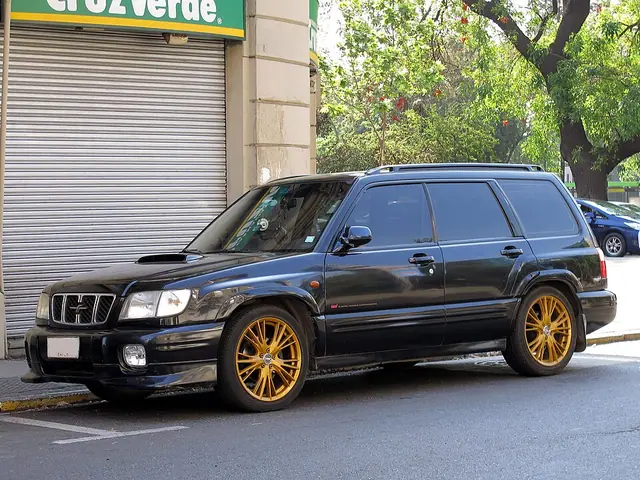
The model was facelifted in January 2000, and in May of the same year came the lowered sporty S/tb-STi version prepared by Subaru's STi motorsport division, and later the STi II Type M in 800 examples. Production of the first generation ended in January 2002, after 520,515 cars had been built, and the second generation was introduced in February 2002. In February 2006 the millionth Forester was built.
The second generation (2002) kept the raised-estate shape and gained a turbo version on the American market too, as well as an STi version in Japan. From the third generation (2007) the Forester became a true crossover SUV, larger and with a sloping roofline, and the fourth (2012), the fifth (2018), the first on the Subaru Global Platform, and the sixth, unveiled in November 2023, continued in that direction. The Forester became one of Subaru's best-selling models: in the USA alone two million had been sold by 2019.