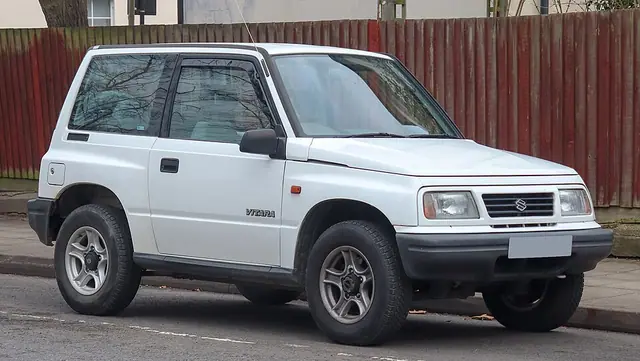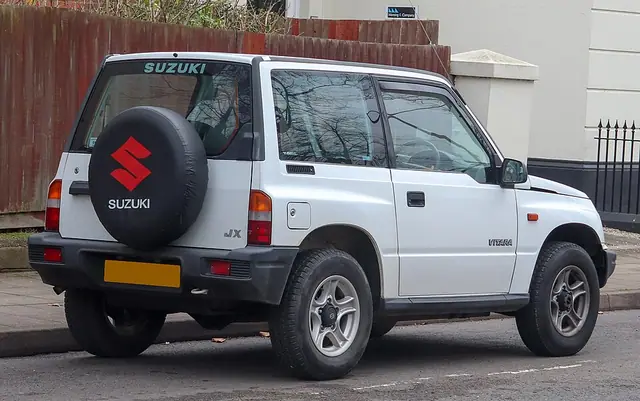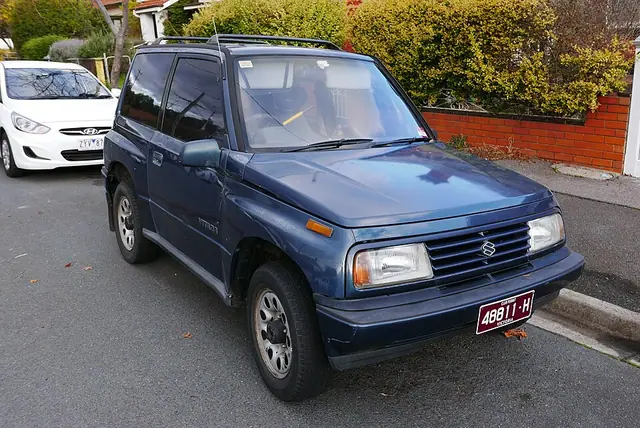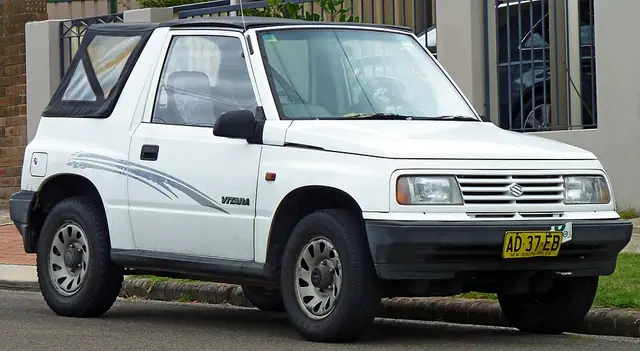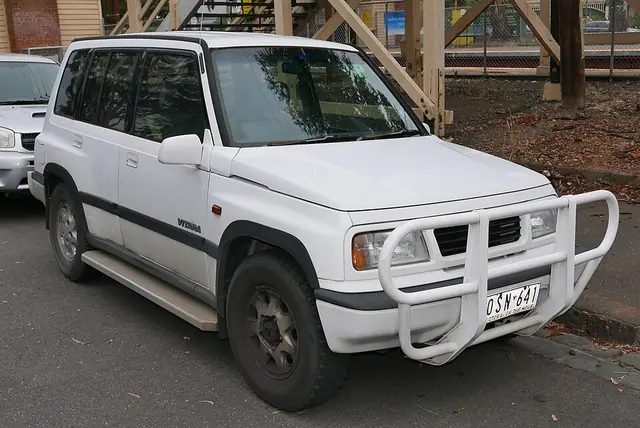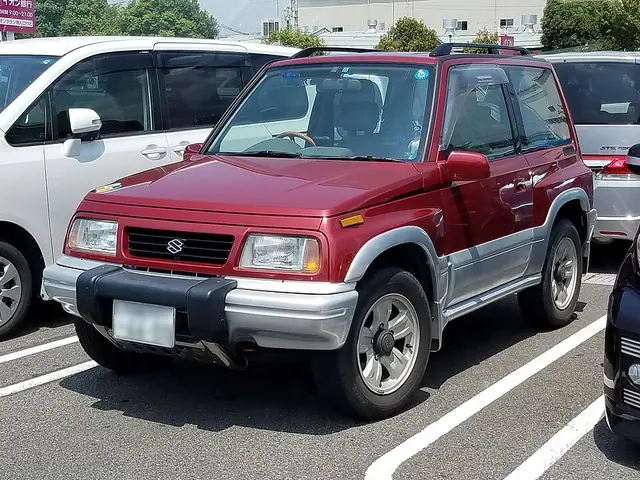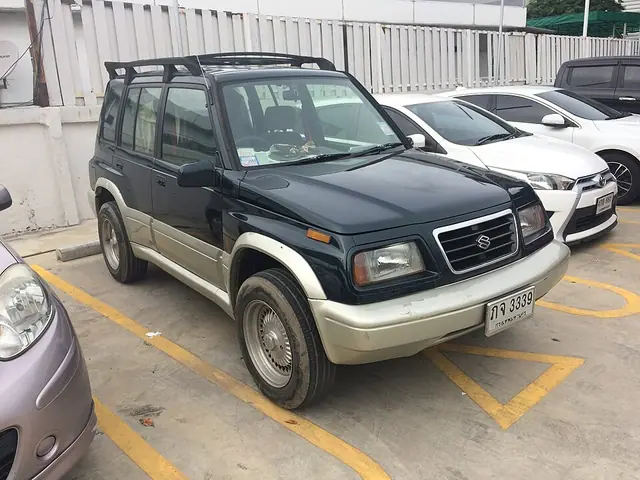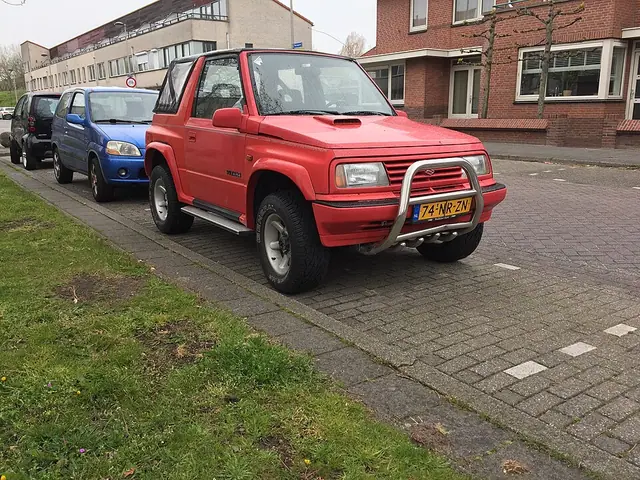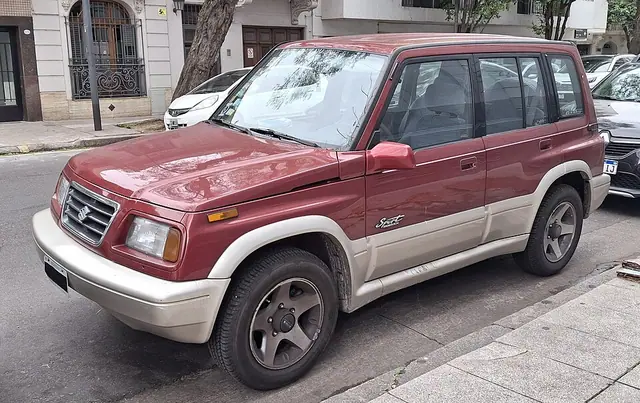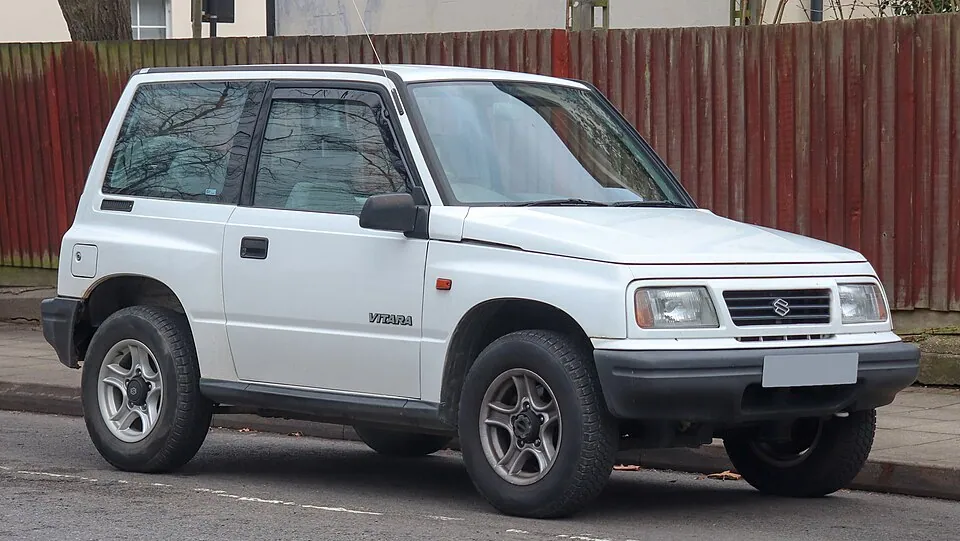
The Vitara, called the Escudo in Japan, was one of the first cars to combine real off-road engineering, with a separate chassis and low range, with the comfort and looks of an ordinary passenger car. Suzuki called it a "cross-country sedan", and the model is considered a forerunner of the light SUVs that dominate the roads today. It was sold under a dozen names, from the Geo Tracker to the Mazda Proceed Levante, and a twin-engined Escudo won the famous Pikes Peak hill climb.
Story
This page covers the first generation (1988–1998); later ones are briefly mentioned at the end. In the late 1980s off-roaders were popular in Japan thanks to the skiing craze, but large models such as the Toyota Land Cruiser and the Mitsubishi Pajero were expensive, thirsty and uncomfortable for everyday driving. Suzuki, which already had the small Jimny, prepared a model one class above it: it kept the ladder-frame chassis, selectable four-wheel drive and low range, but made the car lighter and gave it simple European-style lines and a passenger-car interior. The Escudo was launched in Japan in May 1988, with a 1.6-litre engine and a price of about 1.3 million yen. The name Escudo comes from the former Portuguese currency, while Vitara, as the model was called in most other countries, comes from the Latin word vita (life).
At first there were only three-door versions, a soft-top convertible and a hardtop. At the front it had independent suspension with coil springs, and at the rear a rigid axle located by a central A-arm, modelled on the first Range Rover. In August 1990 the engine gained 16 valves and 100 hp, and the automatic gearbox four speeds. The same year came a five-door version with a longer wheelbase, called the Escudo Nomade in Japan; according to the English Wikipedia, Suzuki feared it would take buyers away from the shorter model, but instead it attracted entirely new buyers and sales in Japan doubled. In December 1994 a 2.0-litre V6, the first six-cylinder engine in Suzuki's history, and a turbodiesel supplied by Mazda were added; in return Mazda sold the Escudo in Japan as the Proceed Levante. From 1996 there was also a 2.5-litre V6, with which the Escudo became the first Suzuki in Japan's higher tax class.
In North America the model was sold from 1989 as the Suzuki Sidekick, and it was also built at the CAMI plant in Ingersoll, Canada, a joint venture of Suzuki and General Motors. GM sold it as the Geo Tracker, Chevrolet Tracker, GMC Tracker, Pontiac Sunrunner and Asüna Sunrunner. In Europe the Vitara was an immediate success, so much so that Italy changed its rules in 1988: off-road vehicles had until then been exempt from the quotas on Japanese car imports, but the new regulation required at least one differential lock, which the Vitara did not have, so from 1 January 1989 it too fell under the quota. To get around the European Economic Community quotas, Suzuki also had the Vitara built in Spain by Santana Motor, which also sold it under its own name as the Santana 300 and 350, until 2006.
The Escudo also confirmed its reputation as a real off-roader in competition. In 1994 the Japanese driver Nobuhiro "Monster" Tajima entered the Pikes Peak hill climb in Colorado with a special Escudo that had two turbocharged engines, one at the front and one at the rear, with about 900 hp in total. A year later, in 1995, he won outright and became the first Japanese driver to win the event. The Vitara also took part in rally raids such as the Dakar and the Australasian Safari.
According to Suzuki, about 1.1 million first-generation cars were sold worldwide over nine and a half years. The second generation was unveiled in November 1997 and in most countries was sold as the Grand Vitara, alongside the even larger XL-7. The third generation of 2005 had a monocoque body with a built-in frame and independent rear suspension, while the fourth, from 2015, built in Hungary, is called the Vitara again but is a crossover with a transverse engine and no real chassis. The Escudo name was used in Japan until 2024, and since that year the Vitara name has also been carried by the electric e Vitara. By 2023 more than 3.9 million Vitara series cars had been sold.