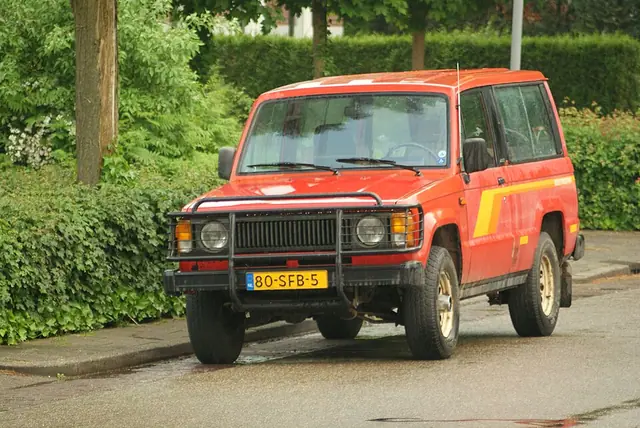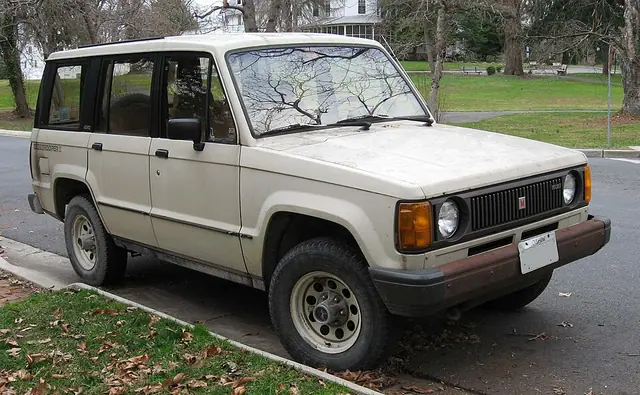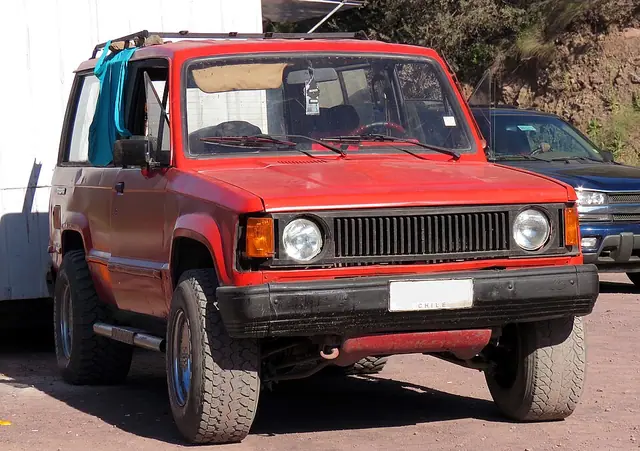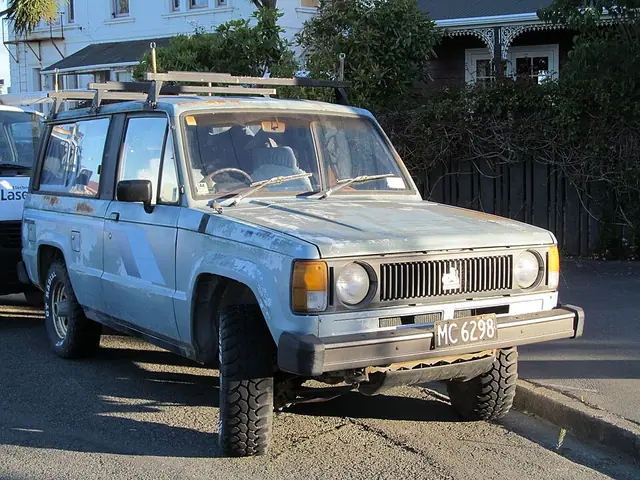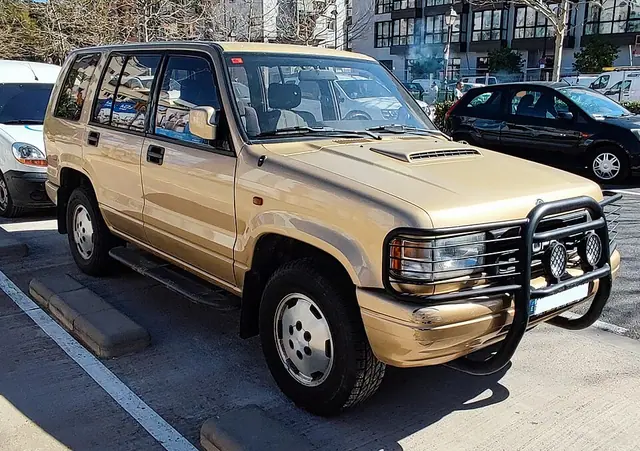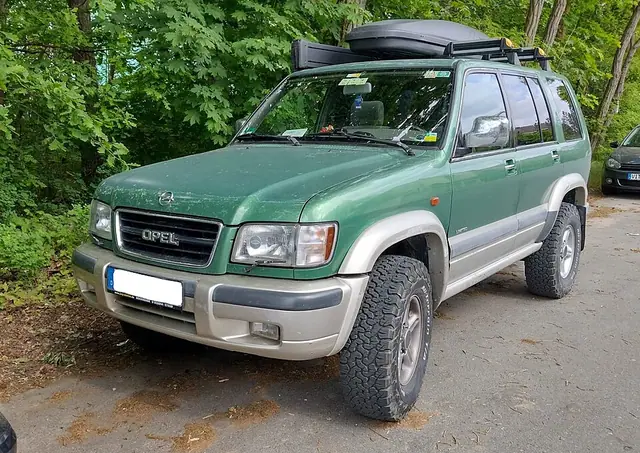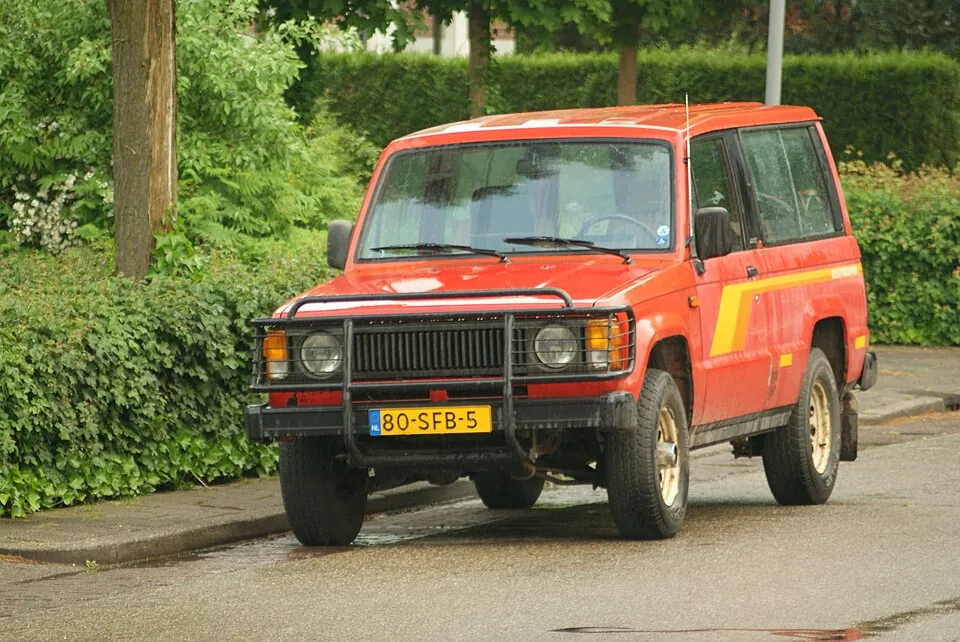
The Trooper was one of the first Japanese off-roaders to offer the comfort of a passenger car along with toughness, and the German Wikipedia calls it a model for the later Mitsubishi Pajero and Toyota Hilux Surf. Few cars have carried so many names: it was sold under the badges of Isuzu, Holden, Chevrolet, Opel, Vauxhall, Subaru, Honda and Acura, and in South Korea the SsangYong Korando Family was also built under licence.
Story
At the end of the seventies Isuzu had a successful small pickup, the Faster, which General Motors sold in America as the Chevrolet LUV. On the basis of that pickup came an off-roader introduced in Japan in September 1981 as the Isuzu Rodeo Bighorn, because Isuzu then planned to label all its four-wheel-drive models with the word Rodeo. At first it was offered only with three doors, as a closed off-roader or with a soft top, on a short or long wheelbase. It had a frame, independent front suspension, manually selectable front drive with low range and modest engines: a 2.2-litre diesel with 62 hp and a 2.0-litre petrol with 88 hp, taken from the elegant Isuzu 117 coupé. Even then GM dealers in Australia were selling it as the Holden Jackaroo, and the Trooper name was gradually introduced for export.
Weighing about 1,680 kg and with such engines, the Trooper was slow, so in January 1984 Isuzu added a turbocharger to the diesel and dropped the word Rodeo from the name. A five-door version with a longer wheelbase also arrived, and in 1987 rectangular headlights and, according to Isuzu, the first direct-injection turbodiesel in an off-roader, a 2.8-litre. In the USA the Trooper was sold as the Trooper II: two-door light trucks were subject to a 25 percent tariff, the so-called "chicken tax", so in its basic version the vehicle was formally a truck, and the rear seat was paid for separately. The American market also got a 2.6-litre fuel-injected petrol engine and, in 1989, GM's 2.8-litre V6 from the Chevrolet S-10 pickup. The same year a special series with suspension tuned by Lotus was sold, and the German tuner Irmscher made luxury versions with Recaro seats.
The first generation travelled the world under various names. In Indonesia, where it was assembled by Garmak Motors, and in South America it was the Chevrolet Trooper; in Venezuela, because of import restrictions, it was assembled locally as the Caribe 442; and from 1988 Subaru sold the Subaru Bighorn with Irmscher trim in Japan. The Korean SsangYong went furthest, building the Korando Family under licence from November 1988, with its own body and later Peugeot and Mercedes engines, and from 1992 the Vietnamese company Mekong Auto built about 30,000 Mekong Star vehicles based on the Korean version. The Trooper reached the United Kingdom in 1987.
In December 1991 an all-new second generation arrived, bigger, more powerful and more luxurious, with a 3.2-litre V6 of up to 193 hp or a 3.1-litre turbodiesel. That also began the best-known series of rebadgings. From March 1992 to April 1999 Opel sold the Trooper as the Opel Monterey, and Vauxhall in the United Kingdom as the Vauxhall Monterey. In Japan Honda sold it from 1994 to 1999 as the Horizon, and in the USA Honda's luxury arm Acura sold it as the SLX, until it was replaced in 2001 by Acura's own MDX. The Opel Monterey also became familiar to German television audiences, as it appeared in the opening titles of ZDF's documentary series Terra X, which was sponsored by Opel. In 1994 the Trooper won the marathon class of the Paris–Dakar Rally and finished twelfth overall, and the Holden Jackaroo won the Australian Safari rally several times.
Its reputation in America was badly damaged by Consumer Reports, which rated the 1995 to 1997 models "not acceptable" because of an alleged tendency to roll over. The US agency NHTSA did not find through its own tests that a recall was needed, and Isuzu sued the publisher for 242 million dollars in damages. The jury concluded that eight of the seventeen disputed statements were false, but that Isuzu had not proved damage, so it received no compensation. After a facelift in 1998 the Trooper got a 3.5-litre petrol V6 with 215 hp, a 3.0-litre direct-injection turbodiesel with 159 hp and Borg-Warner Torque-on-Demand four-wheel drive, which distributes power between the axles automatically. Production in Japan ended in September 2002, when Isuzu withdrew from passenger-car production; in the USA it was replaced by the Axiom and Ascender, while in the Philippines the Trooper was built and sold until 2005.