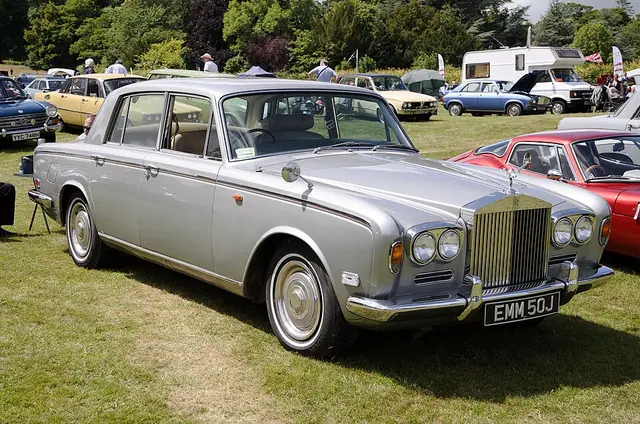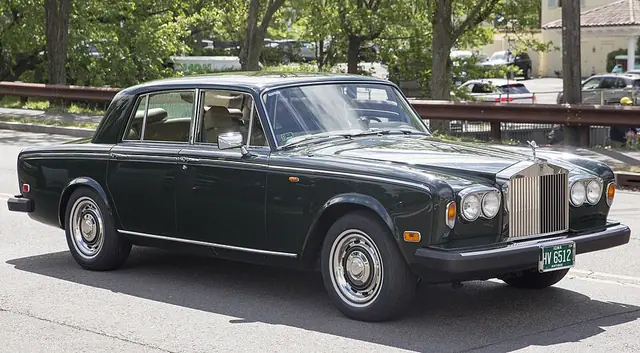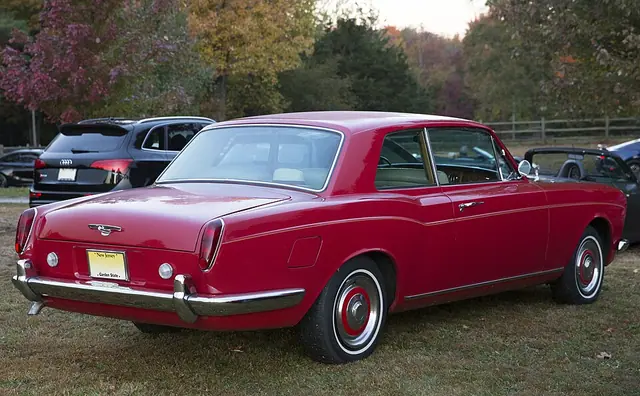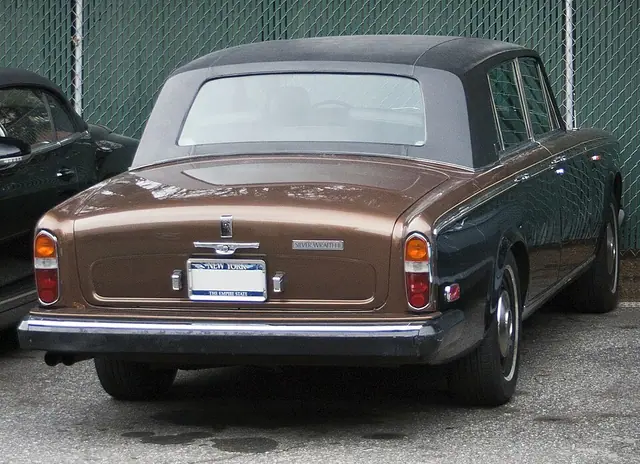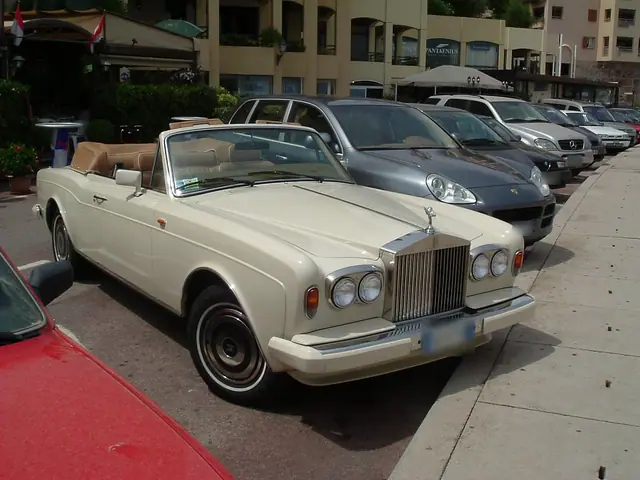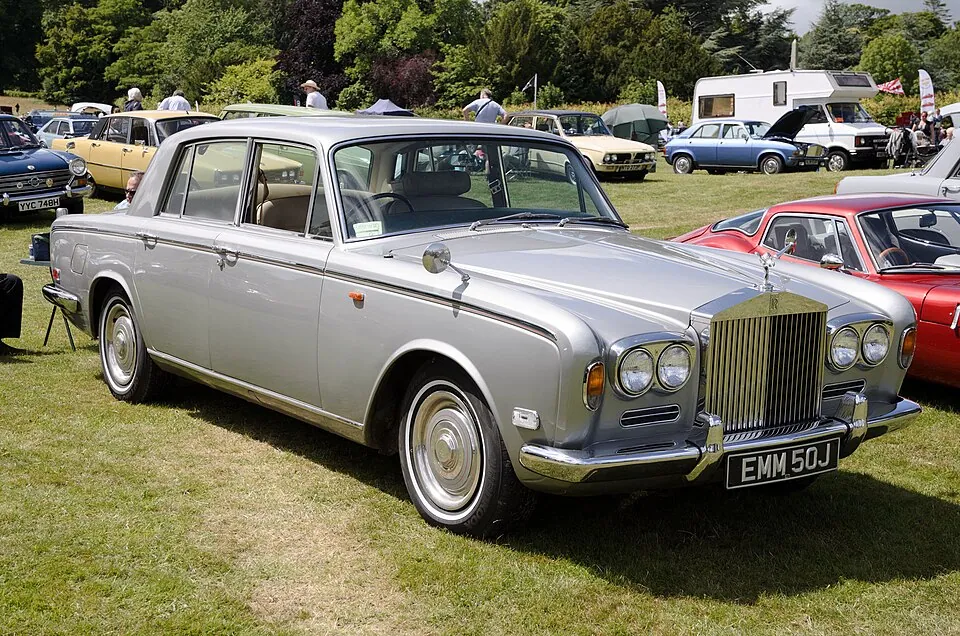
The Silver Shadow was the first Rolls-Royce with a monocoque body, and it borrowed a hydraulic self-levelling suspension system from Citroën. With 30,057 built it became the most numerous Rolls-Royce ever made, and it lived through the company's hardest period: bankruptcy in 1971 and the split in 1973.
Story
Until the mid-1960s Rolls-Royce built its cars on a separate chassis, onto which bodies were mounted. The Silver Shadow, unveiled in October 1965 at the Paris Motor Show, was the marque's first model with a self-supporting (monocoque) body. It was styled by John Blatchley, and the car was narrower, shorter and more modern than its predecessor, the Silver Cloud. It got disc brakes on all wheels, independent suspension and a high-pressure hydraulic system under Citroën licence (the same principle as in the Citroën DS), which levelled the body height. The engine was a 6.2-litre V8, and from 1970 a 6.75-litre one.
The Bentley T was unveiled at the same time, mechanically identical to the Silver Shadow: it differed mainly in its more rounded radiator grille and badges. Bentley was then merely a "cheaper" version of the Rolls-Royce, so it was built in much smaller numbers.
The most dramatic moment in the model's life had nothing to do with cars. In February 1971 the Rolls-Royce company went bankrupt because of the enormous development costs of the RB211 jet engine, and the British state nationalised it. Car production continued, and in 1973 the state separated the car division into a separate company, Rolls-Royce Motors, and sold it to private owners, while keeping the aero engines. The Silver Shadow thus survived the bankruptcy of its maker.
In 1977 came the Silver Shadow II with a number of technical improvements, and the long-wheelbase version was named Silver Wraith II. Production ended in 1980, when it was replaced by the Silver Spirit, and in the same year Rolls-Royce Motors was bought by Vickers.