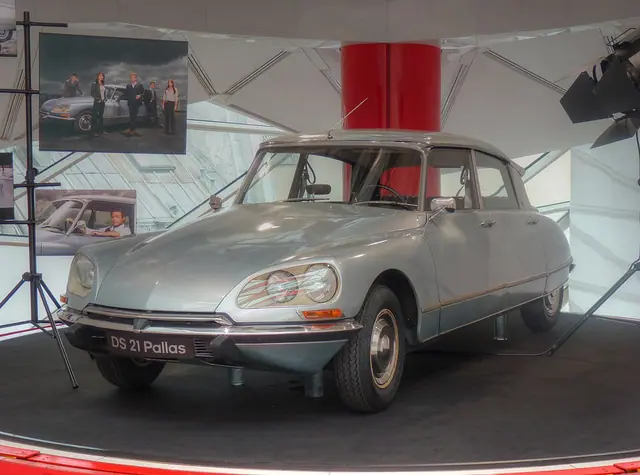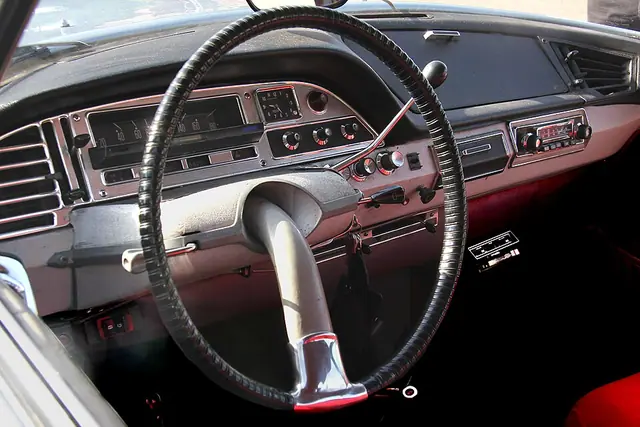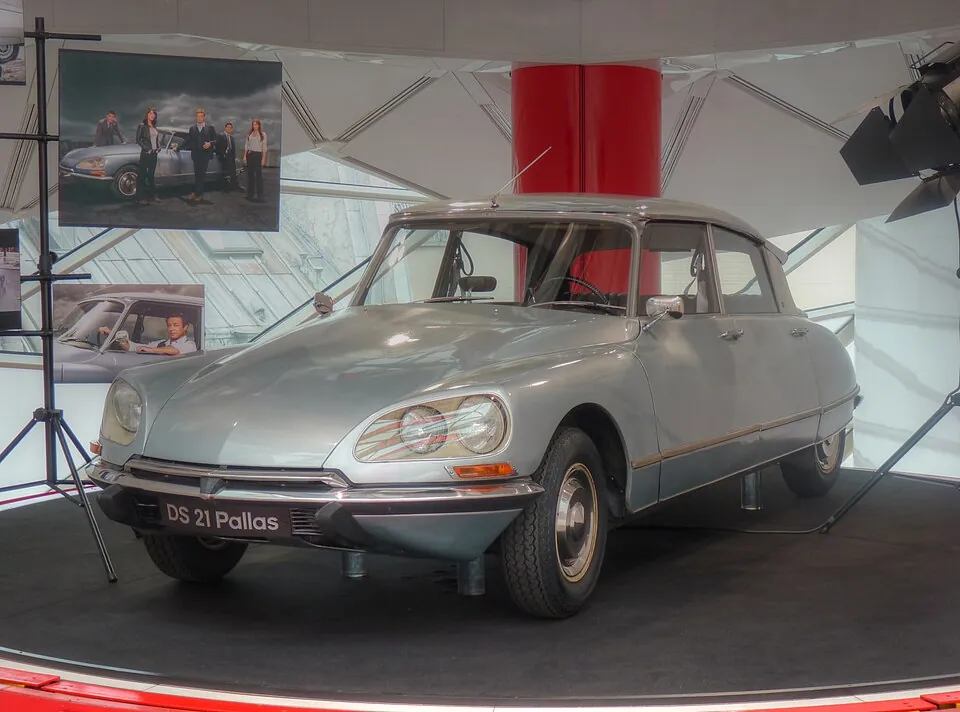
The DS was the first production car with hydropneumatic suspension and disc brakes: it rode softly "like a flying carpet", levelled itself, and the driver could raise and lower the body. At the 1955 Motor Show 743 orders were taken in the first 15 minutes, and 12,000 by the end of the first day. The philosopher Roland Barthes wrote that it looked as if it had "fallen from the sky".
Story
The DS was developed in secret for eighteen years as the successor to the Traction Avant. The same people were behind it: the sculptor Flaminio Bertoni drew the body, and the aeronautical engineer André Lefèbvre engineered the car. The key innovation, the hydropneumatic suspension, was developed by Paul Magès. Instead of steel springs, each wheel had a sphere containing nitrogen and hydraulic fluid, and an engine-driven pump maintained the pressure. The same hydraulics powered the steering, brakes, clutch and gear change.
When the DS 19 was unveiled on 6 October 1955, the public was stunned. During the ten days of the Motor Show Citroën received about 80,000 deposits, a record broken only in 2016. In French the name DS is pronounced like "déesse", goddess. Besides the hydraulics, the DS had a glass-fibre roof, inboard front disc brakes mounted next to the gearbox, and wheels that were changed by undoing a single central bolt. From 1957 there was also a cheaper, simpler ID version.
The DS was also a successful rally car: it won the Monte Carlo Rally in 1959 and 1966. The 1967 facelift, the work of Robert Opron, brought headlamps that turned with the steering wheel, a novelty in series production. Production ended in 1975, after 1,455,746 cars. Following a poll of twenty well-known designers, Classic & Sports Car magazine named it the most beautiful car of all time.