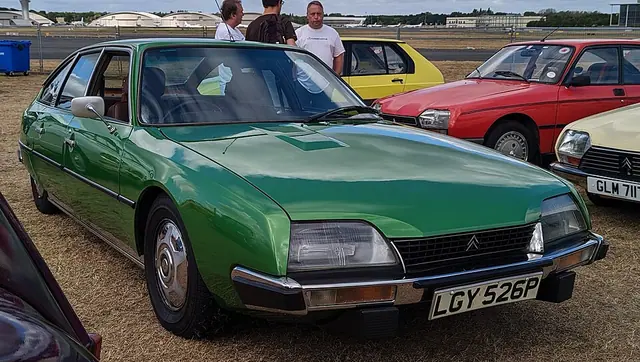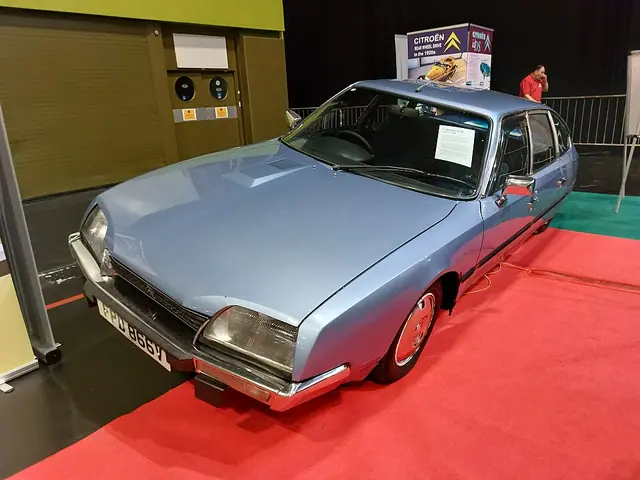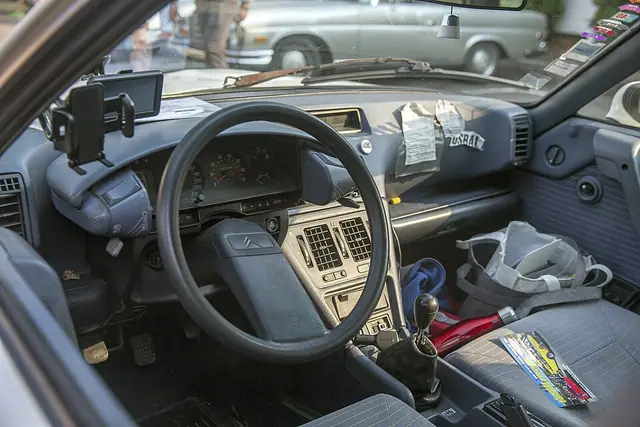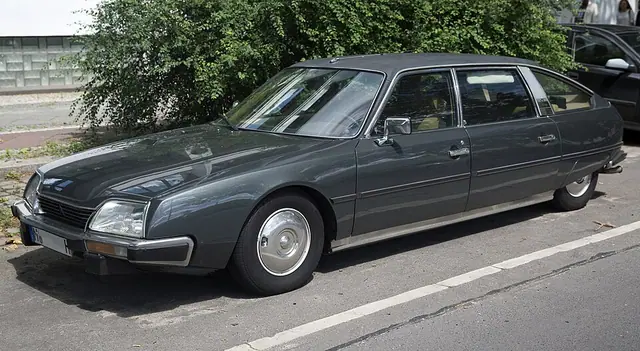
In the eyes of many of the marque's fans, the CX is the last "real" Citroën, created before Peugeot took control of the company. Its name is the symbol for the drag coefficient, and it had hydropneumatic suspension that made it seem to float above the road, a concave rear window and a dashboard without a single stalk around the steering wheel, which looked more like a spaceship cockpit than a car.
Story
A replacement for the legendary Citroën DS was prepared from the late sixties as "Project L". Citroën planned for the CX to have Wankel rotary engines, which it was developing together with Germany's NSU in their joint company Comotor, including a three-rotor engine with more than 160 hp. For that reason the engine bay was designed for very compact engines. The 1973 oil crisis made thirsty Wankel engines unsellable, so the project was abandoned only a few months before the premiere, and the CX had to make do with the old four-cylinder engine from the DS. In the same year, 1974, Citroën, drained by its investments in Comotor and in the new CX plant in Aulnay-sous-Bois, went bankrupt, and at the request of the French government Peugeot took control.
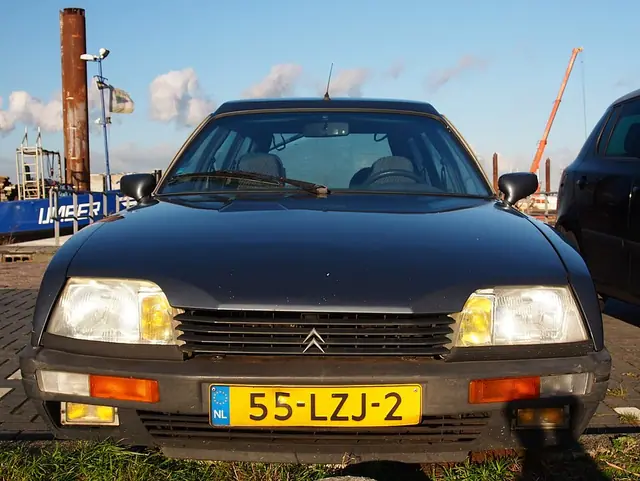
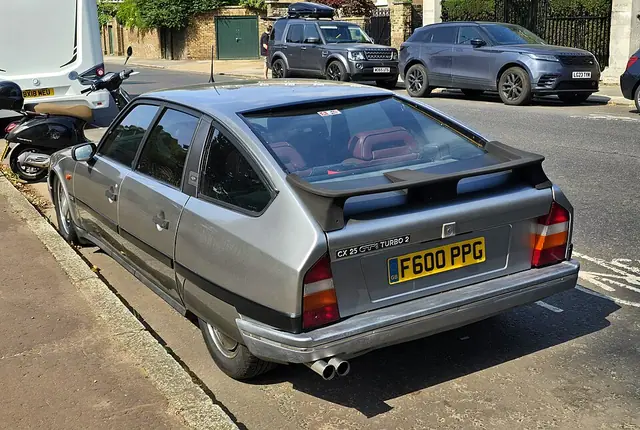
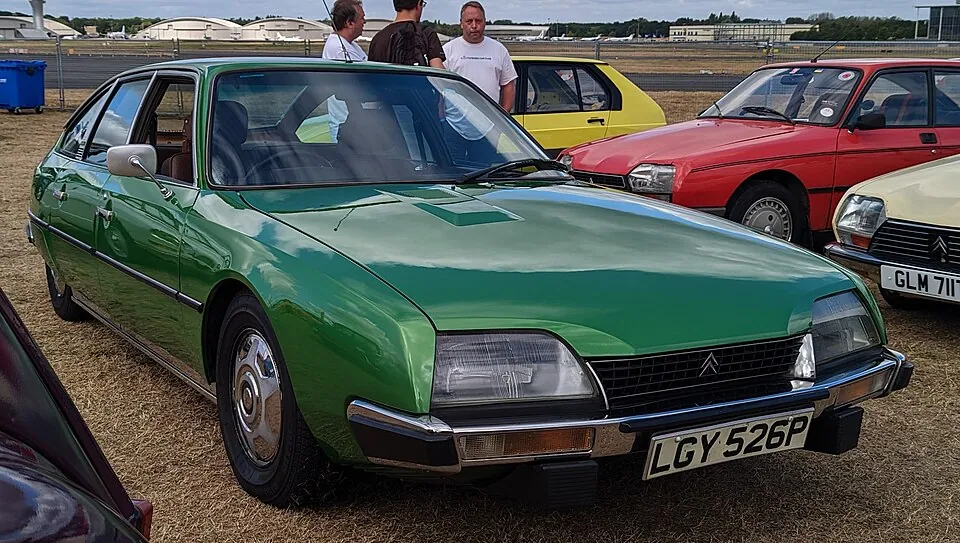
The lines were drawn by Robert Opron, the designer of the GS and SM. The CX had a two-box shape with an abruptly cut-off tail, but, like the GS, kept a conventional boot lid instead of a tailgate. The drag coefficient was 0.36, and the model's name is precisely the French symbol for that coefficient. The rear window was concave, so that the airflow would clear it of rain without a wiper, and at the front there was just one large wiper. The cabin had none of the usual stalks: the indicators, lights, horn and wipers were operated by buttons and rollers on two "satellite" pods next to the steering wheel, so the driver did not have to take his hands off it. On the first series the speedometer and rev counter were rotating drums behind a magnifying lens. Unlike in the DS, the engine was mounted transversely, so the CX was 20 cm shorter than its predecessor and considerably quieter inside.
The model's greatest asset was its hydropneumatic suspension, taken over from the DS and refined: spheres of nitrogen and pressurised fluid swallowed bumps and kept the car at the same height regardless of load. Britain's Car magazine described the ride as floating over bumps, like a ship over the seabed. The DIRAVI steering, taken from the SM, was fully powered and self-centring, and its resistance changed with speed. The CX was unveiled in August 1974, shown to the public at the Paris Motor Show, and in 1975 named European Car of the Year. As early as 1975 sales passed 100,000 a year, and the peak came in 1978, with more than 132,000 cars built. In 1975 came the long Prestige saloon, with a wheelbase 25 cm longer, and the huge estate, popular with ambulance drivers, camera crews and motorcyclists, because a racing motorcycle could fit inside.
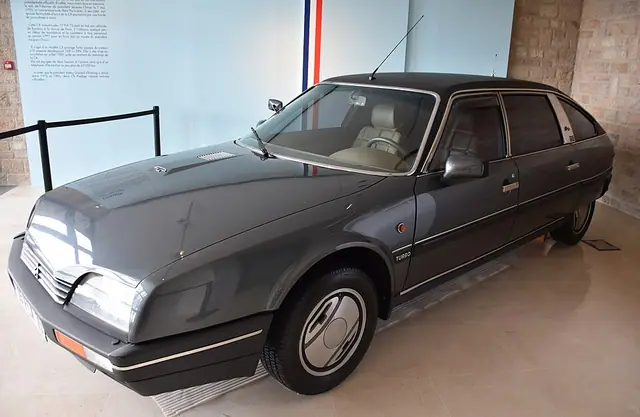
The range grew over the years. Diesel engines became the best sellers, and the 1984 CX 25 Turbo D was the fastest diesel saloon in the world, at 195 km/h. At the end of 1984 came the 25 GTi Turbo with 168 hp and more than 220 km/h, the first CX whose power matched the abilities of its chassis. In 1985 came the Series 2 with plastic bumpers, firmer suspension and a new dashboard without rotating drums, and the millionth CX rolled off the line on 30 October 1987. The model also had some unusual owners: the Prestige was used by the French government, and President Jacques Chirac was driven in one officially for years after production ended; the Swedish firm Nilsson built 15 stretched limousines for the East German leader Erich Honecker, and Elena Ceaușescu was given a CX Prestige as a gift by King Juan Carlos of Spain.
Because of high running costs and little development under PSA, sales declined steadily from the eighties, and the group halted two attempts by Citroën to develop a successor on its own. The saloon was replaced by the XM in May 1989, while the estate, which was eventually built by Heuliez, survived until 1991. In total, 1,170,645 CXs were built. The spirit of the model was later revived in an attempt by the 2005 Citroën C6, but only 23,384 of those were built. In 2016 China's Dongfeng presented a Citroën C6 saloon with advertising that referred back to the CX. Today the most sought-after examples are the rare Series 1 GTi Turbo and the Series 2 Prestige Turbo, and Honecker's CX Prestige limousine sold at auction in 2015 for more than 95,000 euros.