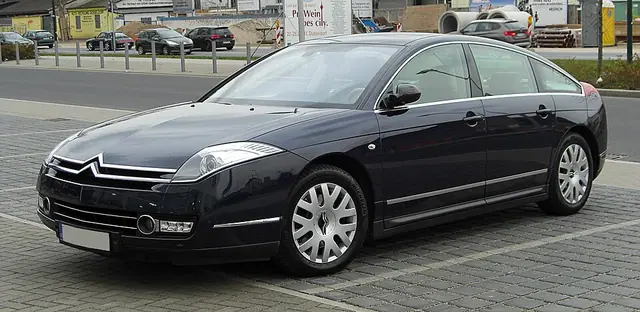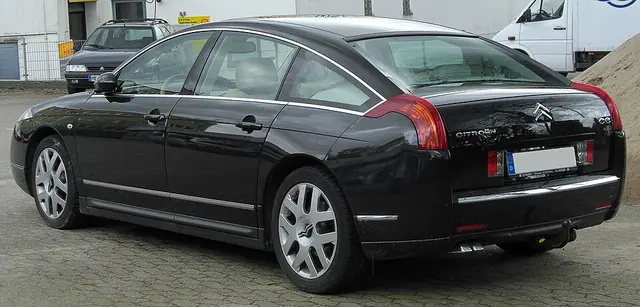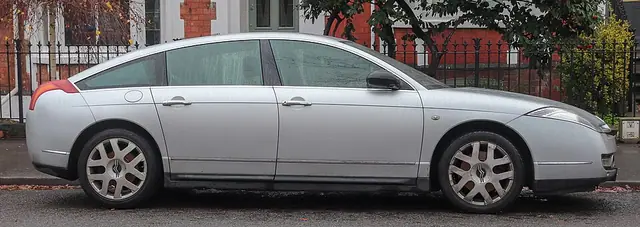
The C6 was the last large saloon in the tradition of the DS, CX and XM: long, low, with a concave rear window and hydropneumatic suspension that carried it as if on an air cushion. French presidents Jacques Chirac and Nicolas Sarkozy were driven in it, but in seven years only just over 23,000 were built, fewer than Citroën had initially expected to sell in a single year.
Story
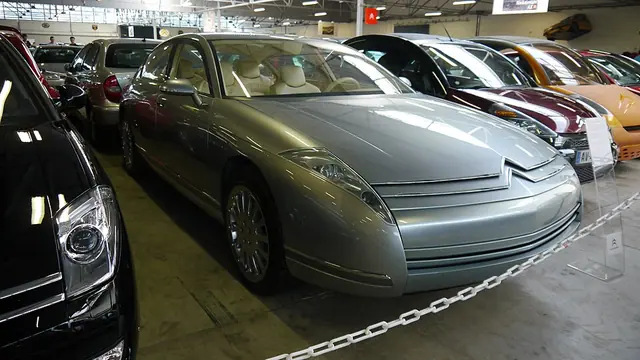
Citroën had used the name C6 once before, for a six-cylinder model of 1928, but the new C6 has nothing to do with it. Its story begins in March 1999 at the Geneva Motor Show, where the C6 Lignage concept was shown, a long saloon with a fastback profile and rear-hinged rear doors. Citroën announced at the time that the production model would replace the ageing XM by the end of 2000, but that did not happen. Management decided to renew the rest of the range first, so the XM was discontinued without a successor, and Citroën was left without a large saloon for several years.
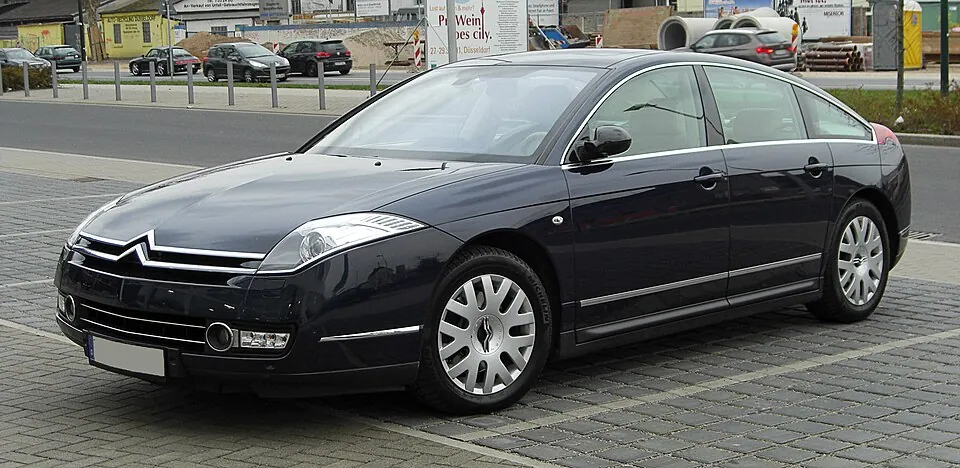
The production C6 was finally unveiled in March 2005 at the Geneva Motor Show and went on sale on 16 November 2005, five years later than originally planned. It differed from the concept mainly in its conventional rear doors. The design, credited to Marc Pinson, deliberately quoted old Citroëns: a long front and short rear overhang, smooth flanks, circumflex-shaped lights and, above all, a concave rear window like the CX's. Although it looks like a five-door car with a big tailgate, the C6 is a classic saloon with a separate boot, and one with a rather small opening at that.
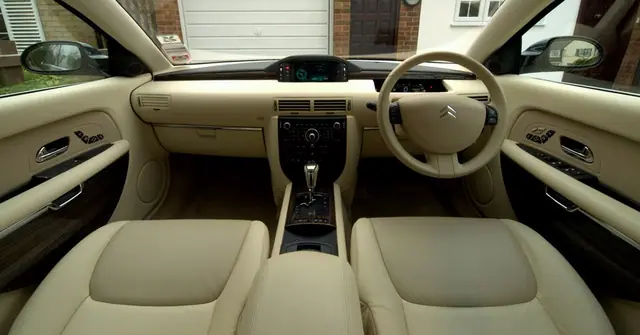
Under the body was the last version of Citroën's hydropneumatic suspension, called Hydractive 3+, in which a computer constantly varies the stiffness of the springs and dampers. The rest of the technology was also rich for its time: a head-up display for speed and navigation on the windscreen, the first in a French car, a lane departure warning that vibrates the driver's seat, xenon headlamps that follow the bends and a small rear spoiler that deploys automatically at higher speeds. On the V6 versions a pyrotechnic mechanism raises the bonnet by 65 mm when a pedestrian is struck, so the C6 became the first car to get four stars in the Euro NCAP pedestrian protection test. Britain's Top Gear demonstrated the comfort of the suspension by filming a horse race with a camera mounted on a C6 while driving over the rough grass beside the track, while a BMW 5 Series did the same job considerably worse.
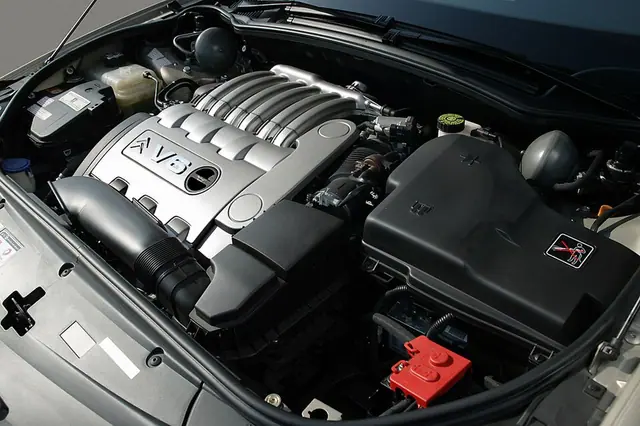
Initially a 3.0-litre petrol V6 with 211 hp and a 2.7-litre diesel V6 with 204 hp, developed jointly with Ford, were offered. In October 2006 came a 2.2-litre twin-turbo four-cylinder diesel with 170 hp, and in June 2009 a 3.0-litre diesel V6 with 240 hp replaced the older 2.7-litre engine. The petrol engine was dropped from the range in early 2009, and in 2010 the C6 got LED daytime running lights and larger mirrors.
The C6 immediately became one of the main cars of the Élysée Palace. Jacques Chirac first appeared in a black C6, even before sales began, at the Bastille Day celebrations on 14 July 2005, and Nicolas Sarkozy also chose the C6 as his official car, including an armoured version. François Hollande arrived at his 2012 inauguration in a DS5, but used the C6 for other official duties. Besides presidents, the C6 was also used by French government ministers, together with the Peugeot 607 and Renault Vel Satis saloons.
Sales, however, were disappointing. At launch there was talk of 20,000 cars a year, and the best year, 2006, brought about 9,100 cars built. By 2008 production had fallen below 2,000 a year, and in 2010 the Rennes plant was building an average of two C6s a day. Buyers in this class chose German saloons such as the BMW 5 Series and Audi A6. The last C6 was built on 19 December 2012, after a total of 23,384 cars. With it began the withdrawal of hydropneumatic suspension from Citroën's range: after the C6, only the more powerful version of the C5 still had it, until 2017.
From 2016 to 2023 the C6 name was also carried by a completely different saloon built by the Dongfeng Peugeot-Citroën joint venture for the Chinese market only, while the role of the large French saloon in Europe was later taken over by the DS 9 and the Citroën C5 X. The original C6 is today a cult car among Citroën enthusiasts, as the last true successor of the line begun by the Citroën DS.