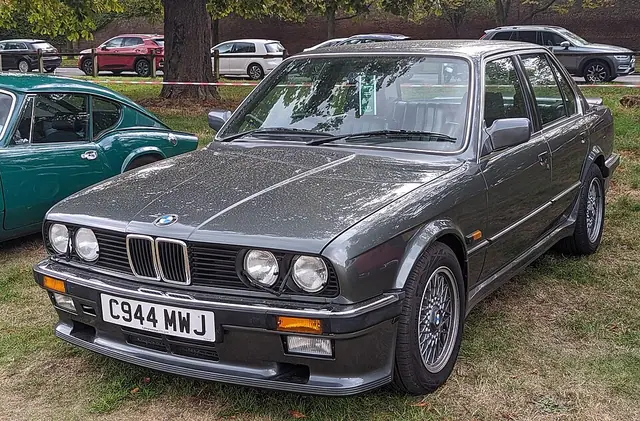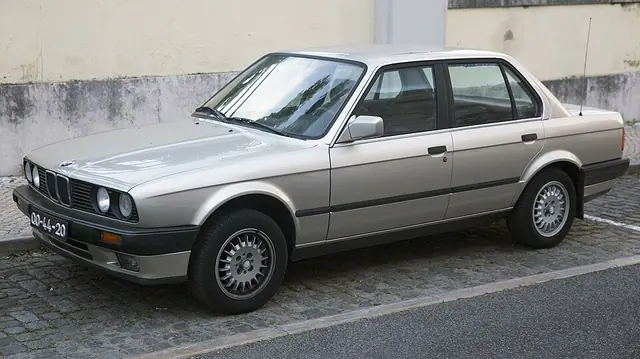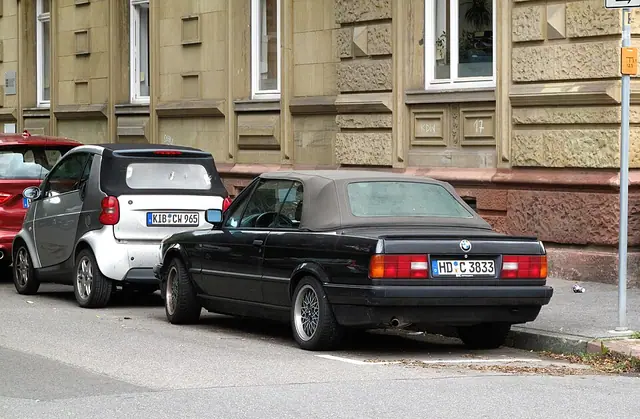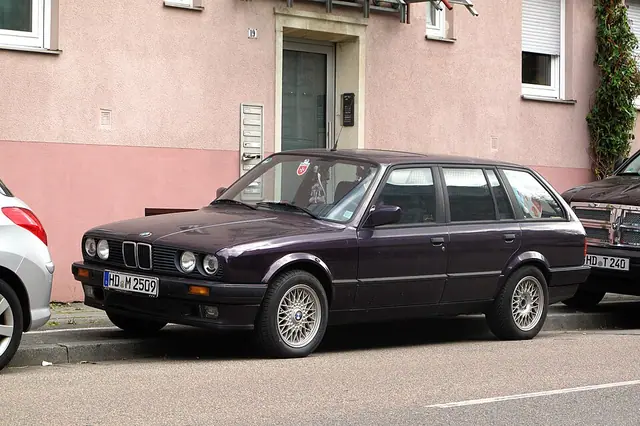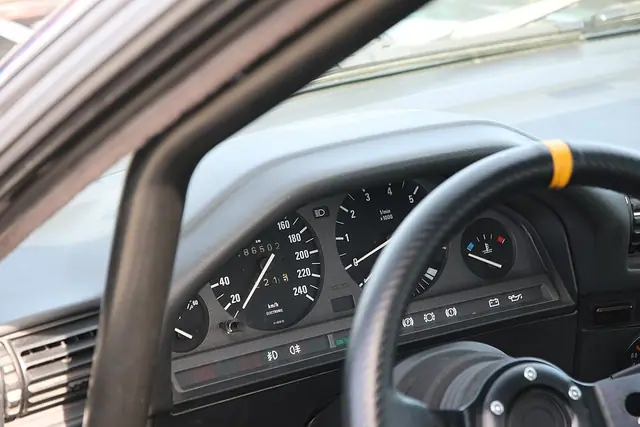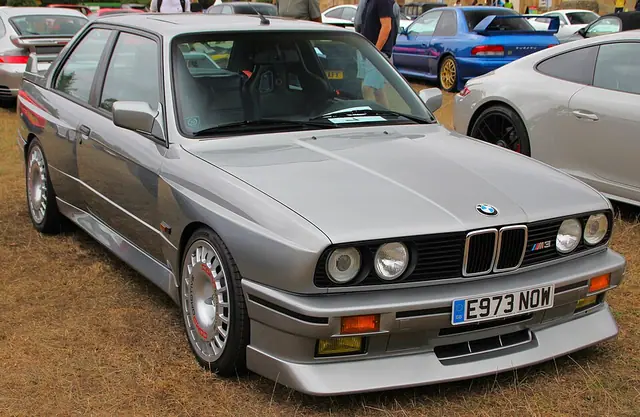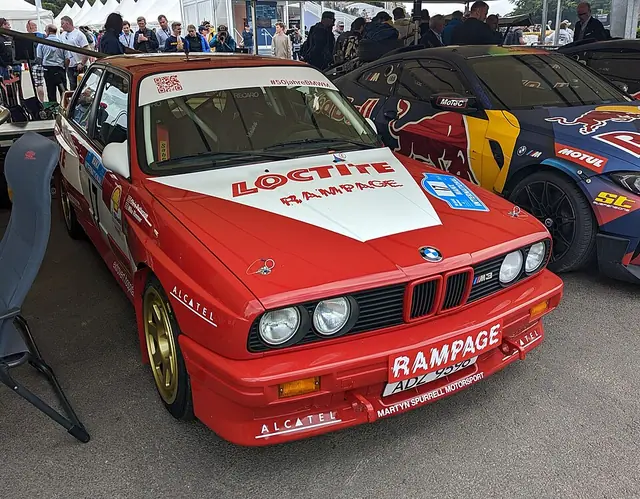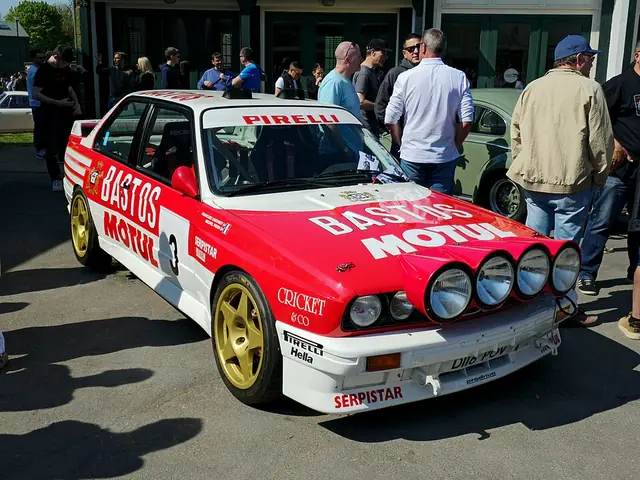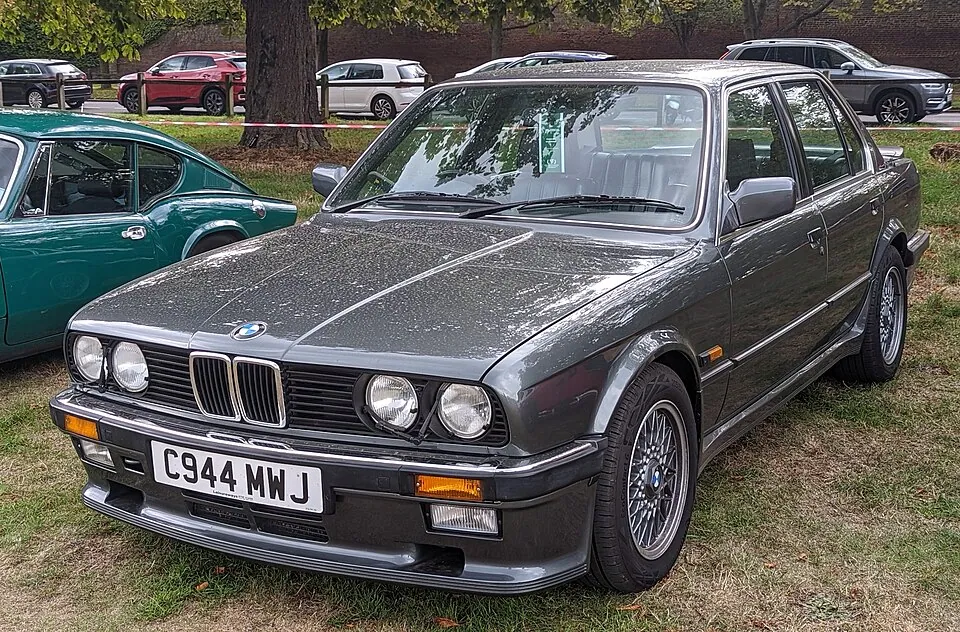
The E30 is the car with which the 3 Series became a whole family: for the first time it had a four-door saloon, an estate, a factory convertible, a diesel engine and four-wheel drive. It gave rise to the first BMW M3, a homologation special that became one of the most successful touring racing cars of all time. Today the E30 is a popular classic, and in the USA, Australia and New Zealand there are even racing series just for this model.
Story
The first 3 Series (E21) of 1975 laid the foundations: a small, sporty, rear-wheel-drive BMW. Development of its successor, known internally as the E30, began as early as July 1976. The design was created under head of design Claus Luthe, and the exterior was shaped by Boyke Boyer. The final look was approved in 1978, and in developing it BMW also used computer-aided design, crash tests and a wind tunnel. Outwardly the E30 resembled the twin-headlamp versions of its predecessor, but it was entirely new, with a new interior and refined rear suspension intended to reduce the tendency to oversteer for which the E21 had been criticised. Series production began in the autumn of 1982, and the car was unveiled at the end of November that year.
At first only two-door saloons were offered, with M10 four-cylinder engines in the 316 and 318i and M20 six-cylinders in the 320i and 323i. Then, for the first time in 3 Series history, came a four-door saloon, and in 1985 a factory convertible, alongside the convertibles still made by the coachbuilder Baur. The same year saw the 325i with a 2.5-litre engine and the 324d, the first diesel in the 3 Series, which was popular in countries with high car taxes. The 325e, where the "e" stands for the Greek letter eta, had a low-revving, high-torque engine for better fuel economy. The 325iX was the first BMW with permanent four-wheel drive. The Touring estate began as a personal project: BMW engineer Max Reisböck built a prototype in his friend's garage in 1984, and series production began in 1987.
The most important derivative was the M3. To take part in Group A touring car racing and the German DTM championship, BMW had to build at least 5,000 road cars. BMW Motorsport therefore created an almost entirely new body with flared wheel arches, a raised boot lid and a steeper rear window, so the M3 shared only its bonnet, roof and sunroof with the ordinary E30. The S14 engine was a 2.3-litre four-cylinder with four valves per cylinder that revved to 7,250 rpm and produced 195 hp with a catalytic converter or 200 hp without. The M3 was shown at the 1985 IAA and built from March 1986 to June 1991. To stay competitive BMW also built limited Evolution series, and the last, the Sport Evolution of 1990, had a 2.5-litre, 238 hp engine and was built in 600 examples. In total, 17,970 M3s were built.
On the track the M3 was extraordinarily successful. It won the 1987 World Touring Car Championship, held in that form only that one year, two European championship titles (1987 and 1988), two in the German DTM (1987 and 1989), two in the British BTCC and a string of other national championships. It won the Nürburgring 24 Hours five times and the Spa 24 Hours four times. It also tried its hand at rallying, where, despite lacking four-wheel drive, it won the asphalt Tour de Corse in 1987 with driver Bernard Béguin. In South Africa, where the M3 was not sold, BMW and Alpina built the 333i with a 3.2-litre six-cylinder engine, and the unusual BMW Z1 roadster was also based on the E30.
In 1987 the E30 got a major facelift, with new bumpers, tail lights and the new M40 four-cylinder engine, and in 1989 came the 318is with the twin-cam M42 engine. When the successor, the E36, appeared in 1990, E30 production began to wind down gradually: the last two-door saloon was built in April 1991, the four-door in February 1992, the convertible in 1993, and the last E30, a Touring estate, rolled off the line in 1994. About 2.34 million cars were built. BMW kept the M3 name in every subsequent generation of the 3 Series, and today's 3 Series and M3 are direct descendants of this model. The M3's predecessor on the race tracks was the 1972 BMW 3.0 CSL coupé, regarded as the first product of BMW's racing department.