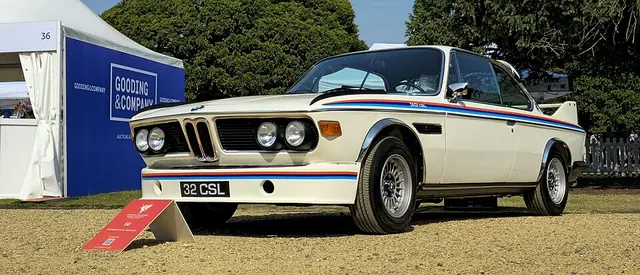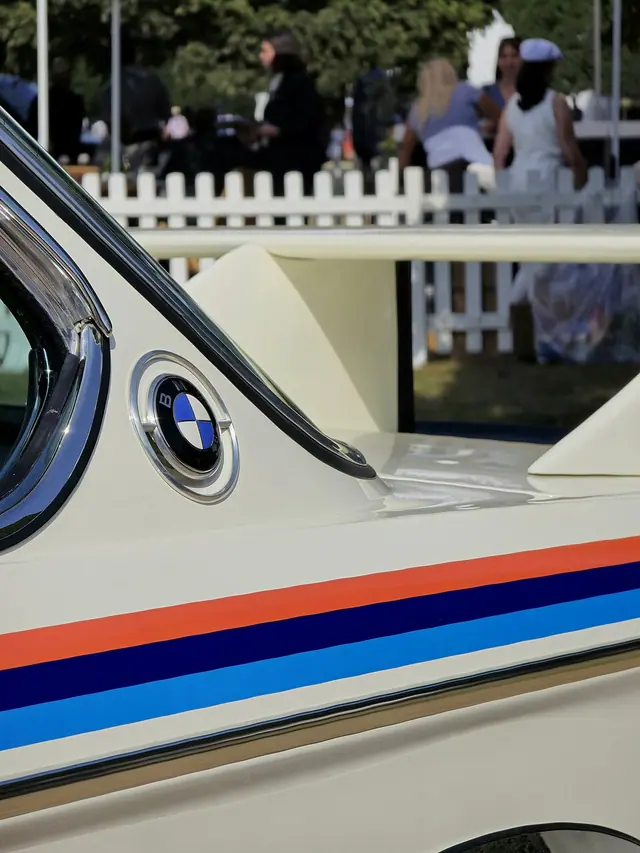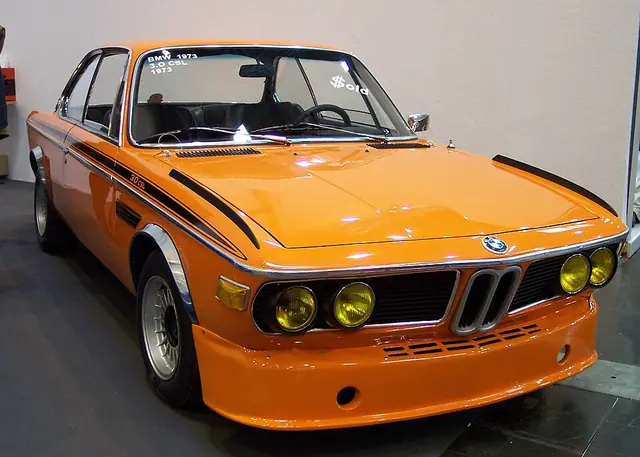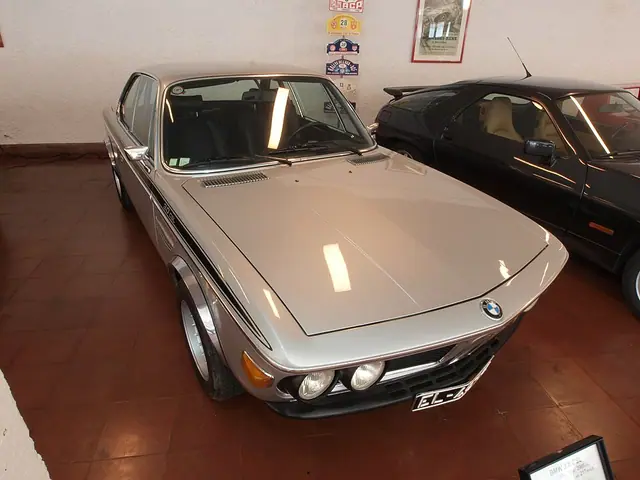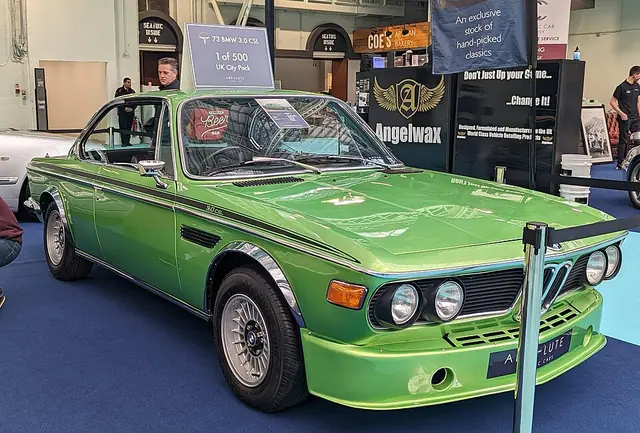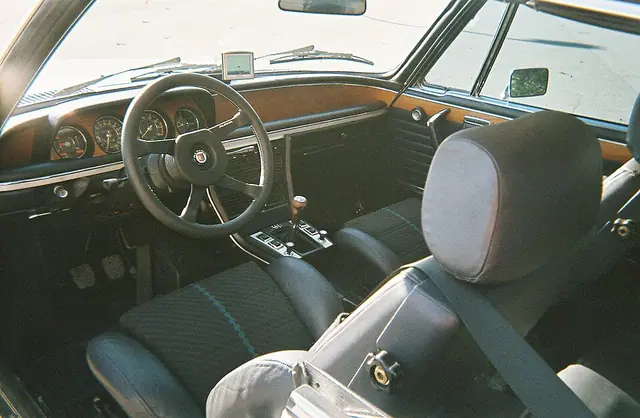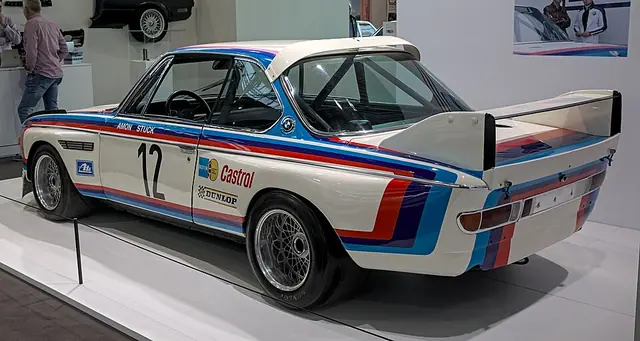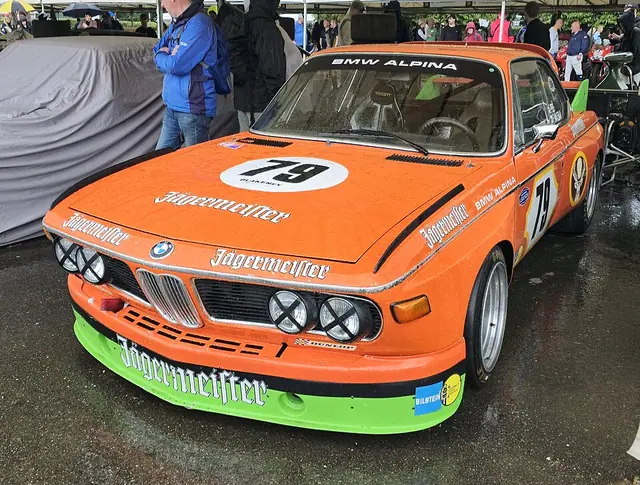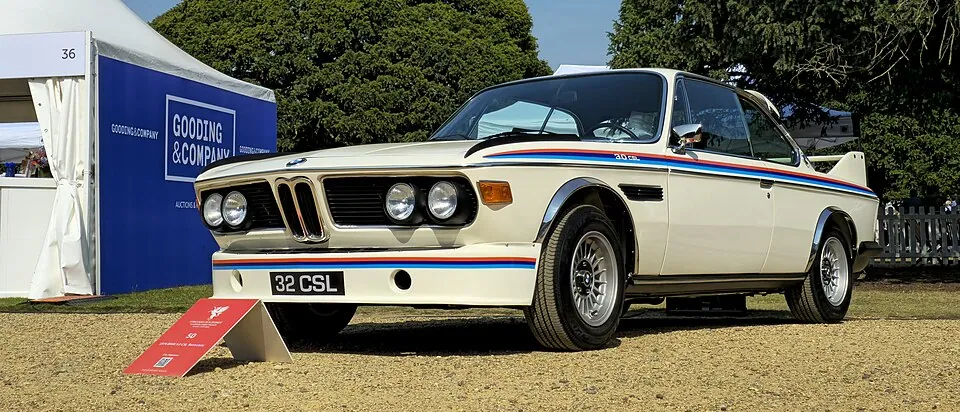
The 3.0 CSL is a racing car disguised as an elegant coupé: BMW made it lighter than the production 2800 CS and 3.0 CS purely so it could enter it in the European Touring Car Championship, which it then won six times. Because of its huge rear wing, which was delivered to customers in the boot because it was not allowed on the road, it was nicknamed the "Batmobile". It is regarded as the first product of BMW's racing department, the forerunner of today's BMW M, and two CSLs were the first BMW Art Cars.
Story
The family of large E9 BMW coupés began in 1968 with the BMW 2800 CS, whose body was built by Karmann. In April 1971 it was replaced by the 3.0 CS with a three-litre, 180 hp engine and the fuel-injected 3.0 CSi with 200 hp. These cars were fast and elegant, but also heavy, and BMW wanted to return to the European Touring Car Championship (ETCC), where the main rivals were Ford's Capri RS 2600 coupés. The rules required a racing car to be based on a production model built in sufficient numbers, so the solution was to build a lighter road version that would serve as the basis for homologation. The result was the 3.0 CSL, where the letters stand for Coupé, Sport and Leichtbau (lightweight construction). Here, unlike other BMW designations where it denotes a long wheelbase, the letter L meant "light".
The weight saving came from thinner body panels, aluminium doors, bonnet and boot lid, Plexiglas side windows and the removal of sound insulation and some equipment. According to the German Wikipedia, the first series, created in 1971 in cooperation with Alpina, had the same carburettor engine as the 3.0 CS and weighed about 1,165 kg, and 169 were built. From August 1972 the CSL got fuel injection and a capacity increased to 3,003 cc, so that the racing cars could compete in the over-three-litre class; this version had 200 hp and reached 220 km/h. About 500 cars went to the United Kingdom, where the importer insisted they keep their sound insulation, electric windows and normal bumpers, so they were not as light as the others. The CSL was not sold in the USA.
1972 was a turning point for BMW's motorsport. That year BMW Motorsport GmbH was founded, and Bob Lutz, who had just joined BMW's board, brought in as its chief racing engineer Jochen Neerpasch, previously head of Ford's competition department. The CSL was the new company's first major project and, according to the German Wikipedia, is regarded as the first product of the later BMW M division, whose colours it already wore. In July 1973 the third version was homologated, with a 3,153 cc, 206 hp engine and an aerodynamic package consisting of a large front spoiler, fins on the front wings, a spoiler above the rear window and a tall rear wing. Because of this look the CSL got the nickname "Batmobile". Since the wing was not allowed on German roads, it was not fitted at the factory but delivered in the boot for the owner to fit himself. Sources differ on who developed the package: the auction house RM Sotheby's mentions Alpina, while Classic & Sports Car magazine names the University of Stuttgart.
On the track the CSL was immediately successful. In 1973 BMW won four of the eight rounds of the European Touring Car Championship and took the manufacturers' title, Toine Hezemans became drivers' champion, and with Dieter Quester he won his class at the Le Mans 24 Hours that same year. CSL drivers also won the European title every year from 1975 to 1979, mostly in private teams, as factory support ended after the arrival of the 6 Series (E24) in 1976. By 1974 the racing versions had grown to 3.5 litres, with a four-valve-per-cylinder head and about 440 hp, and in the 1976 World Championship for Makes the Group 5 CSL won three races. In America it raced in the IMSA championship in 1975, where Sam Posey, Brian Redman and Ronnie Peterson won races. There was also a turbocharged version, which according to the German Wikipedia had up to 590 kW (about 800 hp), but its enormous torque overloaded the gearbox and it started only two races. The German Wikipedia also recounts an anecdote that driver Hans-Joachim Stuck was asked at a petrol station whether the rear wing of his CSL was a new kind of ski rack.
The CSL also earned a special place in art. At the suggestion of the French driver and auctioneer Hervé Poulain, the American artist Alexander Calder painted a racing CSL in 1975, which was driven in the Le Mans 24 Hours. This was the first BMW Art Car, and the following year Frank Stella painted a second CSL. Production of road-going CSLs ended in 1975, together with the whole E9 family, with a total of 1,265 built. Today they are rare and expensive collector's cars. The name was revived at the end of 2022, when BMW presented a new 3.0 CSL based on the M4, built in 50 examples.