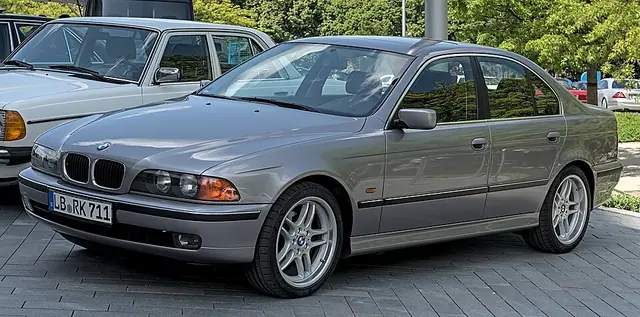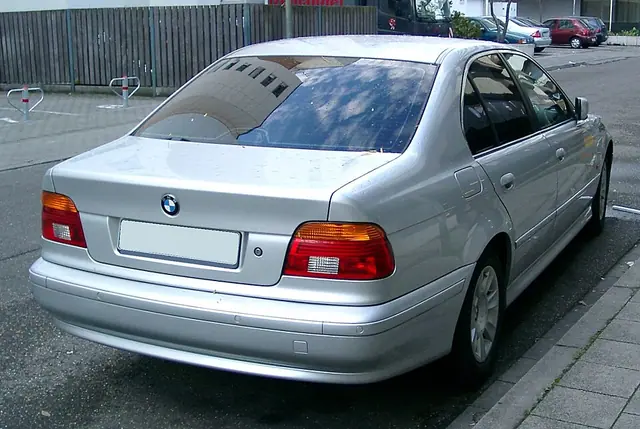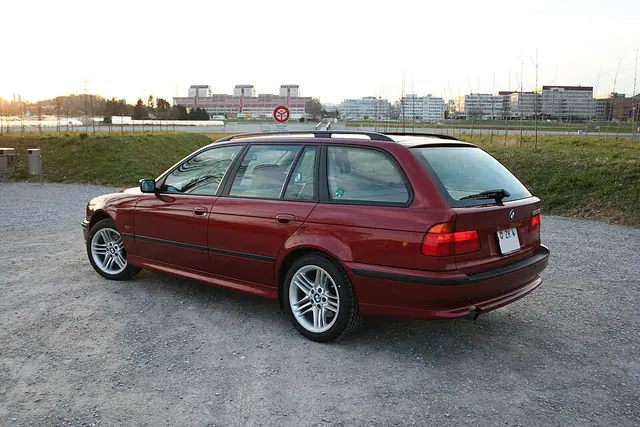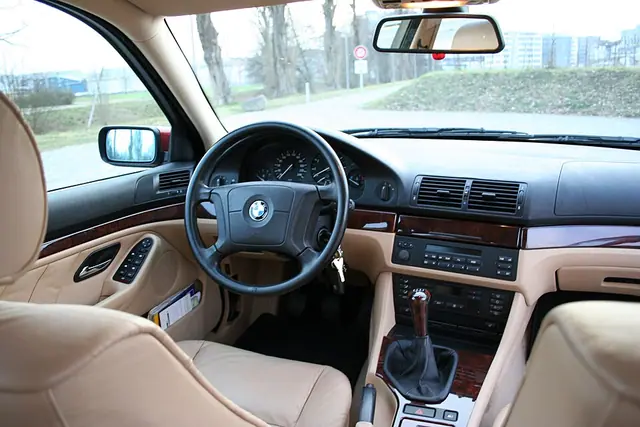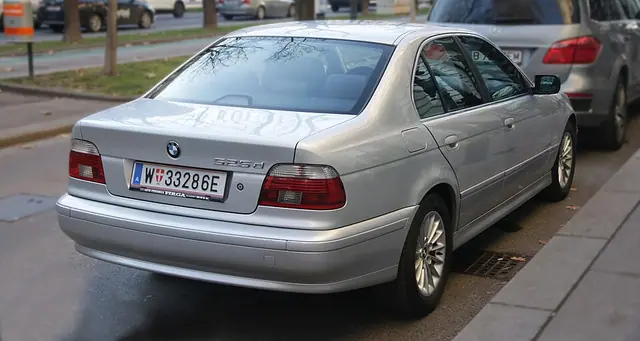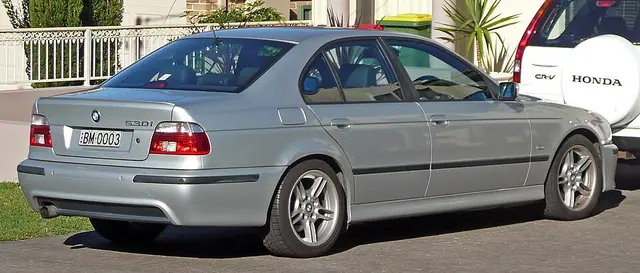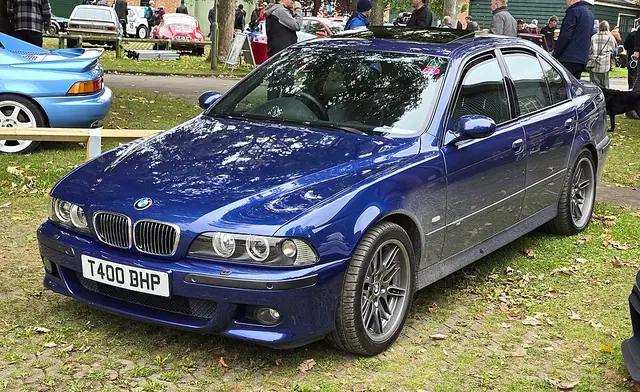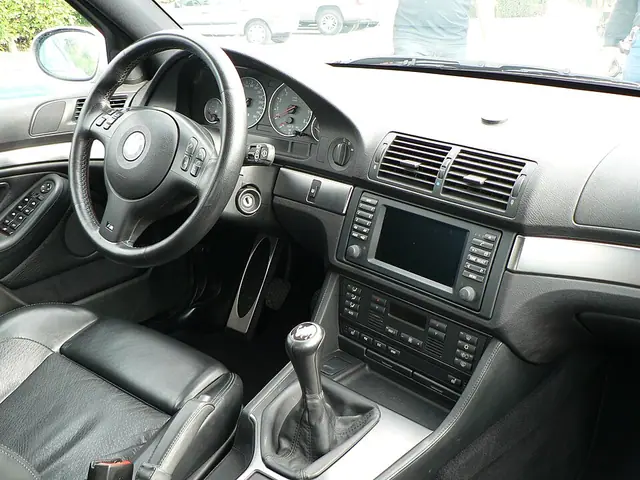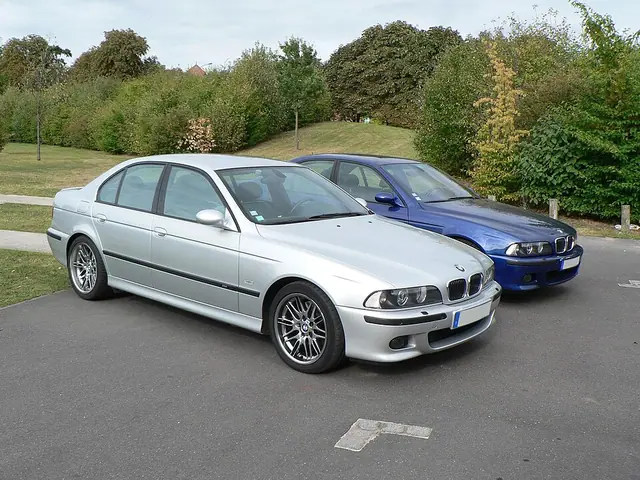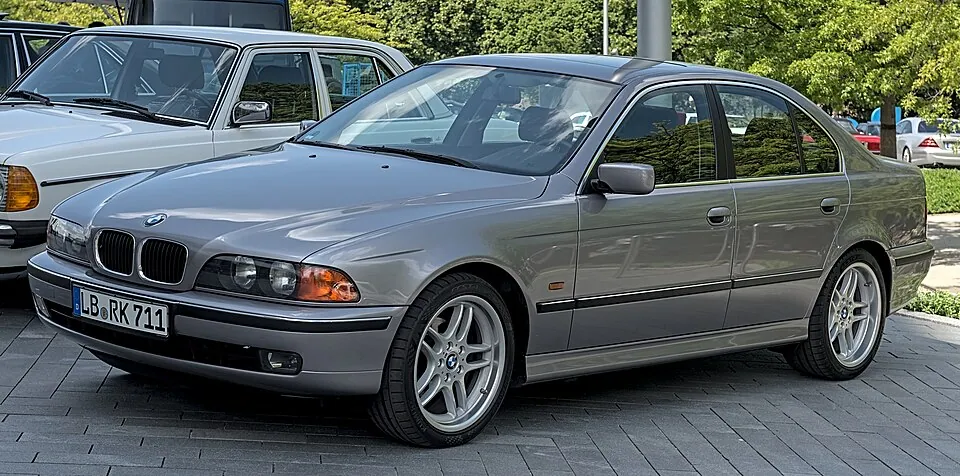
The E39 is often named as one of the best saloons of its class: the American magazine Car and Driver put it on its Ten Best list six years in a row, and in 2001 Consumer Reports gave the 530i the highest score it had ever given a car up to then. It was the first large production car with suspension made almost entirely of aluminium, and the M5 version with a 400 hp V8 was one of the fastest saloons of its time.
Story
Development of the successor to the E34 lasted until 1995. The Japanese designer Joji Nagashima won with his proposal in June 1992, which was refined in the final phase by the team of the new chief designer Chris Bangle. Thirty-nine months passed between the design freeze and the start of production, and the test cars covered a total of 30 million kilometres, from Alaska and the North Cape to South Africa and Death Valley. The E39 premiered in September 1995 at the Frankfurt Motor Show, and the saloon went on sale in December of the same year. The body was considerably stiffer than its predecessor's, and according to BMW the E39 was the world's first production car with suspension made almost entirely of aluminium.
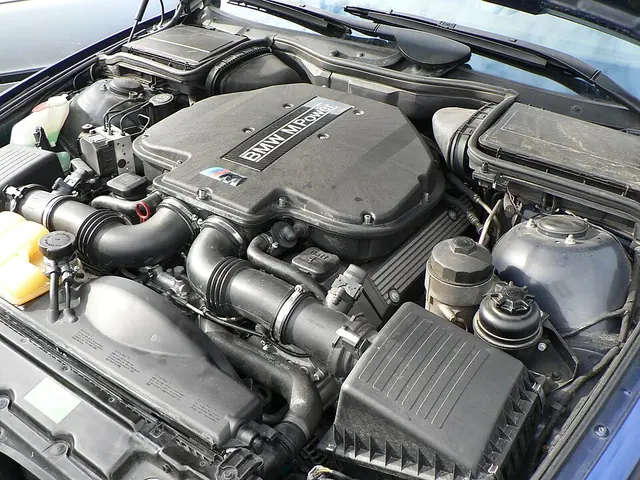
The engine range was wide. The petrol engines were straight-sixes (first the M52 series, from 2000 the M54) and M62-series V8s of 3.5 and 4.4 l, and the diesels were six-cylinders of 2.5 and 3.0 l and, at the end of the decade, the four-cylinder 520d, the first four-cylinder 5 Series diesel. All models had rear-wheel drive. The Touring estate joined the saloon in 1996–1997. The E39 was among the first cars with head airbags, which protect occupants in a side impact, and over time it received xenon headlights, parking sensors, satellite navigation and as many as ten airbags. For special customers there was also the armoured 540i Protection.
The M5, the first M5 with a V8 engine, was unveiled at the 1998 Geneva Motor Show. The 4,941 cc S62 engine produced 400 hp, and all cars had a six-speed manual gearbox and the saloon body; only one M5 Touring prototype was built, and it was never sold. Unlike earlier generations, the E39 M5 was assembled on the same line as the regular 5 Series at the Dingolfing plant, so 20,482 were built, of which 9,992 went to the United States.
In autumn 2000 the model was facelifted: the headlights received illuminated rings, the tail lights LED light bars, and the six-cylinder engines were replaced by the new M54 series. The 530i engine was named one of Ward's 10 Best Engines in 2002 and 2003. The saloon was replaced by the E60 in 2003, and the Touring estate was built until May 2004. In total 1,488,038 were built, including 266,209 estates, of which 17,280 were assembled from kits outside Germany.