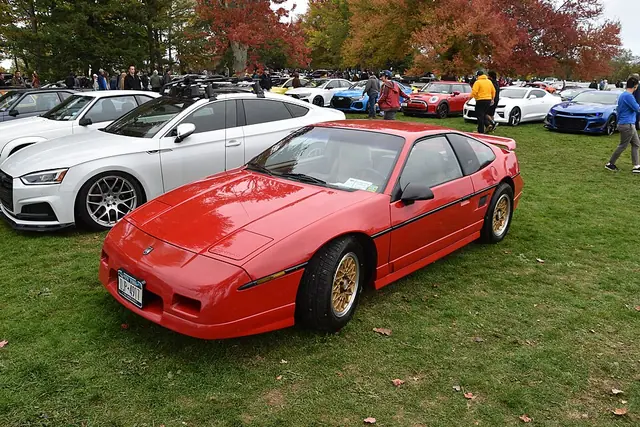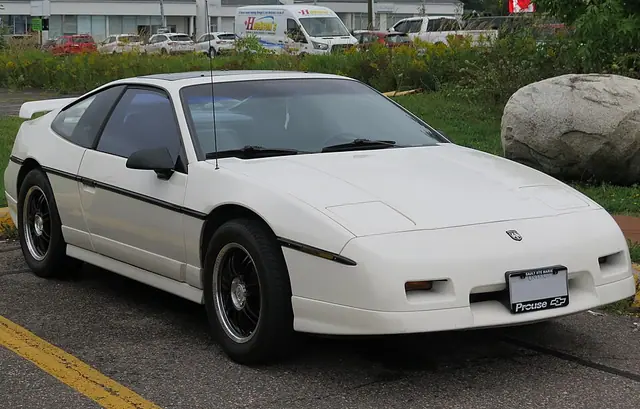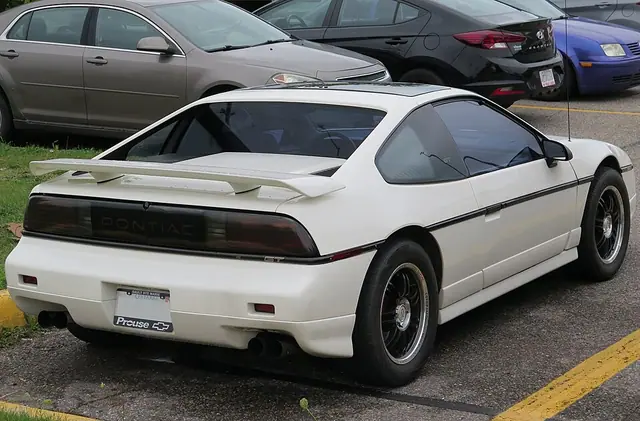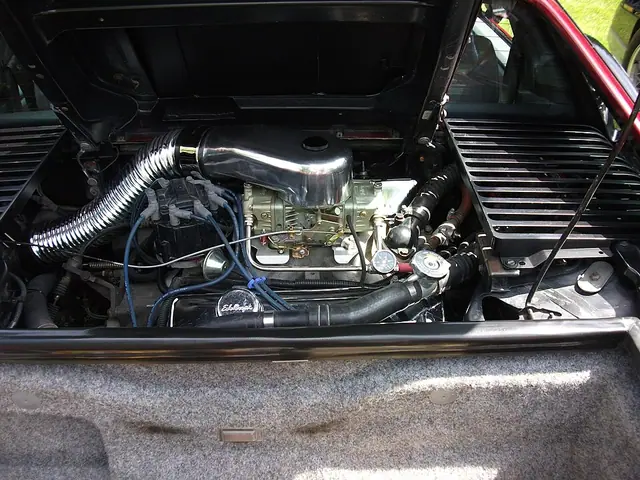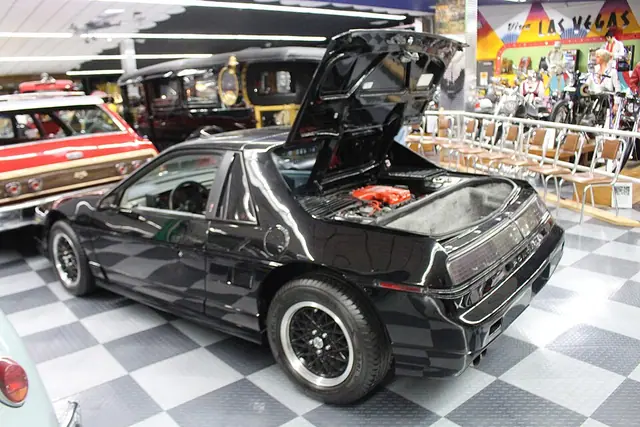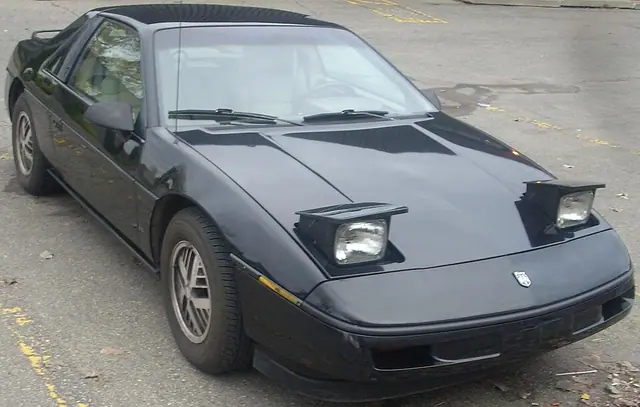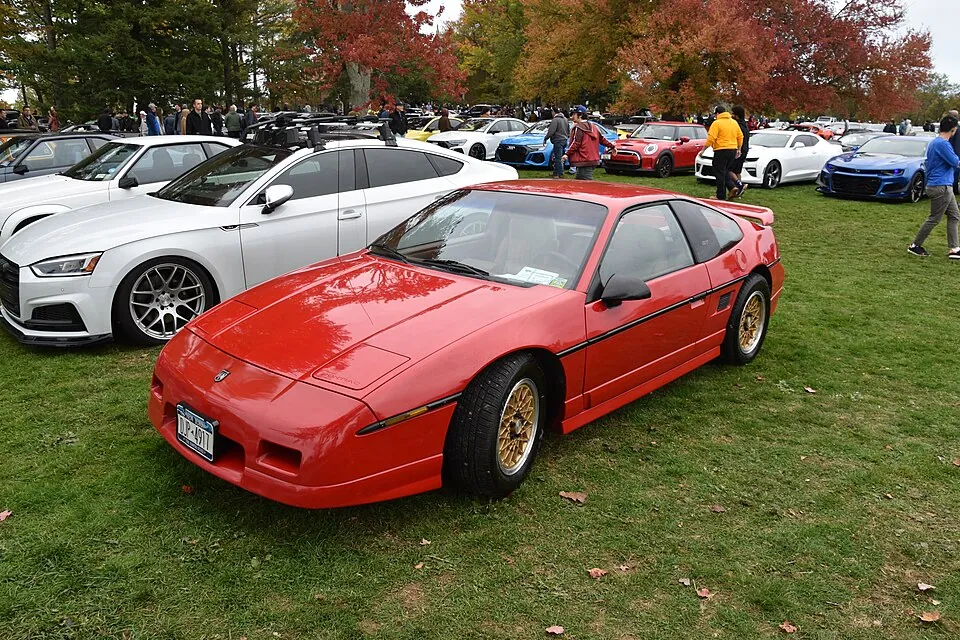
The Fiero was the first series-production American mid-engined car and, according to Pontiac, the world's first production car with a steel space frame and a separate body of composite panels. To get it green-lit at GM at all, it had to be presented as an economical everyday commuter car, so for years it was a sports car without sports-car engineering, and the early four-cylinder cars are remembered for catching fire. Only the 1988 GT got the suspension and brakes the engineers had envisaged from the start, but that was also the last year of production.
Story
In the sixties Pontiac was the brand of muscle cars such as the GTO and the Firebird, but by the late seventies, after the oil crises, it was losing its identity. In 1978 a group of young Pontiac engineers came up with a small two-seat sports car with a mid-mounted V6. General Motors management did not want a car that could compete with the Corvette, so the project was "sold" as an economical four-cylinder commuter car that just happened to have two seats. It was led by Hulki Aldikacti, a Turkish-born engineer, under the protection of Bill Hoglund, who became head of Pontiac in 1980 and wanted the brand to be exciting again. The budget was only $400 million, and the workers at the plant in the city of Pontiac, reopened for this model, chose the name themselves: the Italian word fiero means "proud" or "fierce".
The mid-engine layout was chosen for lower weight and aerodynamics, but the tight budget forced the engineers into compromises. Instead of a new aluminium V6 they got the old 2.5-litre four-cylinder known as the "Iron Duke", and the suspension and brakes were taken from other small GM cars (the X and T platforms): at the rear, together with the drivetrain, they even fitted the front suspension of the Pontiac Phoenix. The real technical jewel was the structure: a steel space frame of about 280 parts joined by 3,800 spot welds, which could be driven even without its body, carrying plastic panels that bore no load at all. The Fiero received five stars in the American NHTSA crash test, and this type of construction was later used for Saturn cars and GM's minivans.
The Fiero went into production in August 1983 as a 1984 model. It was the pace car at the 1984 Indianapolis 500, Car and Driver put it among its ten best cars of the year, and 136,840 were built in the first year, more than any American two-seater up to then. Criticism of the weak engine came quickly, so in 1985 the GT was introduced with a 2.8-litre V6 of 140 hp, and from January 1986 the GT got its characteristic sloping rear roofline, which led many to mistake it for a new Corvette when it was first shown. Through Pontiac dealers the firm Corporate Concepts also offered the Mera conversion, with a body resembling the Ferrari 308, but after 247 cars Ferrari filed a lawsuit and the conversion was stopped.
The biggest problem was fires. Soon after production began, in October 1983, an engineer reported in an urgent memo that two Fieros had caught fire during test drives. The cause was faulty connecting rods from GM's Saginaw foundry and an engine sump, made smaller to fit the cramped engine bay, holding only three quarts of oil. When the oil level dropped, a connecting rod could break and punch through the block, and oil would spray onto the hot exhaust manifold. In an official statement Pontiac said it knew of 260 fires caused by this fault, with ten minor injuries, and according to the book by Paul Ingrassia and Joseph B. White, Fieros caught fire at a rate of one for every 508 cars sold. At the end of 1987 GM recalled all 1984 Fieros, about 125,000 of them, increasing the oil capacity to four quarts and inspecting the engines, but the model's reputation had already been badly damaged.
For 1988 Pontiac finally fitted the suspension the engineers had originally designed: new front wishbones, a new three-link rear suspension, ventilated disc brakes on all four wheels and, on versions with the WS6 package, wider rear than front wheels. Alongside the GT with its 135 hp V6, the cheaper Formula was introduced, with sports suspension and a spoiler on the regular body, and for that year only the Fiero was also offered in yellow. Journalists praised its at last good handling, but buyers were ever fewer: 26,402 were built in 1988, of which only 6,848 were GTs. GM stopped production because of weak and unprofitable sales, and the last Fiero rolled off the line on 16 August 1988. That car was given to one of the plant's workers, who kept it with just over 800 kilometres on the clock, and in December 2020 it was sold for $90,000.
Pontiac already had a Fiero ready for 1989/1990, with the new Quad 4 four-cylinder engine and a more powerful twin-cam V6, but it remained just a prototype, which is kept by GM's Heritage Center. The Fiero left behind a total of 370,168 cars and a large community of owners, and as a cheap mid-engined car it became a favourite basis for Ferrari and Lamborghini replicas. A two-seat successor, the Pontiac Solstice, arrived only many years later.