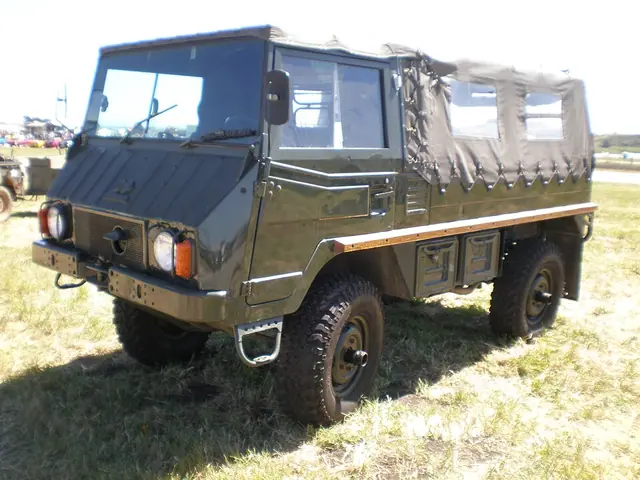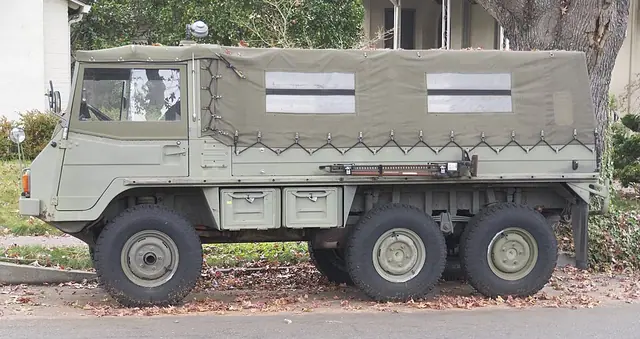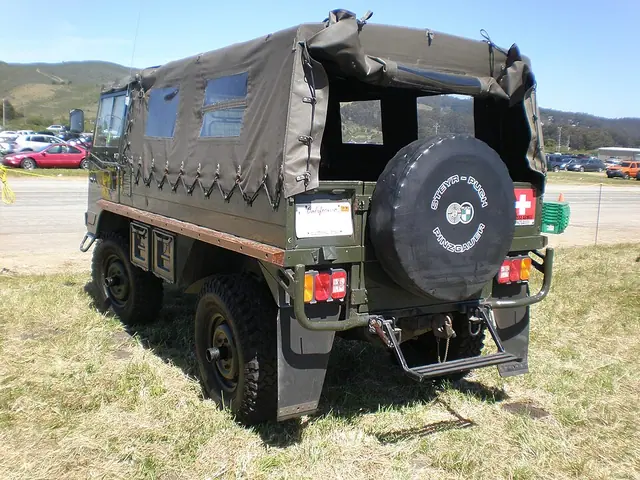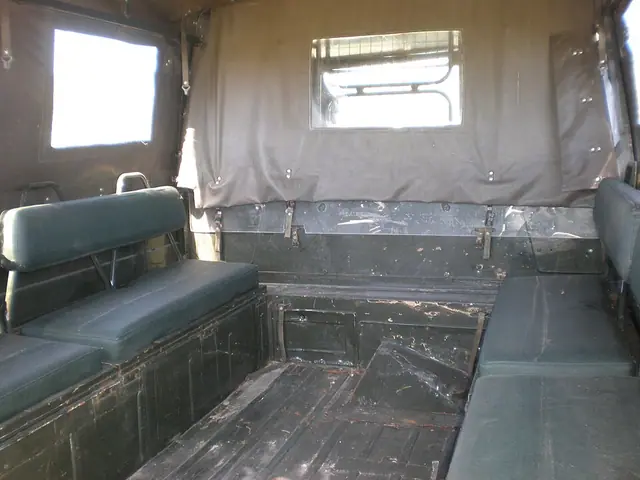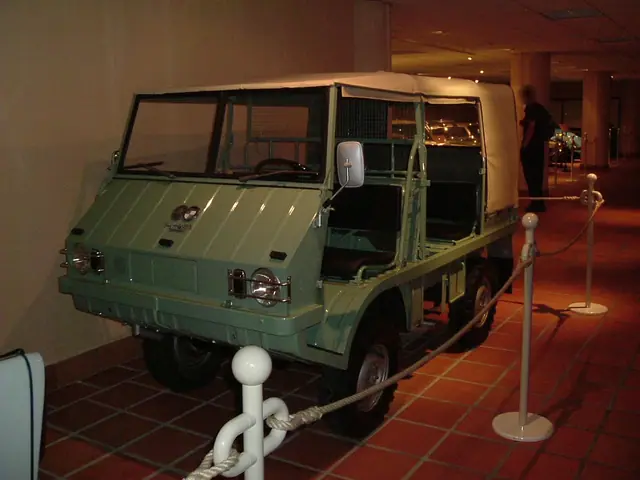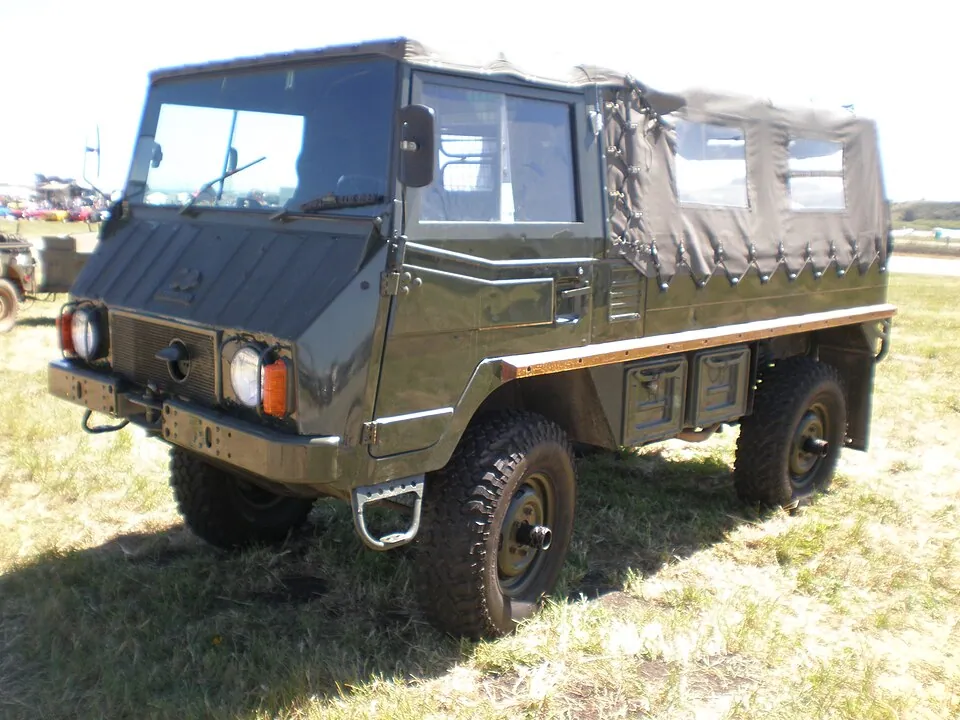
The Pinzgauer is regarded as one of the most capable off-road vehicles ever built: it climbs a 100 per cent gradient, and on difficult terrain it has the edge even over far better-known military vehicles. Its designer Erich Ledwinka applied in it the central backbone-tube ideas that his father Hans Ledwinka had developed at Tatra. It served in dozens of armies, including the Yugoslav army, but also as a fire engine, ambulance and tourist vehicle.
Story
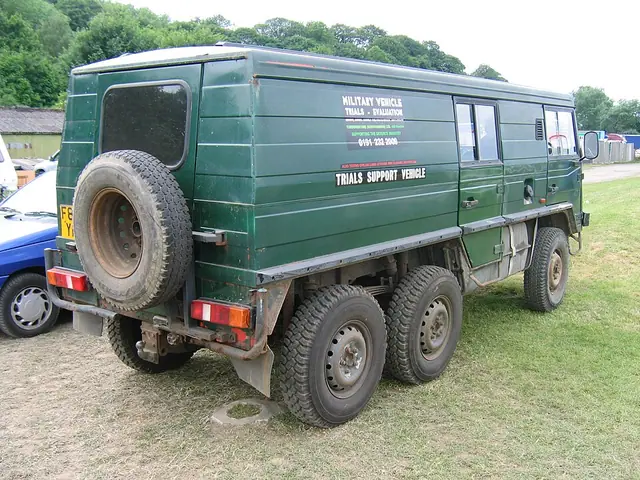
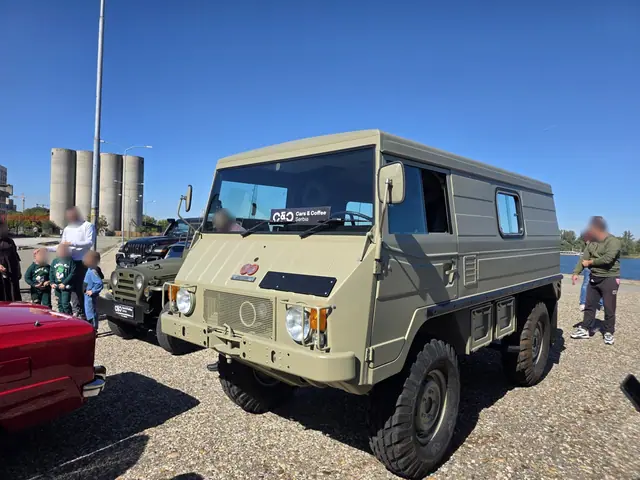
In the sixties the Austrian army wanted a vehicle larger and with a greater payload than the small Haflinger, to replace its old American trucks. Development in Graz was led by Erich Ledwinka, chief engineer of Steyr-Daimler-Puch and son of the designer Hans Ledwinka, who had worked for Tatra and Steyr. Like the Haflinger, the new vehicle was named after an Austrian domestic animal, the Pinzgauer horse from the Pinzgau region. Unlike the Haflinger, which has its engine at the back, the Pinzgauer got its engine above the front axle. The prototype was ready around 1969, and series production began in 1971 as the four-wheeled 710 and the six-wheeled 712. In the selection of a standard vehicle for the Austrian army the Pinzgauer beat the rival Husar from ÖAF.
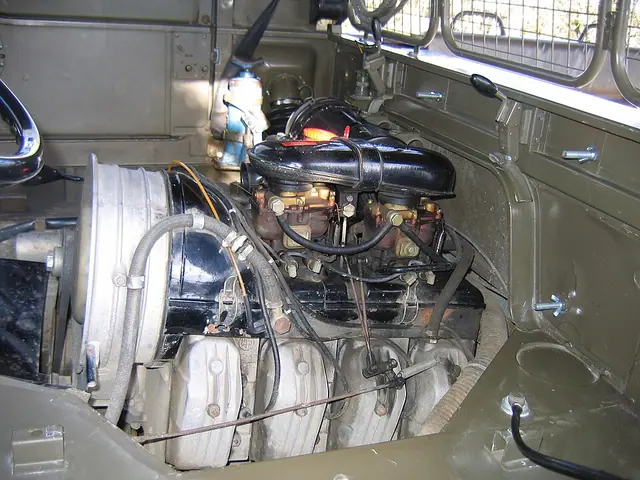
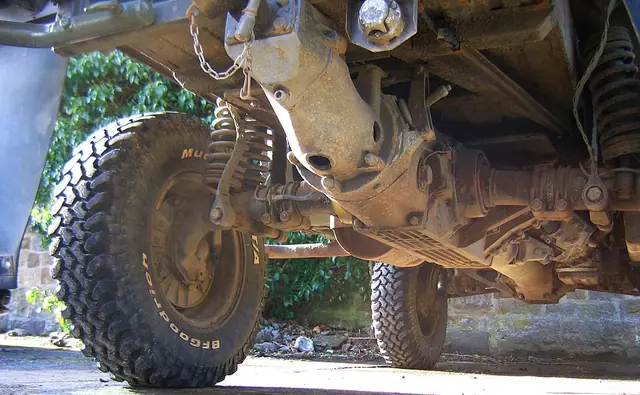
The basis of the design is a central backbone tube through which the drive runs, with the gearbox and differentials joined into a single unit. Attached to it are swing half-axles with independent suspension and portal hubs, as on the Unimog, which raise the axles and give great ground clearance. All the differentials can be locked hydraulically, even on the move. The engine was built specially for this vehicle and has more than one oil pump, so that it never runs short of lubrication whatever the angle. The vehicle climbs a 100 per cent gradient, handles a 43.5-degree side slope and fords water 700 mm deep, and the 4x4 version carries ten people or two NATO pallets. The 6x6 version was planned from the very beginning rather than added later.
The Pinzgauer was bought by the armies of Austria, Switzerland, the United Kingdom, Saudi Arabia, Jordan, Malaysia, New Zealand and many other countries. From 1971 Yugoslavia bought 3,975 Pinzgauers of all versions, and Serbia is still listed among the vehicle's military users today. In the British army it served mainly as a tractor for light guns, and American special forces used around twenty of them in both Iraq wars. In civilian life it proved itself as a fire engine and ambulance, as a postal vehicle and mountain rescue vehicle in Austria, as a camper and as a tourist bus for rough terrain in Africa, Australia and America. Several took part in the Paris–Dakar rally.
By 1985, 18,349 first-generation vehicles had been built. From 1980 Steyr-Daimler-Puch developed a second generation, which went into production in the mid-eighties as the 716 (4x4) and 718 (6x6). Instead of the air-cooled petrol engine it got a Volkswagen six-cylinder turbodiesel, a wider track, bigger tyres, disc brakes and an optional ZF automatic gearbox. By the end of production in Graz, in February 2000, between 24,000 and more than 30,000 Pinzgauers of all versions had been built, depending on the source. The same factory also built the Mercedes-Benz G-Class, so for a long time the two vehicles came out of the same halls.
When Steyr-Daimler-Puch passed into the hands of the Magna group, the rights to the Pinzgauer were sold in 2000 to the British firm Automotive Technik, which continued production in Guildford. The firm later became part of the Armor Holdings group, which in turn became part of BAE Systems in 2007. The armoured Vector version served briefly with the British army in Afghanistan but was withdrawn because of unreliable suspension and poor mine protection, and BAE ended production soon afterwards. The planned Pinzgauer II, also developed in South Africa, never went into production.