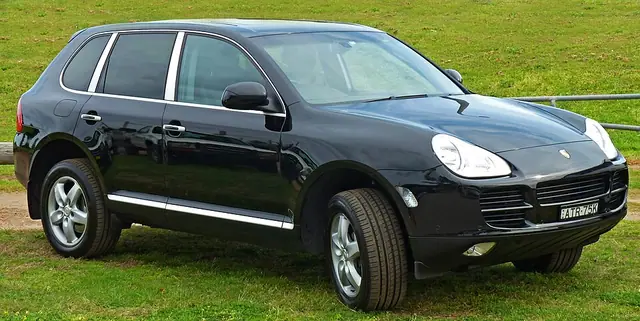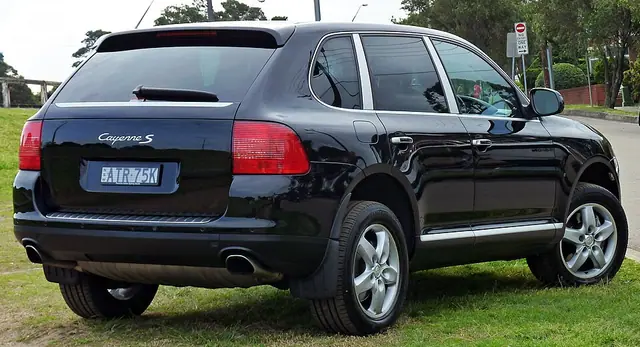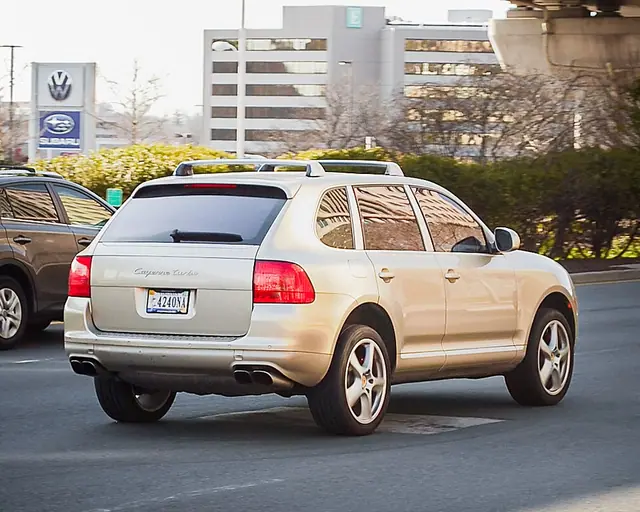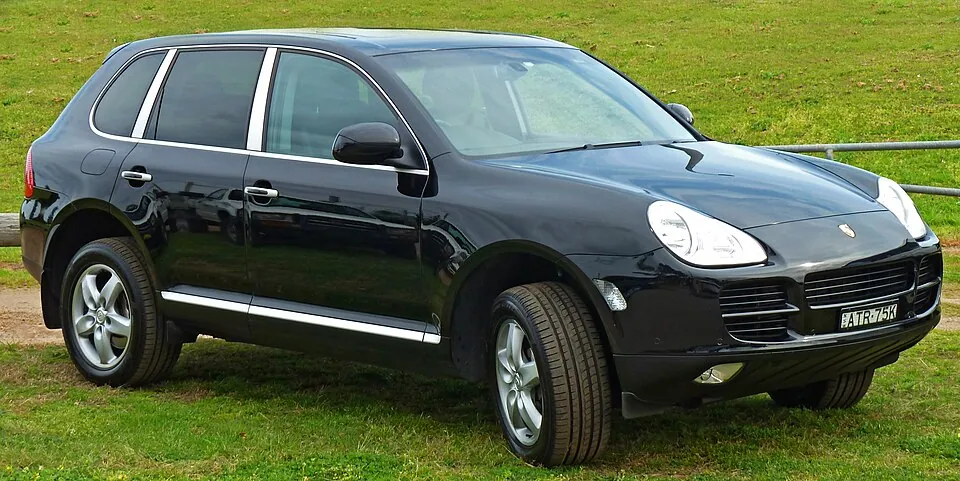
The Cayenne was the first four-door Porsche and Porsche's first off-roader since the tractors of the fifties, so many fans of the marque greeted it with disbelief. It turned out that it was precisely this car, the "third Porsche" alongside the 911 and the Boxster, that secured the future of the small sports-car maker after the crisis of the nineties, and today it is the brand's best-selling model. It was built in cooperation with Volkswagen, but with its own engines and tuning, and it was one of the fastest SUVs of its time.
Story
In the early nineties Porsche was in one of the worst crises in its history: in the 1991/92 financial year it delivered only 23,060 cars and made a loss. The 1996 Boxster helped the marque recover, but the management led by Wendelin Wiedeking concluded that the 911 and a single mid-engined model were not enough for a secure future. A "third Porsche" was needed. On the advice of the American sales organisation, North America then being the brand's most important market, it was decided that it would be an off-road SUV rather than an MPV, which had also been considered. The growing Asian market was also in mind.
To keep costs reasonable, Porsche teamed up with Volkswagen, and the joint project, named "Colorado", was announced in June 1998. At its secret development centre in Hemmingen, Porsche developed the shared platform from which the Cayenne and the Volkswagen Touareg were derived, while Volkswagen contributed its mass-production experience. Each brand had its own engines and its own suspension tuning. The name Cayenne, after the hot pepper, was coined by Manfred Gotta. Testing included driving over sand dunes in Dubai. In 1999 Porsche decided to build the car in Germany, so a new plant was built in Leipzig, officially opened in August 2002. The bodies were built and painted at Volkswagen's plant in Bratislava, together with the Touareg, while the engine, gearbox and other parts were fitted in Leipzig.
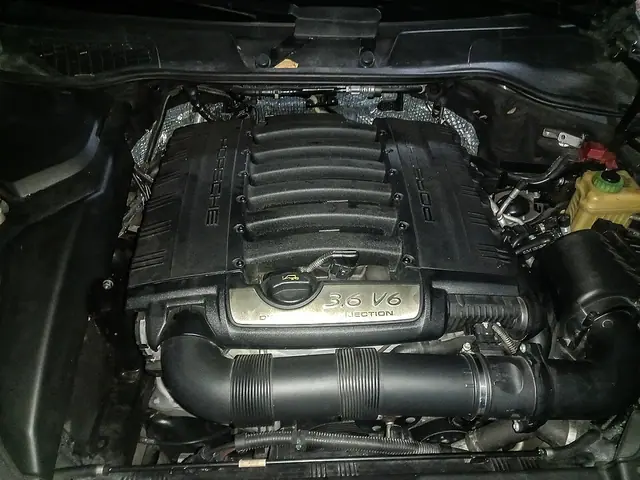
The world premiere was in September 2002 at the Paris show. At first two models were offered with a new 4.5-litre V8: the Cayenne S with 340 hp and the twin-turbo Cayenne Turbo with 450 hp, which reached 266 km/h. The PTM drive normally sent 62 per cent of the power to the rear wheels and 38 per cent to the front, but the split could vary from one extreme to the other; there was also a low-range gearbox and a full centre differential lock. The Cayenne was the first Porsche with air suspension and the first with PASM, which adapts the dampers, and with air suspension the ground clearance could be raised from 21.7 to 27.3 cm. A base Cayenne with Volkswagen's 3.2-litre, 250 hp VR6 engine was added later, and in 2006 the Turbo S with 521 hp. Critics were divided: many fans of the marque felt that Porsche should not build heavy family cars, but road tests praised its performance and handling, unusual for a vehicle of that size.
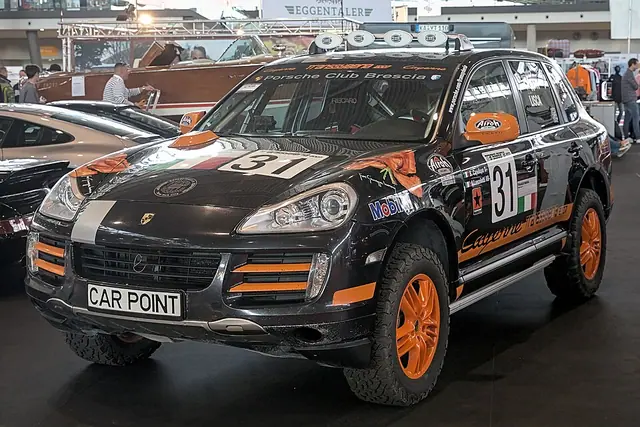
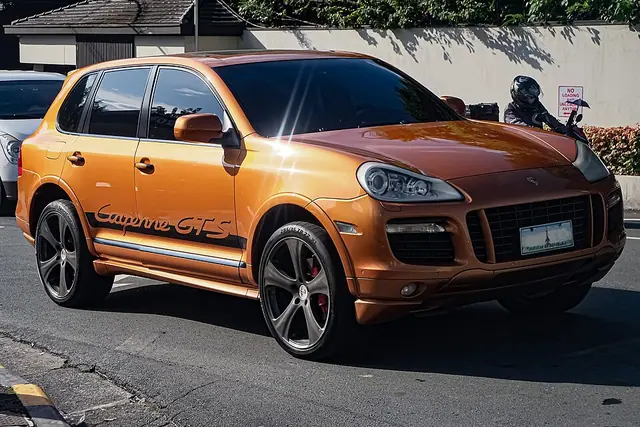
Porsche planned for about 25,000 cars a year, and sales exceeded that from the start. To show that the Cayenne was not only for tarmac, private teams took the first two places with Cayenne S models in the 2006 Transsyberia rally from Moscow to Ulaanbaatar, and for the following years Porsche built a small series of 26 Cayenne S Transsyberia competition cars, which took the first three places in 2007. After the 2007 facelift (internal designation 957) came direct-injection engines, a 4.8-litre V8, the sporty Cayenne GTS with 405 hp and, in 2009, the first diesel Cayenne with Volkswagen's V6 TDI engine. The first generation was built until 2010, and over eight model years 276,652 were made, an average of about 35,000 a year.
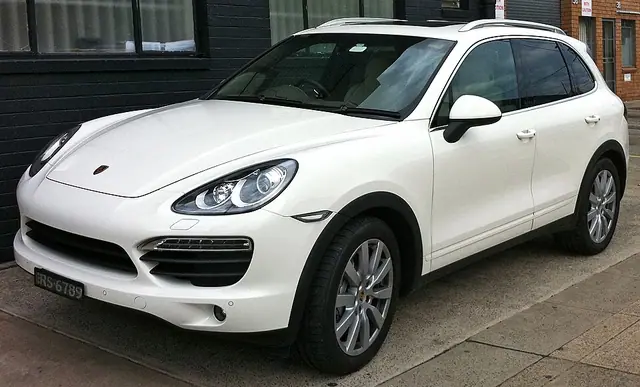
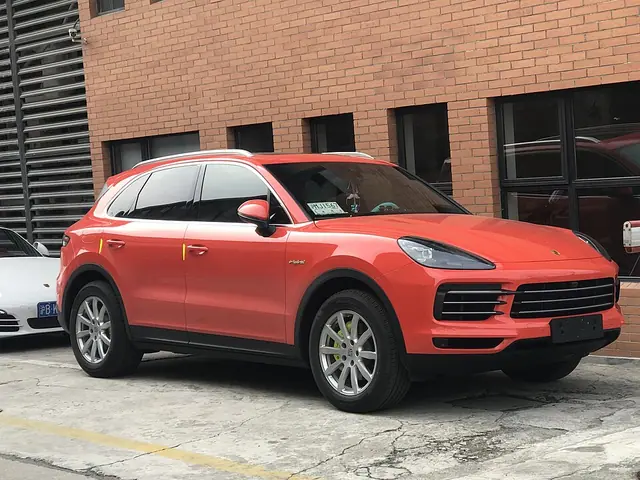
The second generation (92A, E2) was unveiled in March 2010 in Geneva. It was almost 250 kg lighter, mainly because the low-range gearbox was dropped, and it brought Porsche's first hybrid, the Cayenne S Hybrid with a combined 380 hp, and in 2014 a plug-in hybrid. The third generation (E3), unveiled in 2017, is built entirely in Bratislava, on a platform shared with the Audi Q7, Q8, Bentley Bentayga and Lamborghini Urus; since 2019 there has also been a Cayenne Coupé, and the millionth Cayenne was built in the summer of 2020. The fourth generation, the Cayenne Electric, was unveiled in November 2025 as the first purely electric Cayenne, and it is offered alongside the third generation with combustion engines.