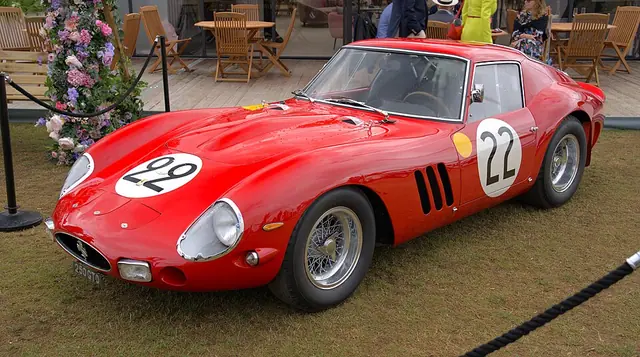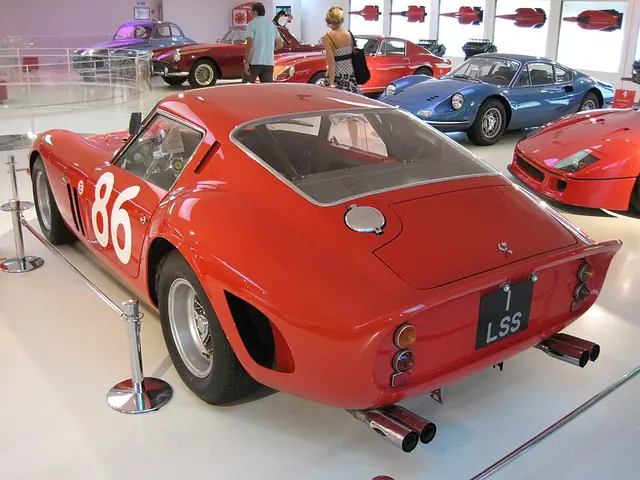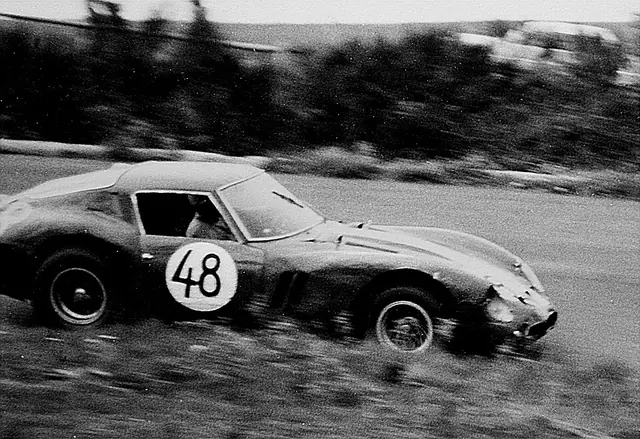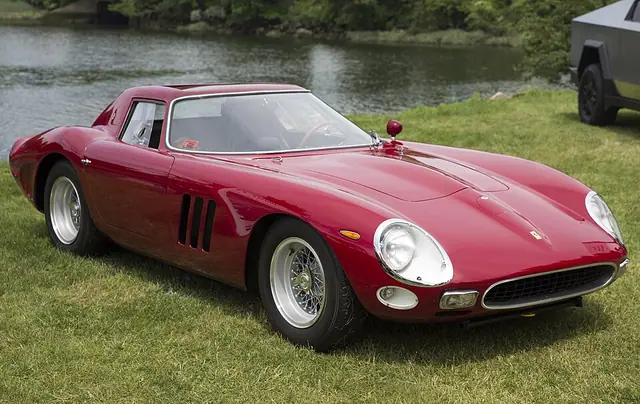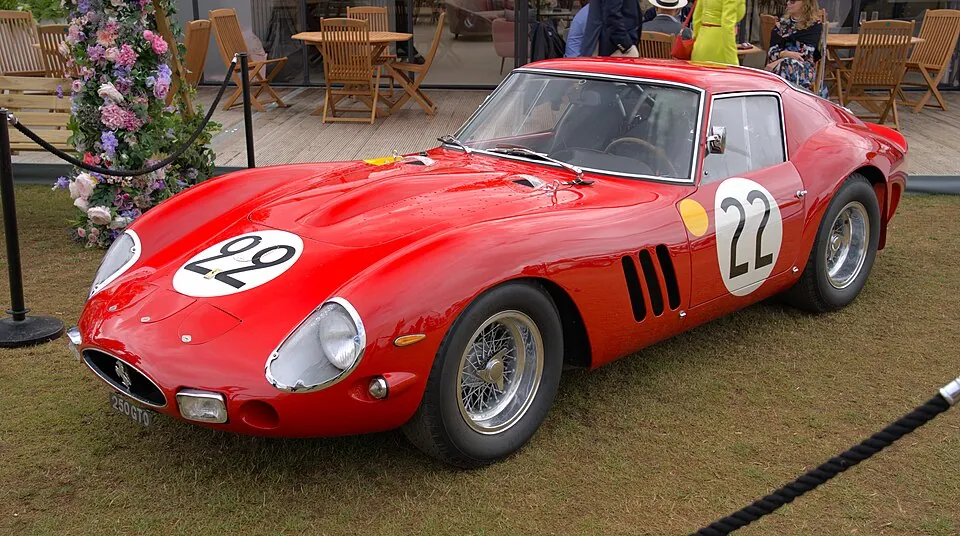
The 250 GTO is a racing car that could also be driven on the road, built in just 36 examples so that Ferrari could win GT races in the early sixties, which it did three years in a row. Today it is probably the most valuable collector car in the world: one example was sold privately in 2018 for 70 million dollars, and another reached 48.4 million dollars at auction the same year.
Story
The name GTO stands for Gran Turismo Omologato, or "homologated GT", and the number 250 for the displacement of one cylinder in cubic centimetres. FIA rules for the GT class required at least a hundred cars to be built within a year, but Ferrari managed to enter the GTO as a development of the older 250 GT SWB, which was already homologated. So 36 cars were enough, and the story that Enzo Ferrari showed the inspectors the same cars in different places has remained just a legend.
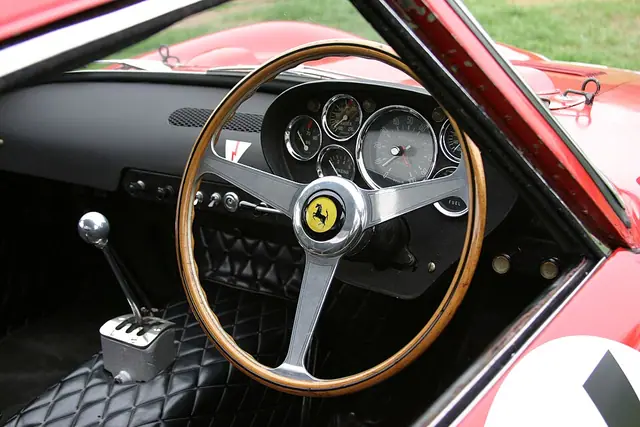
Development was led by chief engineer Giotto Bizzarrini. The welded tubular chassis came from the 250 GT SWB, but the engine was moved lower and further back, and after testing in the Pisa wind tunnel the body got a long, low nose, small air intakes and a small rear spoiler, which was a novelty at the time. The engine was the proven three-litre V12 from the 250 Testa Rossa racer. At the end of 1961 Bizzarrini and other engineers left Ferrari after a row with Enzo Ferrari, so development was taken over by the young Mauro Forghieri, together with Sergio Scaglietti's coachworks, where almost all the bodies were built. The interior was bare: no speedometer, cloth seats and no carpets.
In its first race, the 1962 Sebring 12 Hours, Phil Hill and Olivier Gendebien finished second overall. With the GTO Ferrari won the International Championship for GT Manufacturers in the over-two-litre class in 1962, 1963 and 1964, and the GTO also won the Tour de France Automobile in 1963 and 1964. At the Le Mans 24 Hours it finished second overall in 1962 and 1963. Its main rivals were the Jaguar E-Type, the Aston Martin DB4 GT Zagato and the Shelby Cobra. It was specifically against the GTO that Carroll Shelby built the Cobra Daytona coupé, which lost the title to Ferrari by six points in 1964 and won it in 1965.
For the 1964 season Forghieri and Mike Parkes reworked the body along the lines of the 250 LM. Three new "Series II" cars were built and four older ones were converted. After 1964 the GTO was outdated and passed into the hands of privateers, and in the late sixties it sold as a used racing car for a few thousand dollars, although new in America it had cost about 18,000 dollars.
From the late seventies prices began to rise, and today every car is known by its chassis number. In June 2018 GTO number 4153GT was sold privately for 70 million dollars, and in August 2018 the auction house RM Sotheby's sold car 3413GT for 48,405,000 dollars, at the time the highest price ever paid for a car at auction. Ferrari later reused the GTO name for the 288 GTO of 1984, from which the Ferrari F40 was developed.