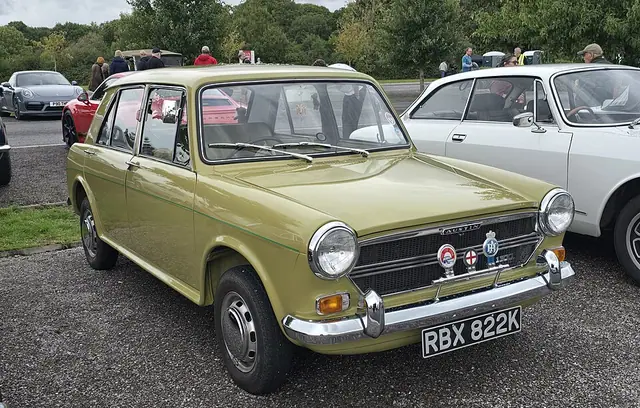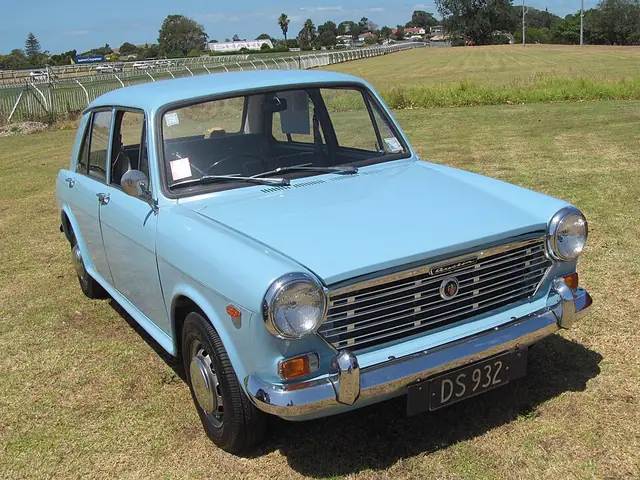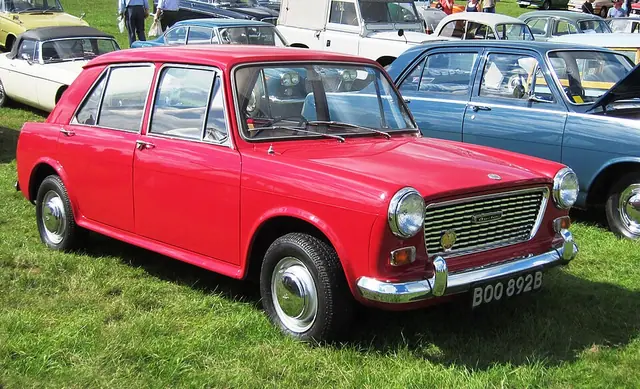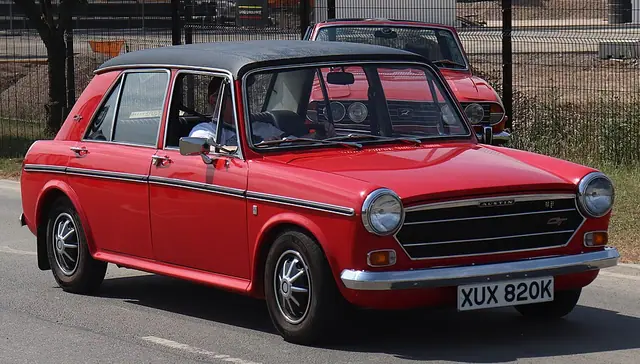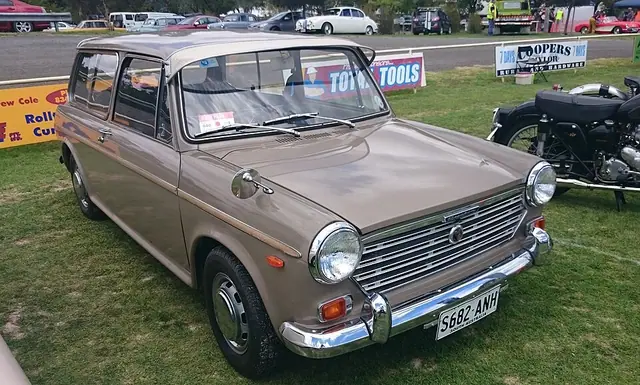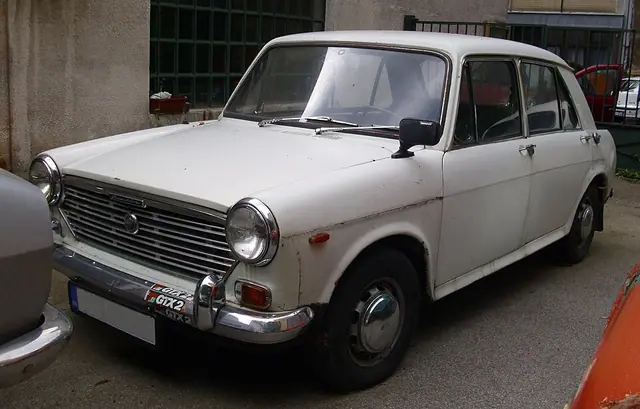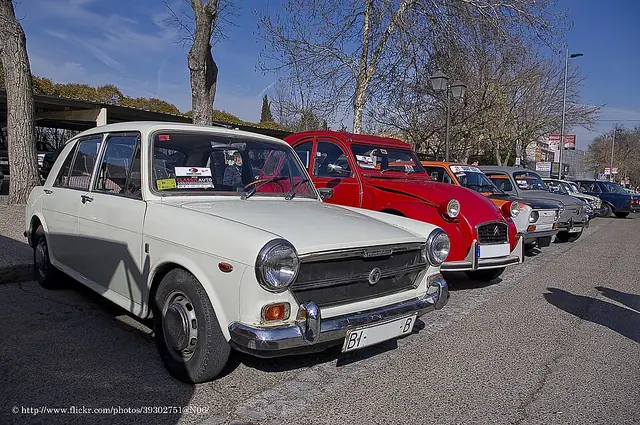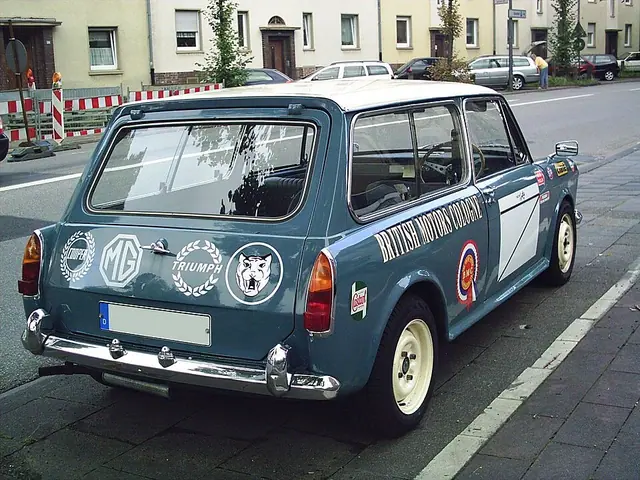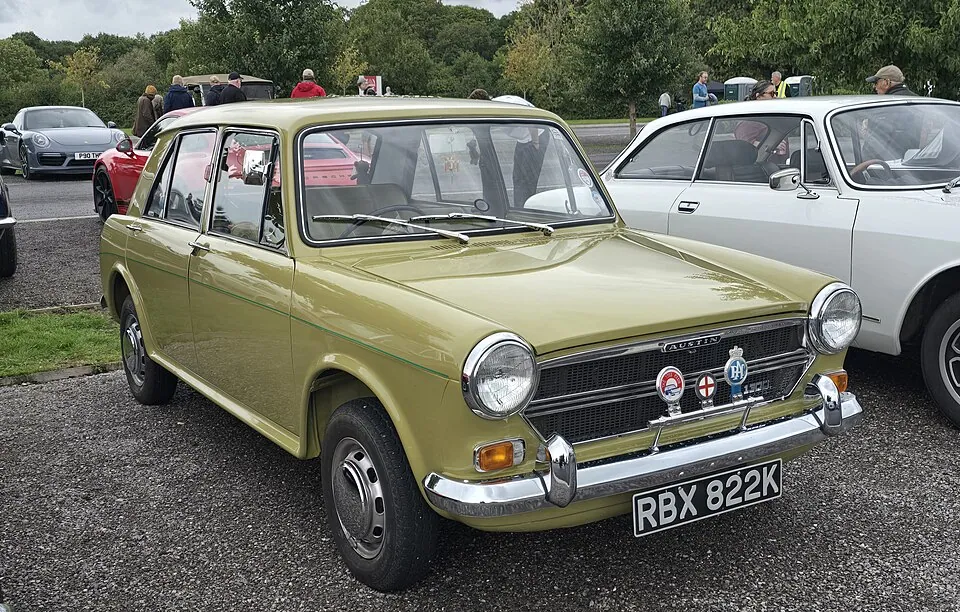
What the Mini did for the smallest cars, the ADO16 did for family cars: a transverse engine and front-wheel drive gave lots of space in a short body, and the fluid-filled Hydrolastic suspension rode more softly than most more expensive cars. It was Britain's best-selling car for almost a whole decade, more than two million were built, and it was also assembled in Yugoslavia, at the IMV plant in Novo Mesto.
Story
After the success of the Mini in 1959, Alec Issigonis was given the task at the British Motor Corporation of applying the same idea to a larger, more comfortable car. The project was called ADO16, after its number in BMC's shared drawing office (Amalgamated Drawing Office). The mechanicals stayed the same as the Mini's: an A-series four-cylinder engine mounted transversely, with the gearbox beneath the engine in the same casing, and front-wheel drive. As Issigonis was busy with the Mini, development was taken over in the late fifties by engineer Charles Griffin, who insisted on better equipment and a quieter cabin. The body styling was entrusted to the Italian house Pininfarina, which had already drawn the Austin A40 Farina. The result was a car as short as small family models but with interior space comparable to the larger Ford Cortina.
The biggest novelty was the Hydrolastic suspension, the work of engineer Alex Moulton. Instead of steel springs, each wheel had a fluid-filled rubber unit, and the front and rear units on the same side were connected by pipes. When a front wheel hits a bump, fluid is pushed towards the rear one, so the car pitches less and rides more calmly over potholes. According to Moulton, the model was the mechanically interconnected system of the Citroën 2CV, which he and Issigonis had studied in the mid-fifties, but with greater resistance to roll in corners. The front wheels had disc brakes, a rarity on cheap cars in the early sixties.
First to be unveiled, on 15 August 1962, was the Morris 1100, followed by the MG 1100, the Austin 1100 (1963), the luxurious Vanden Plas Princess 1100 with leather and walnut, and the Wolseley and Riley Kestrel. It was a classic example of BMC policy: the same car sold under six brands, with a different grille and equipment. Buyers took to it immediately. The ADO16 was Britain's best-selling car from 1963 to 1966 and from 1968 to 1971, with about 15 per cent of the market in its best years, and the millionth car was built in March 1967. From 1965 a four-speed automatic gearbox by Automotive Products was offered, and in 1966 came a three-door estate, called the Countryman at Austin.
In May 1967 the MG, Riley, Wolseley and Vanden Plas got the larger 1,275 cc engine familiar from the Mini Cooper S, and in October 1967 Austin and Morris introduced the 1300 models, along with the facelifted second series (Mark II) with a wider grille and cropped rear "fins". Because of exports after the devaluation of the pound, British buyers waited months for an Austin 1300. At the London Motor Show in October 1969 the sporty Austin 1300 GT was unveiled, with twin carburettors and 70 hp, a black grille and a black vinyl roof, as an answer to the Ford Escort GT. In the USA it was sold as the Austin America, mostly with an automatic gearbox, but it was not a success there, as it was one of the smallest cars on the market. The car's silhouette also found its way into British road signs, designed in the sixties and still in use today.
The ADO16 was assembled all over the world: in Italy it was built by Innocenti (IM3, I4, I5), in Spain by Authi in Pamplona (later also as the Austin Victoria), and it was also assembled in Belgium, Australia, New Zealand, South Africa and Chile. In Yugoslavia the IMV plant (Industrija motornih vozil) in Novo Mesto, in today's Slovenia, began assembling Austins from kits shipped from Britain in the late sixties. According to the English Wikipedia, from October 1969 to December 1972 it assembled 13,550 four-door Austin 1300 Super Deluxe cars and 485 of the local IMV 1300 Special version, with twin carburettors and metallic paint. Because of problems with parts deliveries, IMV signed an agreement with Renault in 1972 and switched to assembling the Renault 4, from which today's Revoz plant later grew.
After 1971 the ADO16 was gradually phased out: the Morris 1300 made way for the Morris Marina, and in 1973 came the Austin Allegro, intended as its successor. The last British ADO16, a Vanden Plas Princess 1300, rolled off the line on 19 June 1974, and in South Africa the Austin Apache, derived from the same car, was built until 1977. Surprisingly few examples of what was once Britain's best-selling car survive: according to the British DVLA, in February 2016 only 640 were registered for road use in the United Kingdom. The Austin 1100 Countryman is also remembered for a scene in the series Fawlty Towers (1975), in which Basil Fawlty, played by John Cleese, furiously "punishes" it with a thrashing after it breaks down.