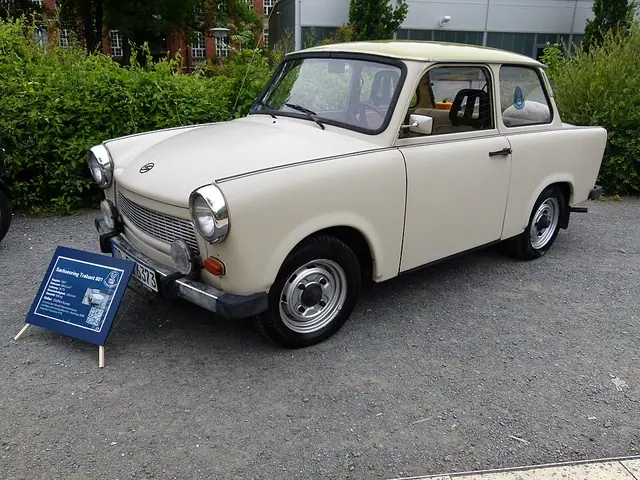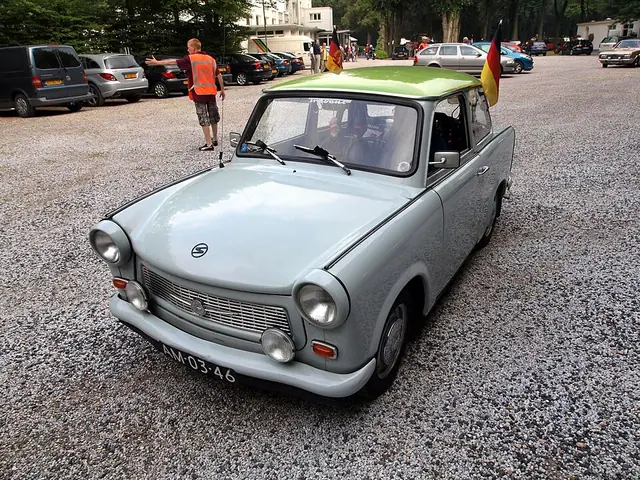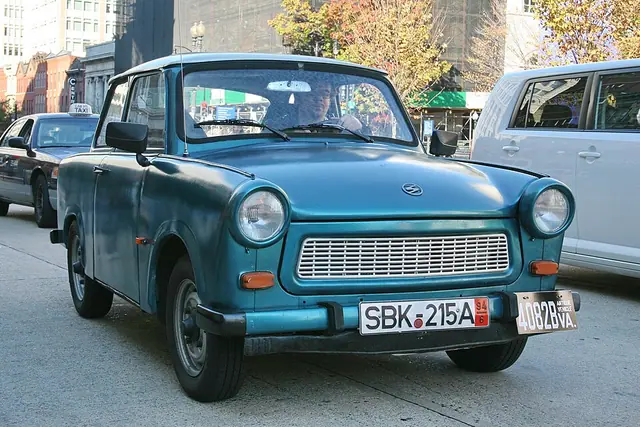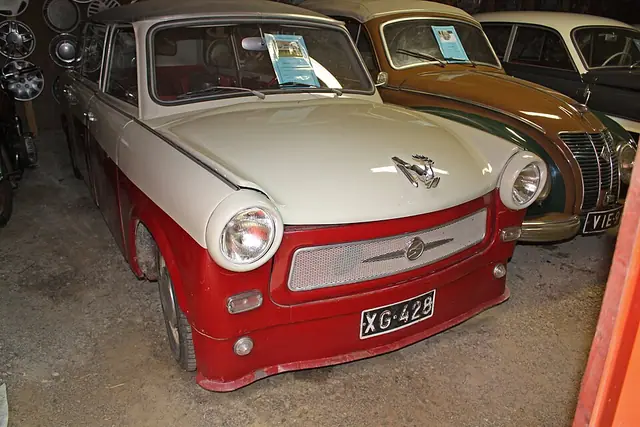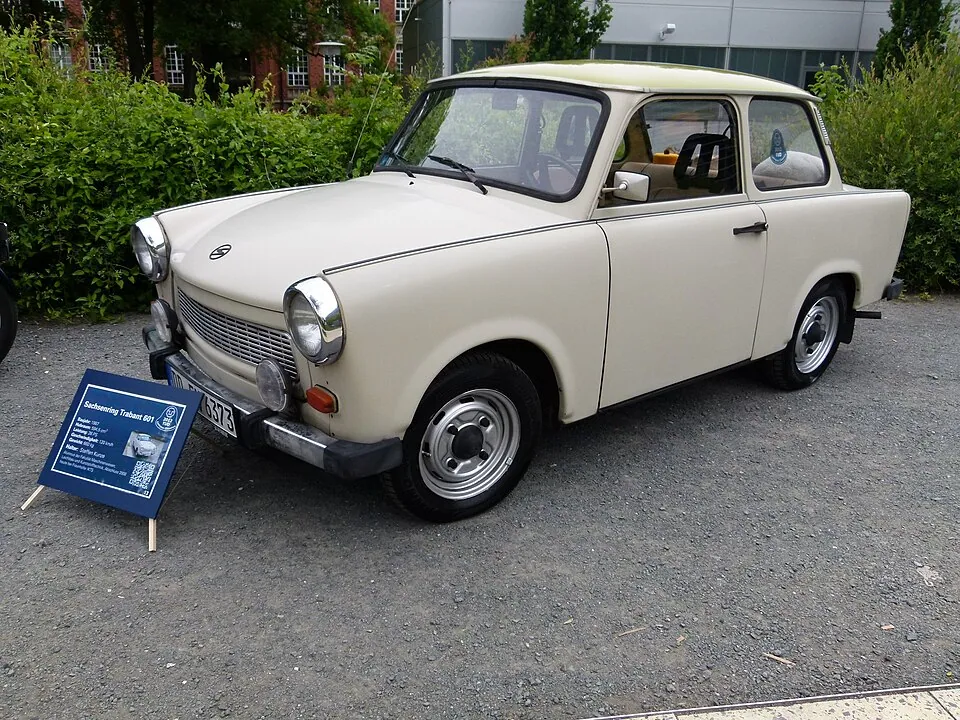
The Trabant was East Germany's "people's car": a body of Duroplast, a plastic reinforced with cotton fibres, and a two-stroke engine with only two cylinders. People waited up to ten years for one, and it was built for 26 years almost without change. In the autumn of 1989, columns of Trabants crossing the border became one of the best-known images of the fall of the Berlin Wall.
Story
The Trabant P601 was the third generation of the Trabant, after the P50 of 1957 and the P60. It was shown at the Leipzig Spring Fair in 1964, and the Zwickau factory built it on the site of the former Horch and Audi works. When it came out it was not outdated: it had a transverse engine, front-wheel drive, a monocoque body and independent suspension on all wheels. Its weak point was the engine, a two-stroke two-cylinder unit descended from the pre-war DKW, noisy, with blue smoke from the exhaust and a mixture of oil and petrol in the tank.
The body was made of Duroplast, a phenolic resin reinforced with cotton waste from the Soviet textile industry, because there was not enough sheet steel in the GDR. The plastic panels were hung on a steel skeleton. It was originally planned to build the P601 from 1967 to 1971 and then replace it with a new model. The engineers drew successors, the P602, P603 and P610, and even tested a Wankel engine, but the party leadership stopped every project as too expensive and unnecessary.
So the P601 stayed in production for a quarter of a century with minor changes: in 1969 a more powerful 26 hp engine, later plastic bumper ends, electronic ignition and, in 1984, a 12-volt electrical system. Besides the saloon there was the Universal estate, the open military Kübel version and the civilian Tramp, as well as the Hycomat with an automatic clutch, intended mainly for disabled drivers. In 1985 the basic model cost 8,500 marks, and buyers waited ten years or more for delivery.
The Trabant was also rallied: in 1970 two Trabants took the first two places in their class at the Monte Carlo Rally. After the Wall fell in 1989, thousands of East Germans crossed to the West in Trabants, greeted with applause by people at the border. As early as 1990 the Trabant 1.1 appeared with a four-stroke Volkswagen engine, but it was too late: buyers wanted used Western cars, and production ended in April 1991.
Today the "Trabi" is a cult car and part of East German nostalgia. Films have been made about it, such as the 1991 comedy Go Trabi Go, there are fan clubs all over Europe, and in Berlin tourists can hire one to drive around the city.