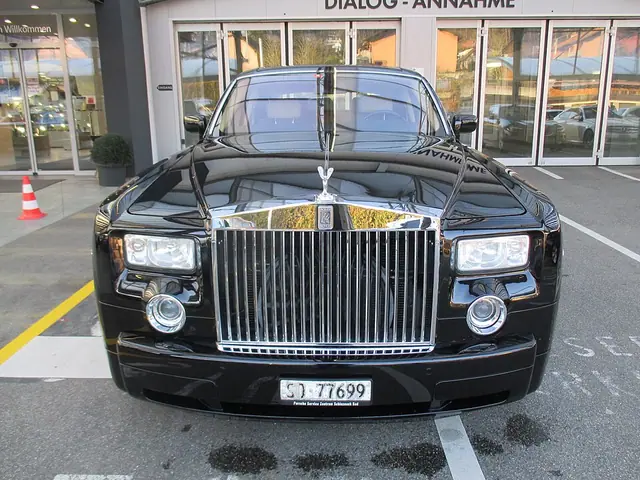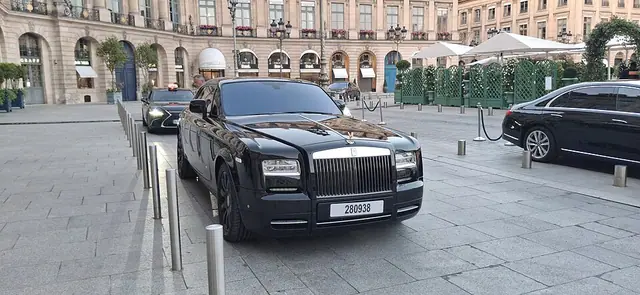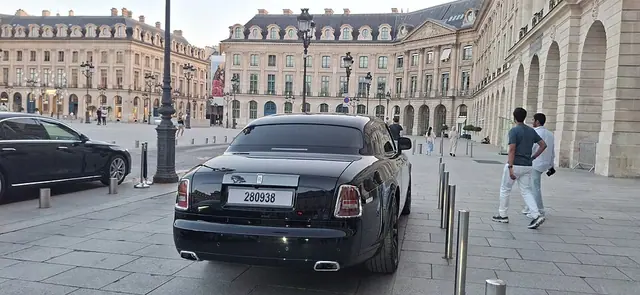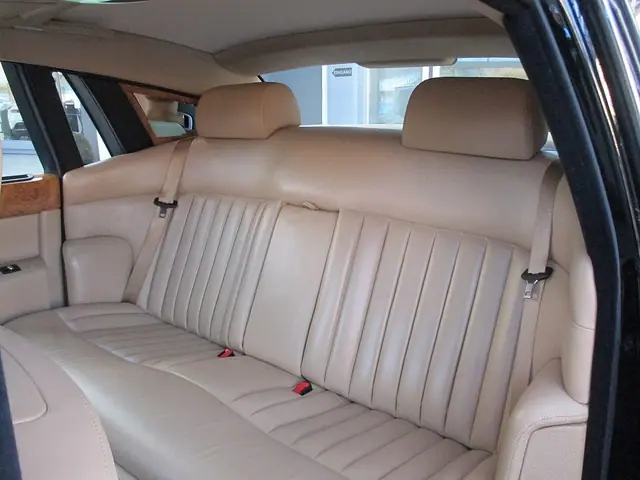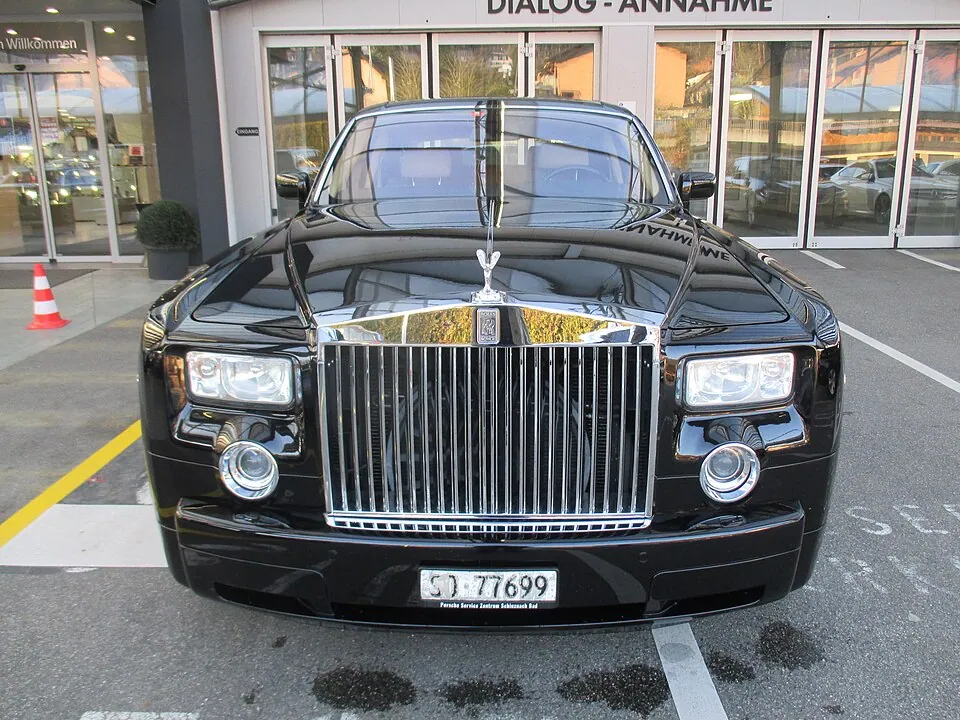
The 2003 Phantom was the first Rolls-Royce created after the strange split of 1998, when Volkswagen bought the factory in Crewe and BMW the right to the name. In just four years BMW built an entirely new car and a new factory at Goodwood, and the Phantom restored the marque's prestige and became the benchmark of luxury for the new century. Its exterior was drawn by a designer born in Belgrade.
Story
In the late nineties the Vickers group was selling Rolls-Royce Motors, the factory in Crewe that built Rolls-Royces and Bentleys. BMW, which already supplied engines for the Silver Seraph and the Bentley Arnage, bid 340 million pounds, but Volkswagen bid 430 million and won. Only then did it become clear that the Rolls-Royce name and badge did not belong to the seller, but to the aero-engine maker Rolls-Royce plc, which in 1998 licensed the rights to the name and logo to BMW for 40 million pounds. After long negotiations it was agreed that Volkswagen would build Rolls-Royce cars in Crewe until the end of 2002 and keep only Bentley from 1 January 2003, while BMW would take over the Rolls-Royce marque from that day. This meant that BMW had to create an entirely new car and a new factory in less than five years, without a single day of experience under that name.
The project was given the designation RR01. The Duke of Richmond's estate at Goodwood, near Chichester and the famous racing circuit, was chosen as the new company's home, and a factory was built there with a paint shop, leather and wood workshops and assembly under one roof. The design team was led by Ian Cameron, and the exterior is credited to Marek Djordjevic, a designer born in Belgrade in 1969, who studied at the Art Center College of Design in Pasadena and was Rolls-Royce's head of exterior design. The aim was to translate traditional elements such as the tall radiator grille, the long bonnet and the Spirit of Ecstasy figure into a modern form. This was already the seventh model of the marque to bear the Phantom name, but technically the new car had nothing in common with the Phantom VI, which had been built until 1991. The first in the line was the Phantom I of 1925.
The construction was entirely new: a load-bearing frame of aluminium sections, extruded in Norway, machined in Denmark and hand-welded in Germany, and a body mostly of aluminium. BMW initially considered a nine-litre V16, but Rolls-Royce owners invited to assess the project felt they did not need that much power. So BMW's V12 was chosen, enlarged to 6.75 litres, the same displacement as the old Rolls-Royce V8 of 1959. It had 460 PS and 720 Nm, and for a car 5.83 metres long and weighing about 2.5 tonnes that was enough for 0–100 km/h in about six seconds. Instead of a rev counter, the dashboard had a power reserve gauge, showing how much of the engine's power is still available to the driver.
The Phantom was full of details that Rolls-Royce still prides itself on. The rear doors open backwards, as on the first Phantoms, and close at the touch of a button; hidden in them are Teflon-coated umbrellas. The Spirit of Ecstasy figure retracts electrically into the grille if someone tries to remove it, and the RR badges in the centre of the wheels always stay upright as the wheel turns. Only three robots worked at Goodwood, applying paint, while everything else, from polishing the lacquer to the three-millimetre coachline, was done by hand. The first car was handed to its customer in a special ceremony at 00:01 on 1 January 2003, the first day BMW was allowed to use the name, and it was presented to the public a few days later at the Detroit show. In the first year 481 cars were delivered, about half of them in the United States.
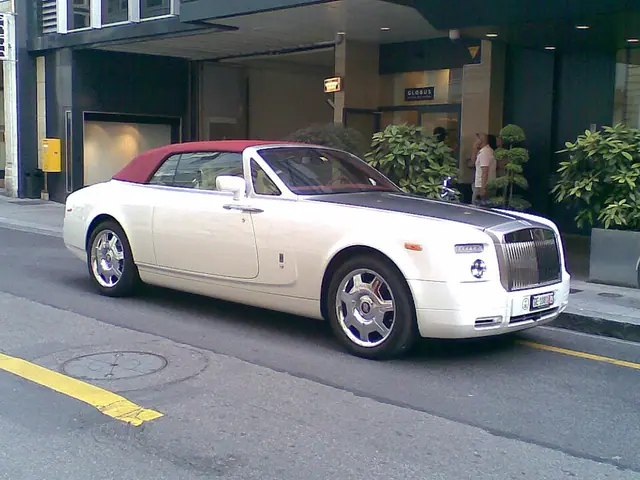
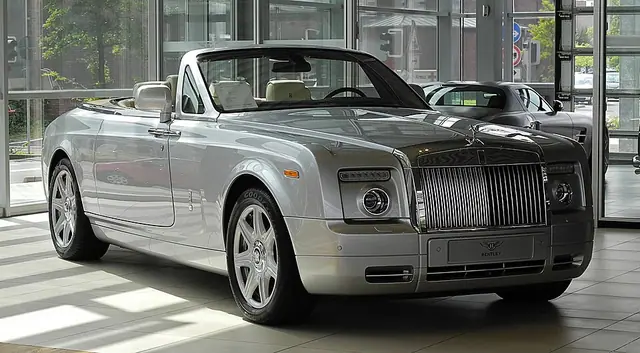
The range grew quickly. From 2005 a saloon with a wheelbase 250 mm longer was offered, in 2007 the Phantom Drophead Coupé convertible, previewed by the 100EX concept, and in 2008 the Phantom Coupé, previewed by the 101EX concept. As early as 2007 Rolls-Royce reached its target of a thousand cars sold in a year for the first time (1,010 Phantoms, a quarter of them convertibles). Numerous special editions were also built, from 35 Centenary Edition cars for the marque's centenary in 2004 to a single experimental electric Phantom, the 102EX, of 2011. From 2009 the Phantom was no longer the only model, as it was joined by the smaller Ghost. The facelifted Series II of 2012 got rectangular LED headlamps, a new eight-speed gearbox and a simpler dashboard.
Production of the Phantom VII ended in January 2017, after 10,327 cars of all versions, more than previous Phantoms had ever achieved, since none of them had exceeded 600 cars a year. The Phantom proved that a German-owned Rolls-Royce could remain British and exclusive, and the Goodwood factory has since become the marque's home, as Derby and Crewe once were for models such as the Silver Ghost and the Silver Spirit. Its successor, the Phantom VIII, was unveiled on 27 July 2017.