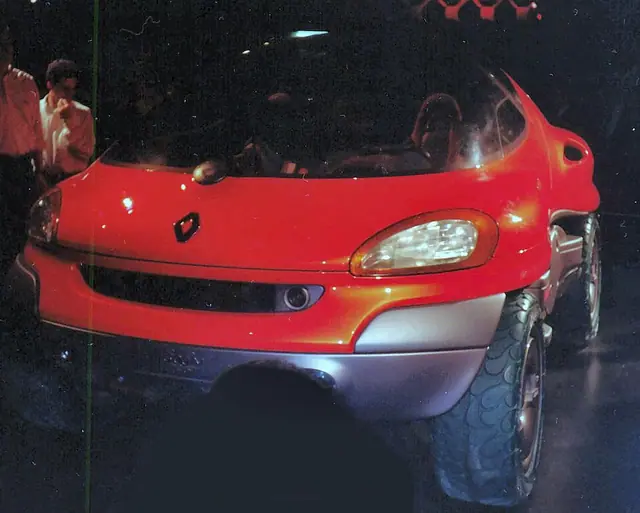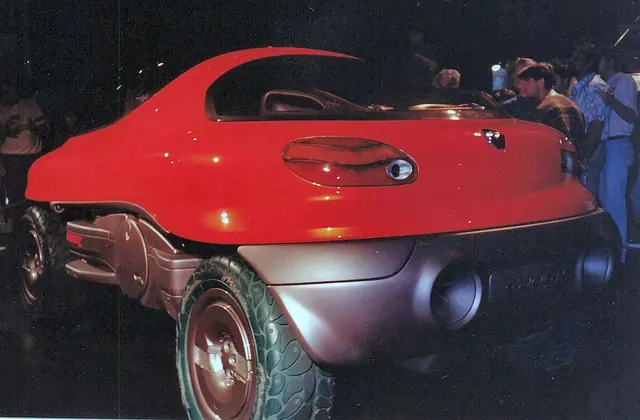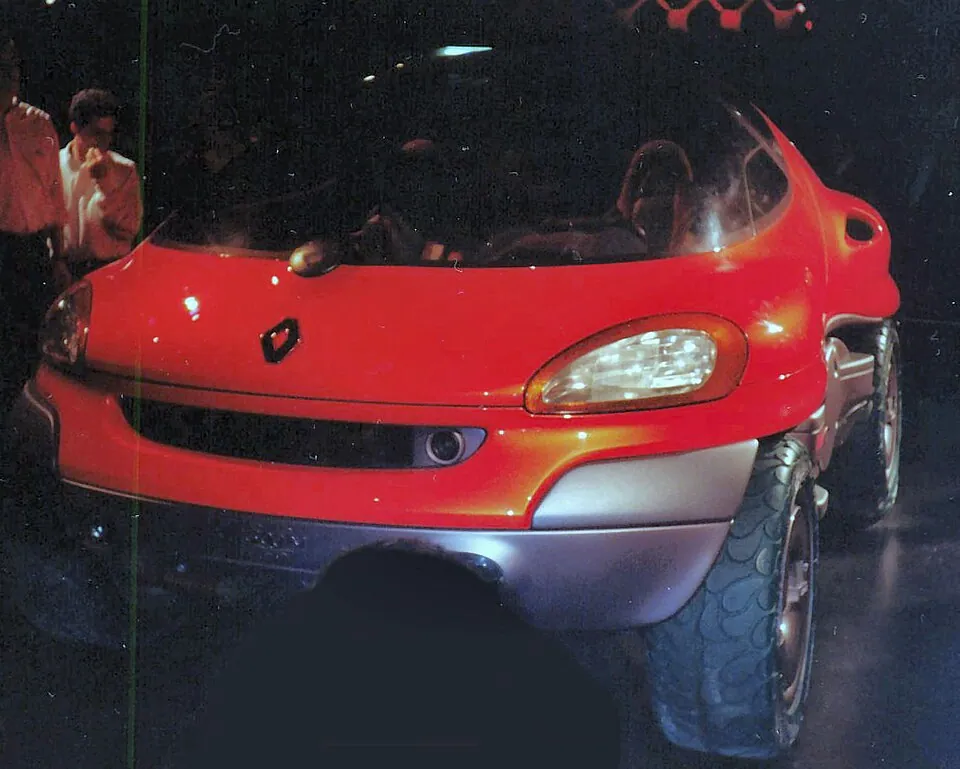
The Racoon is one of the most unusual concepts of the nineties: an off-roader that can drive into the water and float, with a body like a glass bubble on a tall chassis. In it Renault showed ideas that were then almost science fiction, such as cameras instead of mirrors, satellite navigation and an infrared camera for night driving.
Story
The Racoon was created at Renault's design centre at the time when it was led by Patrick Le Quément, and it was shown to the public at the 1993 Geneva motor show. Renault never planned a production version: from the start the Racoon was conceived as a playful experiment showing what the car of the future might be.
It was powered by a 2,963 cc twin-turbo petrol V6 with 262 horsepower, driving all four wheels through a six-speed manual gearbox. The suspension could raise the body hydraulically to increase ground clearance on rougher terrain. For travel on water there were two water jets (turbines), with which the Racoon could sail at about five knots, enough to cross a calm river or lake.
Even getting in was unusual: instead of conventional doors, the glass part of the cabin moved to let the occupants in, and the opening was triggered by remote control. Inside there were three seats. The windscreen was cleaned by ultrasound instead of wipers, and the mirrors were replaced by cameras. Many of these technologies are commonplace today, but in 1993 they were still in their infancy.