Founding and founders
Adam Opel was born on 9 May 1837 in Rüsselsheim, the eldest son of locksmith Philipp Wilhelm Opel. He learned his trade in his father's workshop, and from 1857, as a journeyman, he travelled via Liège, Brussels and England to Paris. There, together with his brother Georg, he worked in sewing machine factories. In the summer of 1862 he returned home and built the first Opel sewing machine in his father's workshop. The following year he set up on his own in a former cowshed, and his brother in Paris sent him steel, shuttles and needles.
His marriage to Sophie Scheller, an innkeeper's daughter, allowed him in 1868 to build a proper factory. The business grew: in 1885 three hundred workers made 18,000 sewing machines a year. At his sons' urging Opel began making bicycles in 1886, first high-wheelers with a large front wheel. The five Opel brothers were successful cycle racers, and in the 1920s Opel became the largest bicycle maker in the world.
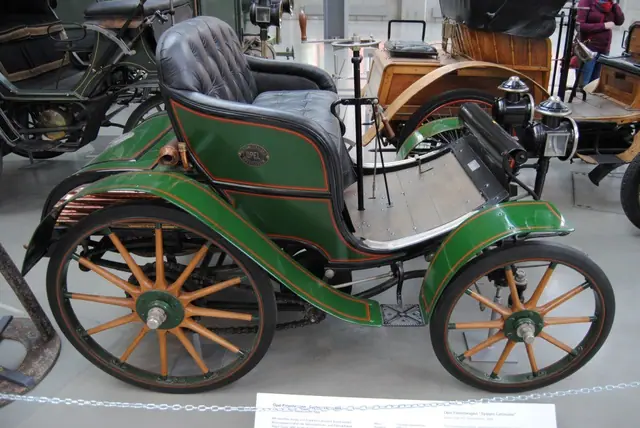
According to legend, Adam Opel did not believe in the motor car and called it a "stink box", a toy for millionaires. He died of typhoid on 8 September 1895. The company was taken over by his widow Sophie and his sons Carl, Wilhelm, Heinrich, Fritz and Ludwig, and it was they who took it into the world of cars. On 21 January 1899 Opel took over Friedrich Lutzmann's car factory in Dessau, and production of the Opel Patent-Motorwagen "System Lutzmann" began in Rüsselsheim. These cars could not compete with the French, so in 1902 Opel signed an agreement with the French firm Darracq and in the same year presented its first car of its own design.
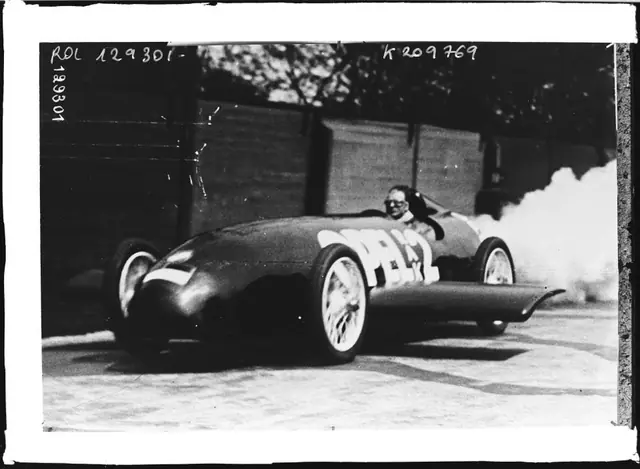
After a major fire in 1911 Opel stopped making sewing machines, of which it had built about a million by then, and kept only bicycles and vehicles. In 1924 Opel introduced in Rüsselsheim the first moving assembly line in the German car industry, building on it the small 4 PS model nicknamed "Laubfrosch" (tree frog). By 1928 it had become the largest car maker in Germany. That same year Fritz von Opel reached 238 km/h in the RAK 2 rocket car on the AVUS track. In March 1929 the family sold 80 per cent of the company to America's General Motors, which became the sole owner in 1931.
The meaning of the logo
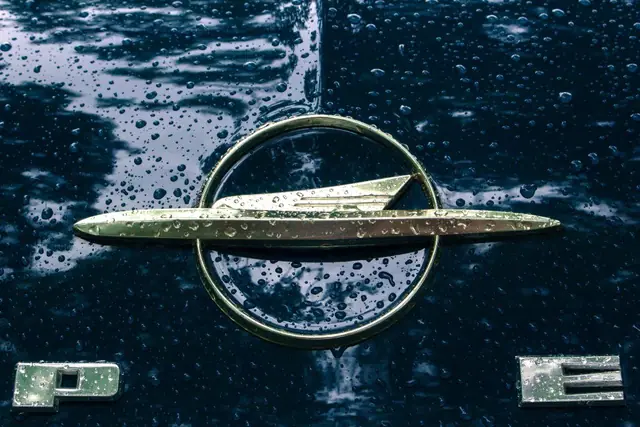
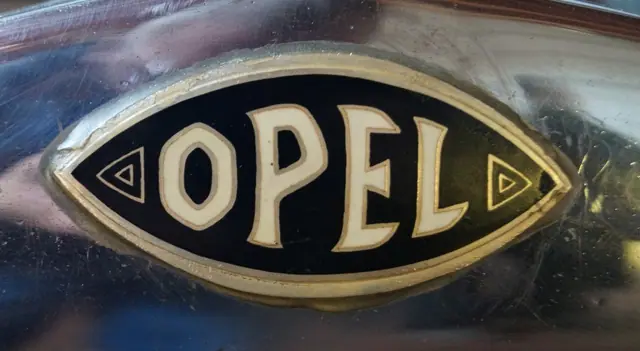
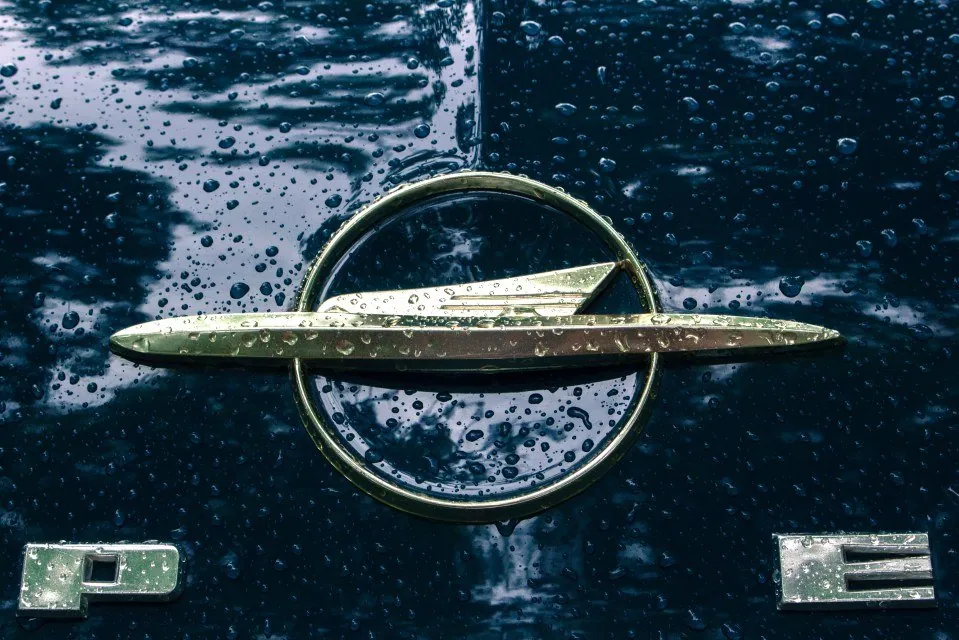
Opel's badge, a lightning bolt in a circle, has a long history. The first mark was the ornate letters A and O, Adam Opel's initials, cast on the sewing machine housings. In the late 1880s the word "Blitz" (lightning) appeared as the name of a bicycle model. From 1902 the cars carried a small oval brass badge, the "Opel eye", and in 1910 a new "eye" with a laurel wreath was introduced, said to have been sketched by Grand Duke Ernst Ludwig of Hesse. With small changes it was used until the mid-1930s.
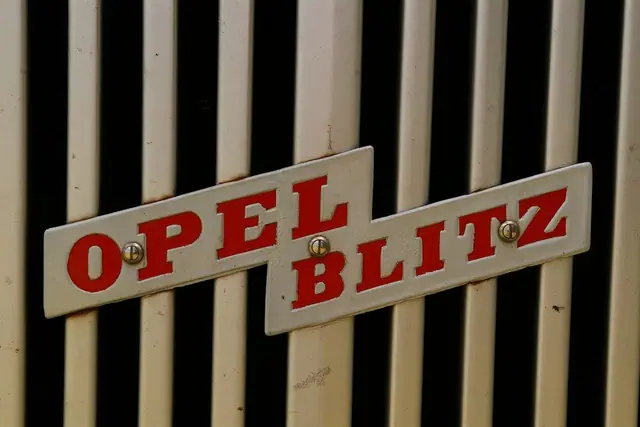
In 1930 Opel chose the name "Blitz" for a new truck in a nationwide competition, and a jagged lightning bolt was drawn for the first time. In the mid-1930s a new badge reached the cars: a stylised Zeppelin in a wheel, a symbol of progress and modern travel, which was also used as a bonnet mascot. In the 1950s the Zeppelin gained fins and grew ever sharper, until in late 1963 it turned into a horizontal lightning bolt in a circle, worn by the 1964 model year cars.
Opel's "Blitz" is therefore really a stylised Zeppelin, and it takes its name from the Opel Blitz truck. The badge was refreshed many times later: in 1970 it gained a yellow square and the Opel name, in the 2000s a three-dimensional look, and in 2017 Opel presented a flat, two-dimensional badge meant to express "clarity and modernity".
Key moments
- 1862. Adam Opel builds his first sewing machine in Rüsselsheim.
- 1886. The first Opel bicycle leaves the factory.
- 1899. On 21 January Sophie Opel and her sons take over Lutzmann's factory; car production begins.
- 1911. A major fire destroys the factory; Opel stops making sewing machines.
- 1924. The first moving assembly line in the German car industry and the small "Laubfrosch".
- 1928. Opel is the largest car maker in Germany; the RAK 2 rocket car reaches 238 km/h.
- 1929. In March General Motors buys 80 per cent of Opel, and the whole of Opel in 1931.
- 1935. The Olympia, the first German car with a unitary steel body; Opel is the first in Germany to build more than 100,000 vehicles in a year.
- 1936. The first Opel Kadett is presented; in 1937 Opel is the largest car maker in Europe.
- 1962. Production of the post-war Kadett begins at the new Bochum plant.
- 1968. The Opel GT sports coupé.
- 1970. The Opel Manta and Ascona; in 1972 Opel sells more cars in Germany than Volkswagen.
- 1989. The Opel Calibra, the most aerodynamic production car of its time; in 1990 it is followed by the Opel Lotus Omega, with a top speed of almost 283 km/h.
- 2017. On 1 August the French PSA group takes over Opel from General Motors; since 16 January 2021 Opel has been part of the Stellantis group.