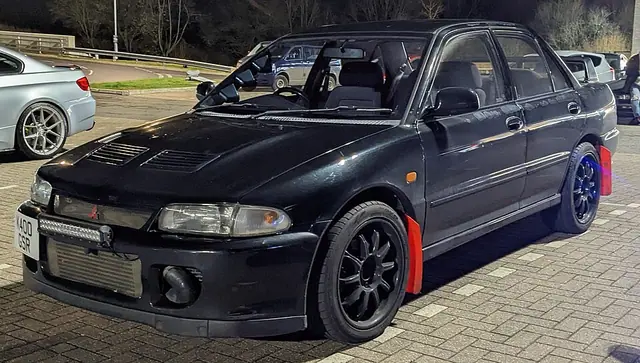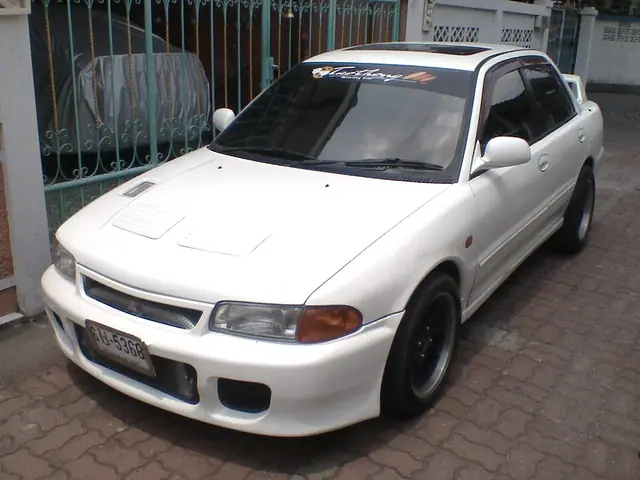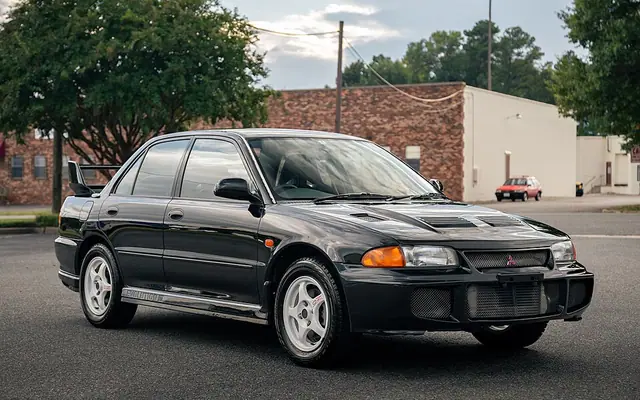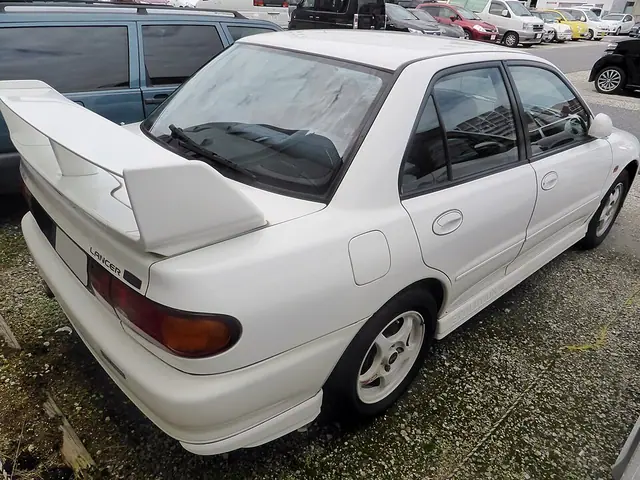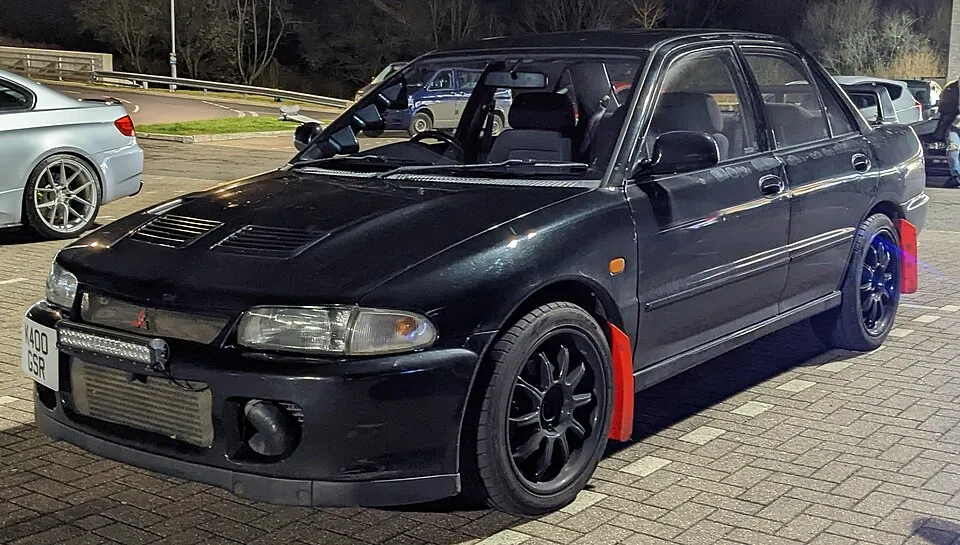
The Lancer Evolution was a modest family saloon into which Mitsubishi put the turbocharged engine and four-wheel drive of its rally car in order to meet the rules of the world championship. In it the Finn Tommi Mäkinen was world champion four years running, from 1996 to 1999, and its eternal rivalry with the Subaru Impreza, on rally stages and on the street, defined an entire era of car culture.
Story
In the early nineties Mitsubishi competed in the World Rally Championship with the Galant VR-4, but the sport increasingly favoured smaller, lighter cars. Group A rules required a rally car to be based on a production model built in a certain number of examples, so in 1992 Mitsubishi put the Galant VR-4's 2.0-litre turbocharged engine and four-wheel drive into the smaller Lancer body. The result was the Lancer Evolution, later called the Evolution I. The 4G63 engine produced 250 hp and 309 Nm, and the top speed was 228 km/h. There was a well-equipped GSR version and a lightened RS version, about 70 kg lighter, without electric windows and with steel wheels, intended for competitors and for those who would modify the car themselves. According to Wikipedia, 5,000 were sold in 1992 and 1993.
The Evolution name was no accident: almost every year a new, improved version arrived, designated by a Roman numeral. The Evolution II of December 1993 got better suspension, wider tyres and 260 hp, and the Evolution III of February 1995 a more aggressive front end, a bigger rear spoiler and 270 hp; 10,080 were built. In 1996 the Lancer got a new platform, and the Evolution IV turned the engine and gearbox through 180 degrees to improve weight distribution. A new twin-scroll turbocharger raised output to 280 hp, the maximum Japanese manufacturers could declare under their mutual agreement, although the real output of subsequent versions was higher. The GSR received Active Yaw Control, which electronically distributed torque between the rear wheels, and the planned 6,000 cars sold out in three days. The Evolution V got flared wings, Brembo brakes and 17-inch wheels, and the Evolution VI improved cooling and, in RS form, a titanium-aluminide turbine, the first in a production car.
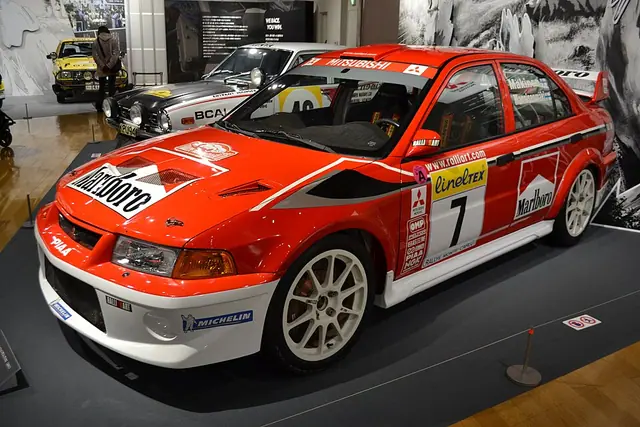
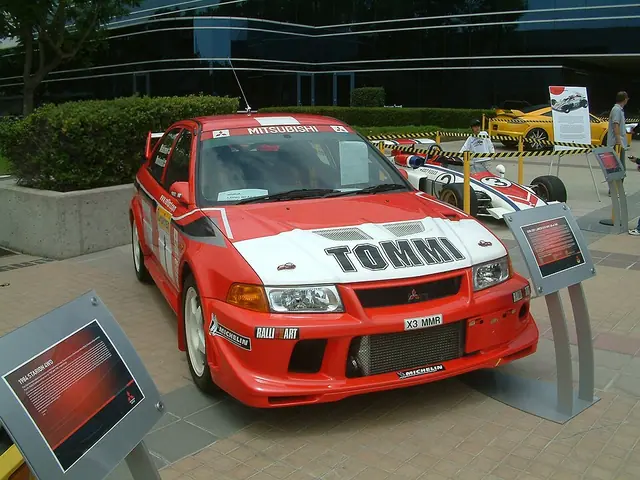
On the rally stages the Evolution became a champion. The Finn Tommi Mäkinen joined Mitsubishi in 1995, and from 1996 to 1999 he won the world title four times in a row, with the III, IV, V and VI in turn. 1998 was particularly successful, when Mitsubishi, helped by the Briton Richard Burns, won the manufacturers' title for the only time. That year Burns won the Safari Rally and the Rally of Great Britain, driving a car entered as a Carisma GT, because the Lancer was not sold in most of Europe. Unlike its main rivals, which from 1997 built special cars to World Rally Car rules, Mitsubishi competed with a Group A car, much closer to the production model, until the 2001 San Remo Rally. The Evolution also dominated the Group N production-car category from 1995 to 2000.
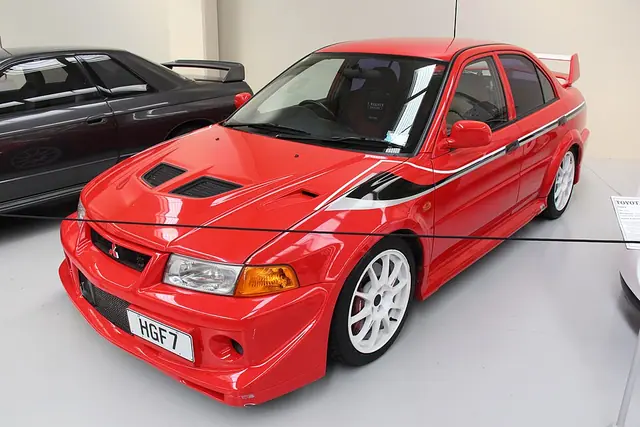
In honour of the champion, a special Evolution VI Tommi Mäkinen Edition arrived in December 1999, with a different front bumper, red-and-black Recaro seats bearing Mäkinen's signature, white 17-inch Enkei wheels, lower suspension and quicker steering; many ordered it in red with graphics like those on his rally car. Enthusiasts also call it the Evolution 6½, and today it is one of the most sought-after models in the series. The Evolution was at first intended only for the Japanese market, but demand through "grey imports" pushed Mitsubishi to offer it, from the IV onwards, through the Ralliart network in the United Kingdom and other European countries.
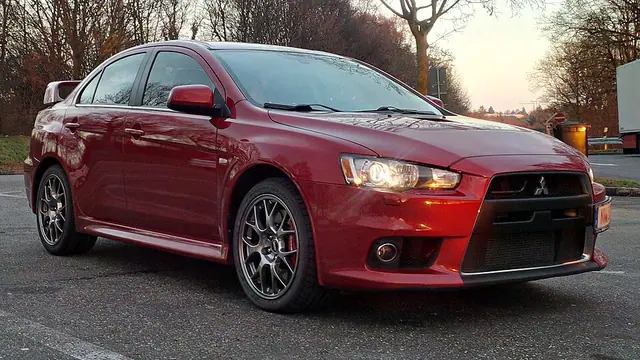
Later versions were bigger and technically more complex. The Evolution VII of 2001, based on the larger Lancer Cedia, got an active centre differential, and in 2002 a GT-A version with an automatic gearbox. The Evolution VIII of 2003 was the first sold officially in the United States, where Mitsubishi had seen the success of the Impreza WRX, and the British FQ-400 had 411 hp. The Evolution IX of 2005 got MIVEC variable valve timing and 291 hp, and there was also an estate. The last, the Evolution X, went on sale in October 2007 with a new aluminium 4B11T engine, Super All Wheel Control and a dual-clutch gearbox. Mitsubishi decided to concentrate on crossovers and electric cars, so after a special 2015 Final Edition series of 1,000 cars for Japan, production ended in April 2016, after 24 years and ten generations.