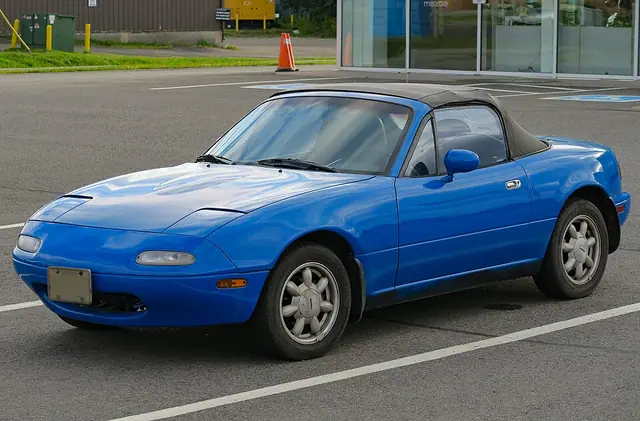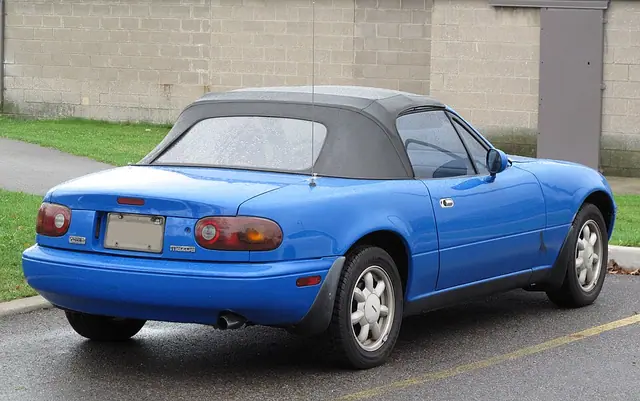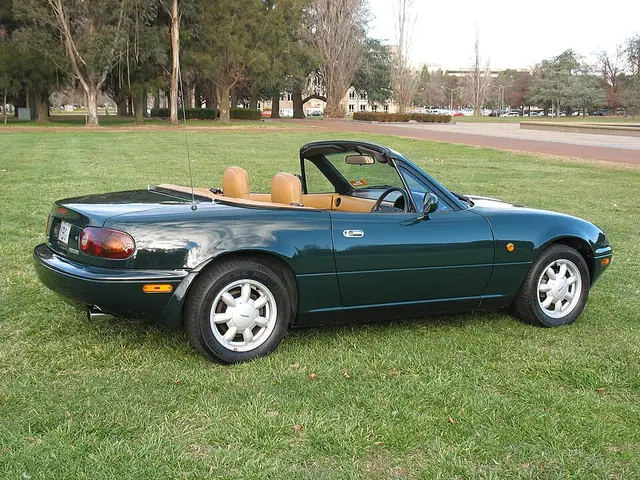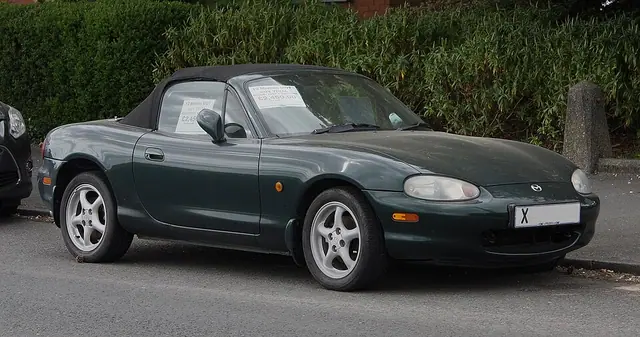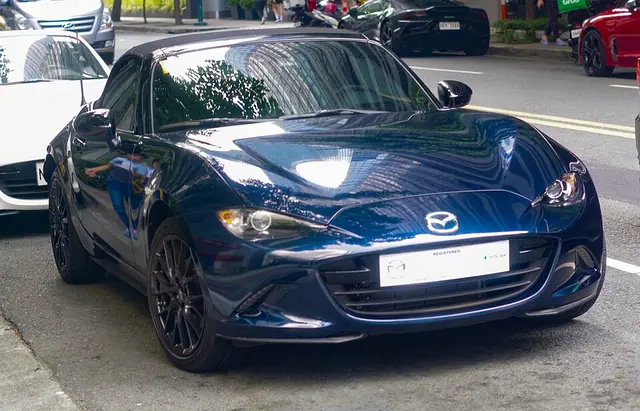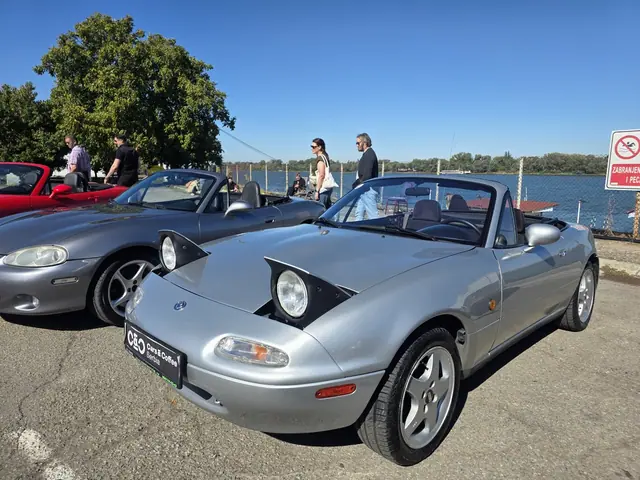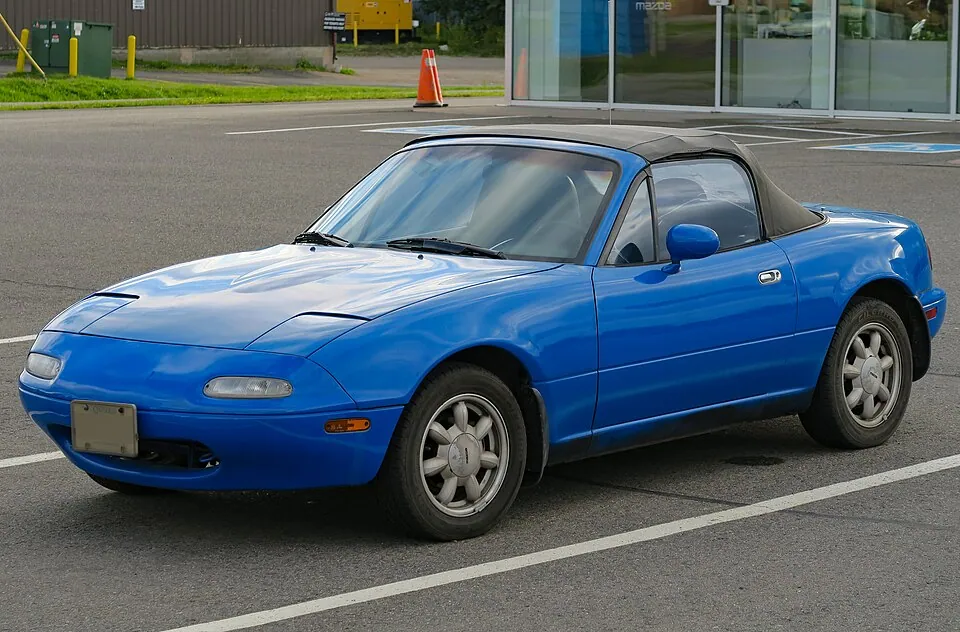
At the end of the eighties the MX-5 brought back to life the small, light and cheap roadster, a type of car that had almost died out with the disappearance of British MGs and Triumphs. It was built on the Japanese principle of "jinba ittai", the unity of horse and rider, and since 2000 it has held the Guinness record as the best-selling two-seat sports car in history.
Story
The idea was born in 1976, when Bob Hall, a Motor Trend journalist who knew Japanese cars very well and spoke Japanese, talked with Kenichi Yamamoto, Mazda's head of development. Asked what kind of car Mazda should build, Hall replied that the simple "wind-in-the-hair" British sports car no longer existed and that someone should build one. When Hall joined Mazda in the USA in 1981, Yamamoto, by then chairman, remembered the conversation and allowed him to develop the idea. At Mazda's new design studio in California Hall brought in designer Mark Jordan, and in 1983 the project was approved as part of the internal "Offline 55" programme.
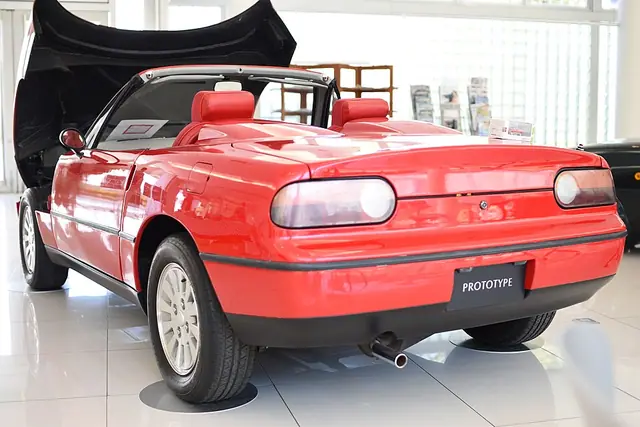
The California design studio and the team in Tokyo competed with proposals. The Californians proposed a classic layout with a front engine and rear-wheel drive, called Duo 101, while the Japanese proposed front-wheel drive or a mid-engine. In August 1984, when full-size clay models were shown, Duo 101 won. It was strongly influenced by the British Lotus Elan of the sixties, from the door handles and tail lights to the air vents and the console. The British firm IAD built a running prototype with a glass-fibre body and an engine from the Mazda 323, which was driven on the streets of Santa Barbara in 1985. The project was finally approved on 18 January 1986, led by Toshihiko Hirai, and the final shape was refined by Tom Matano, Mark Jordan, Wu-huang Chin, who also worked on the Mazda RX-7, Norman Garrett and Koichi Hayashi.
The MX-5 was unveiled on 10 February 1989 at the Chicago Auto Show and arrived in the USA, as the Miata, in May of the same year. It had a 1.6-litre, 115 hp engine specially adapted for this model, a five-speed manual gearbox, double-wishbone independent suspension on all four wheels, weight distribution close to 50:50 and pop-up headlights. The base model had no power steering, air conditioning or radio, to keep it as light and cheap as possible. Demand was so high that American dealers asked up to 10,000 dollars over the price of about 14,000 dollars, and buyers waited for months. In Japan it was sold as the Eunos Roadster, under Mazda's new brand for more expensive models, and in Europe from 1990.
For the 1994 model year the first generation got a 1.8-litre engine, airbags and a stiffened body, and it was also built in numerous special editions, from the British racing green version of 1991 to the yellow J Limited in Japan. The first-generation NA was discontinued after the 1997 model year with a total of 228,961 built. The second-generation NB (1998) lost the pop-up headlights because of pedestrian-protection rules, and it was the only one with a factory turbo version, the Mazdaspeed. The third-generation NC (2005) also brought a folding hardtop version, and the fourth-generation ND (2015) was named World Car of the Year in 2016 and served as the basis for the Fiat 124 Spider.
In 2000 Guinness World Records named the MX-5 the best-selling two-seat sports car in history, when 531,890 had been built. The millionth MX-5 was produced on 22 April 2016, and by May 2025 the Ujina plant had built 1,256,158, a record that no other roadster has come anywhere near.