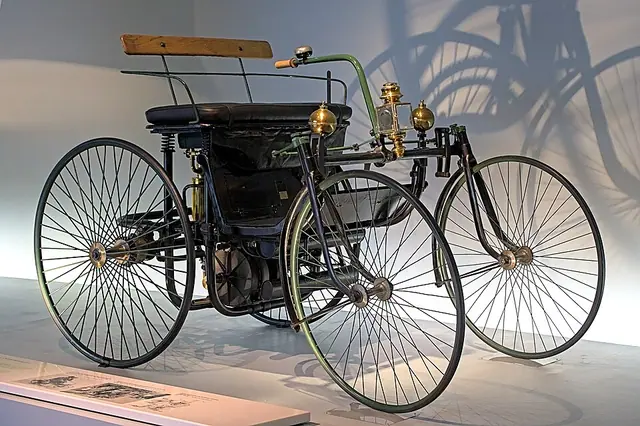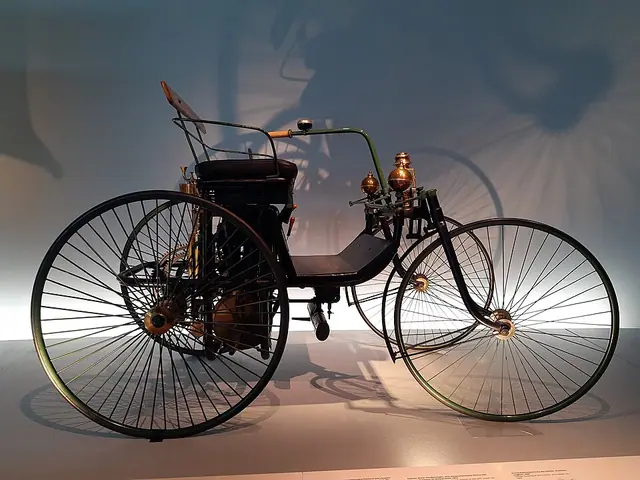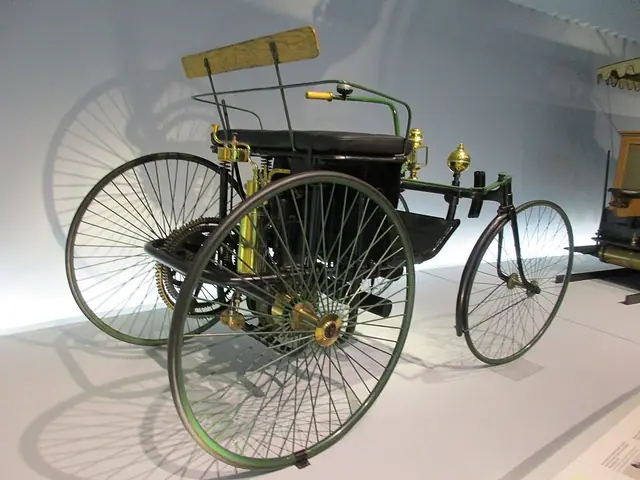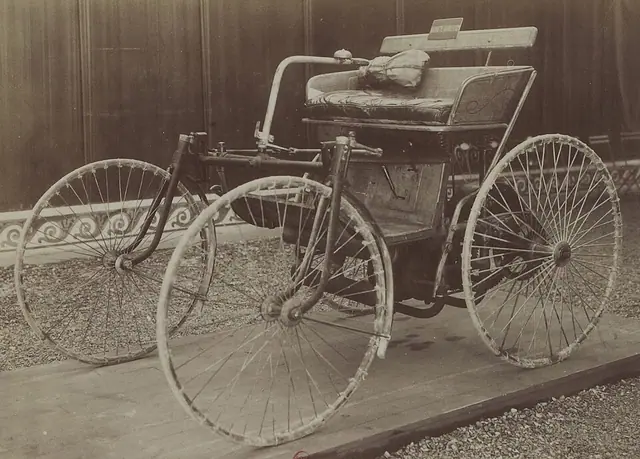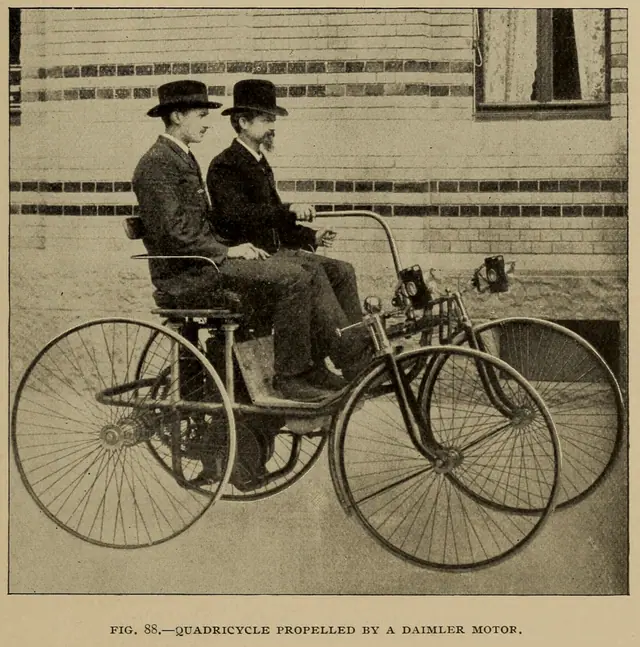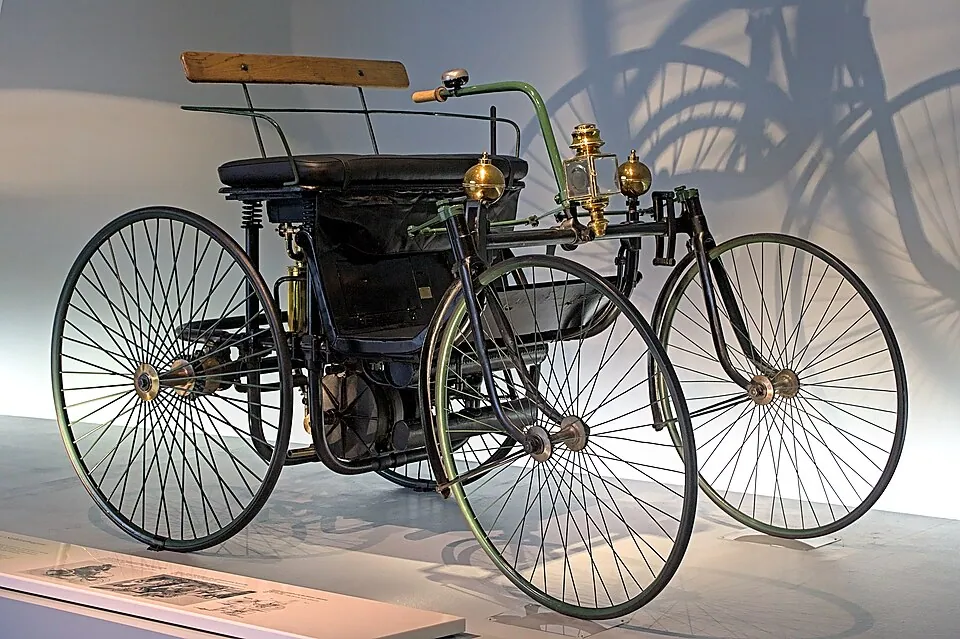
The Stahlradwagen was Daimler and Maybach's first car designed from the outset as a car, rather than a carriage with an engine fitted. It had the world's first V engine and a four-speed gearbox, and after the 1889 Paris exhibition it became the model for the first cars of Peugeot and Panhard, so it is regarded as the spark that started the French motor industry.
Story
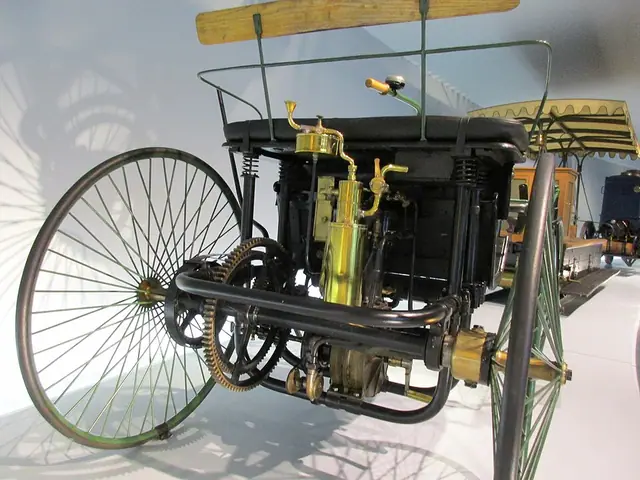
After leaving the Deutz works in 1882, Gottlieb Daimler and Wilhelm Maybach developed light, fast petrol engines in Cannstatt. They built their first four-wheeler in 1886 by fitting an engine into an ordinary carriage (the Motorkutsche). Three years later Maybach designed an entirely new vehicle. The frame of thin steel tubes looked like two bicycles joined side by side, and it was made by a knitting-machine and bicycle factory in Neckarsulm, which later became NSU. The engine's cooling water flowed through the frame tubes, so the frame also served as a radiator.
The heart of the vehicle was a new two-cylinder engine with the cylinders set at an angle of 17 degrees, the world's first V engine, with a displacement of 565 cc and an output of 1.5 hp at 700 rpm. It weighed about 40 kg per horsepower, half as much as Daimler's earlier single-cylinder engines. The engine was at the back, and power went through a four-speed gear transmission, from about 5 km/h in first to 16 to 18 km/h in fourth. The front wheels sat in bicycle-style forks and were linked by a tie rod. There were no springs except under the seat, and braking was by a single hand-operated band brake.
The Stahlradwagen was presented at the 1889 World's Fair in Paris, the same one at which the Eiffel Tower was opened, on the stand of Panhard & Levassor. The link with France was already in place: in 1886 the Belgian industrialist Édouard Sarazin had obtained the licence for Daimler engines in France, and after his death in 1887 the licence passed to his widow Louise, who then married Émile Levassor. From the end of 1889 Panhard & Levassor built Daimler engines under licence. Armand Peugeot, then a bicycle maker, saw the vehicle and the engine at the exhibition and became interested in a light car with Daimler power.
That is how the first French cars came about: Peugeot built the Type 2 in early 1890, and Panhard & Levassor its first car in mid-1891, both following the concept of the Stahlradwagen and using Daimler engines made under licence by Panhard & Levassor. By the end of the century Peugeot had become the largest car maker in France. In Germany itself success did not come: from 1892 to 1895 Daimler-Motoren-Gesellschaft, founded in 1890, sold a reworked version called the Daimler Motorwagen, developed without Daimler and Maybach, but it sold poorly and nearly drove the company into bankruptcy.
One Stahlradwagen is now on display at the Mercedes-Benz Museum in Stuttgart, not far from the Benz Patent-Motorwagen, the 1886 car of Daimler's rival Carl Benz. The two firms, Daimler and Benz, merged only in 1926, and that merger created Mercedes-Benz, whose later models such as the Mercedes-Benz SSK continued the same line.