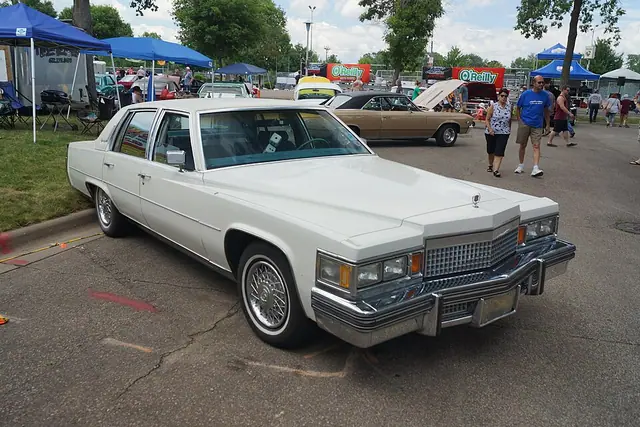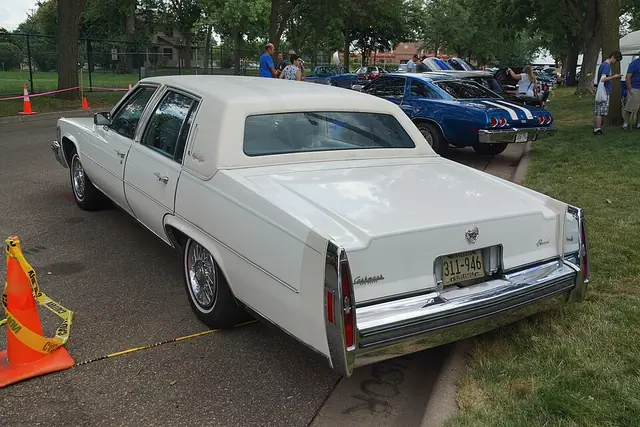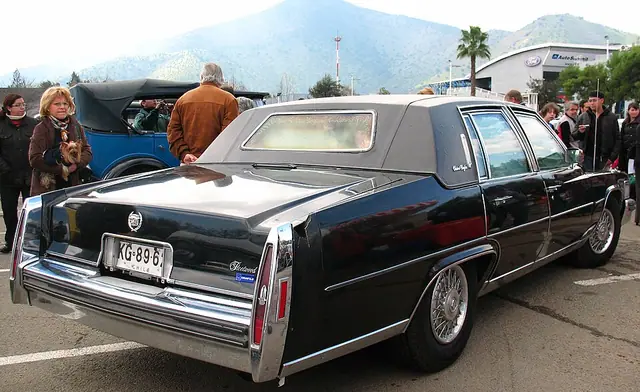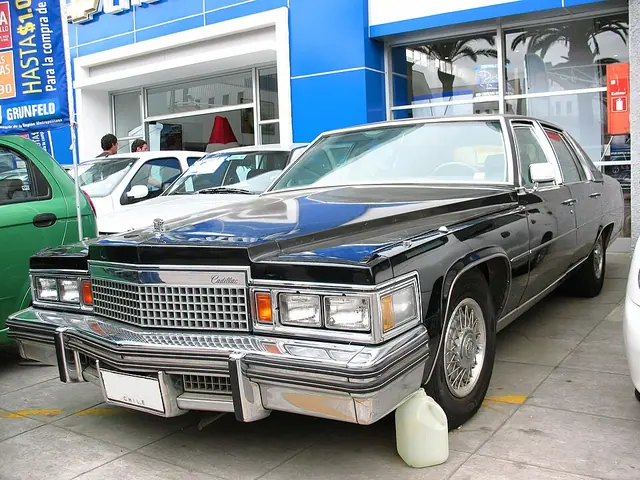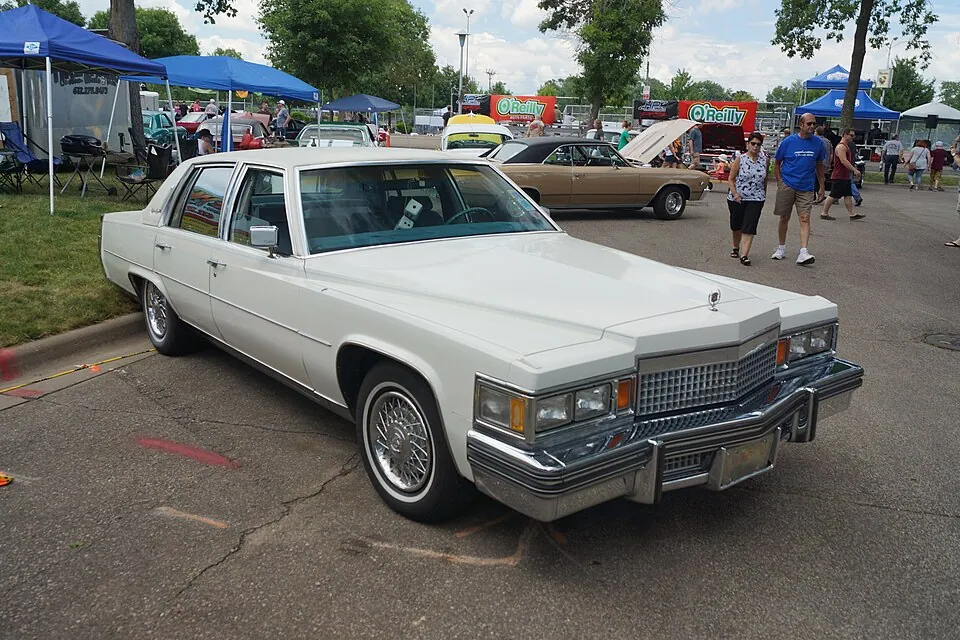
The late-seventies Fleetwood Brougham was the most luxurious owner-driven Cadillac, and it belonged to the generation with which General Motors, after the oil crisis, downsized its big cars for the first time, without losing cabin space. Its wheelbase was 29 cm shorter and it was about 400 kg lighter than its predecessor, yet it kept everything people expected of a Cadillac: plush seats, a vinyl roof, "opera" lamps on the rear pillar and a seven-litre V8.
Story
The name Fleetwood comes from the coachbuilder in the town of Fleetwood, Pennsylvania, which Fisher Body, part of General Motors, bought in 1925, and which from then on built bodies for Cadillac only. In the 19th century the word "Brougham" denoted a closed one-horse carriage, named after the British statesman Henry Brougham, and Cadillac had used it since 1916 for various luxury bodies. From 1965 the Brougham was a trim package on the Fleetwood Sixty Special, from 1966 a separate model, and from 1971 the only version, called the Fleetwood Sixty Special Brougham. When the Sixty Special name was dropped for 1977, the Fleetwood Brougham became Cadillac's largest owner-driven saloon, with only the chauffeur-driven Fleetwood Seventy-Five limousine above it.
1977 was a turning point. Because of the oil crisis and new American corporate average fuel economy rules (CAFE), General Motors downsized all its big cars, and Cadillac did so in its 75th anniversary year. The new De Ville models were more than 23 cm shorter, 10 cm narrower and about half a tonne lighter, yet had more headroom and legroom and a bigger boot. The Fleetwood Brougham lost its own, longer wheelbase: it had 121.5 inches, like the Sedan de Ville, 11.5 inches (29 cm) less than the 1976 model, and was almost 400 kg lighter. The 500 cubic inch engine was replaced by a new 425 cubic inch (7.0 l) unit derived from the same family, and critics considered the new cars better than their predecessors in almost every respect except, perhaps, looks.
On the outside the Fleetwood Brougham differed from the Sedan de Ville only in details, such as a slightly altered centre pillar and rear side windows, but inside it was more opulent, with more standard equipment. The 1979 model, the third year of that generation, got a new grille with the Cadillac script on its upper edge and a light aluminium bonnet, while bigger changes were saved for 1980. Standard equipment included automatic climate control, a radio with digital display and automatic station seeking, electric windows and locks, a vinyl roof with "opera" lamps and automatic rear level control. The d'Elegance package brought button-tufted plush for an extra $997, or leather for $1,367. The base 425 cubic inch engine had 180 hp, and the version with electronic fuel injection 195 hp. According to enthusiast sources, 42,200 Fleetwood Brougham saloons were built for the 1979 model year.
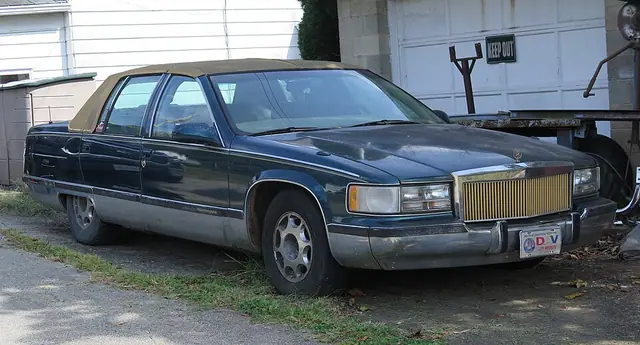
The Fleetwood Brougham became one of the symbols of American luxury in the late seventies and eighties: long, soft-riding and covered in chrome, with a Rolls-Royce-inspired grille after 1980. That year it got new sheet metal and, briefly, a two-door coupé, and under regulatory pressure the engine was reduced to 6.0 l. In 1981 it got the unfortunate V8-6-4 cylinder-deactivation engine, then the aluminium HT-4100, and in 1986 Oldsmobile's 5.0 l V8. When Cadillac moved to smaller front-wheel-drive models in 1985, the Fleetwood Brougham stayed in production because of demand, with the old rear-wheel drive, from 1987 under the name Brougham, until 1992. Its successor, the 1993–1996 Fleetwood, still on the same wheelbase, was Cadillac's last body-on-frame, rear-wheel-drive saloon. For comparison, a similar role in the Ford group was played by the Lincoln Town Car, and it shared its basic body with its sister model, the Coupe de Ville.