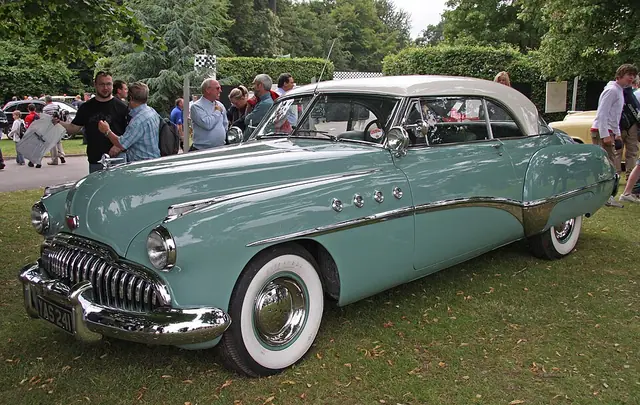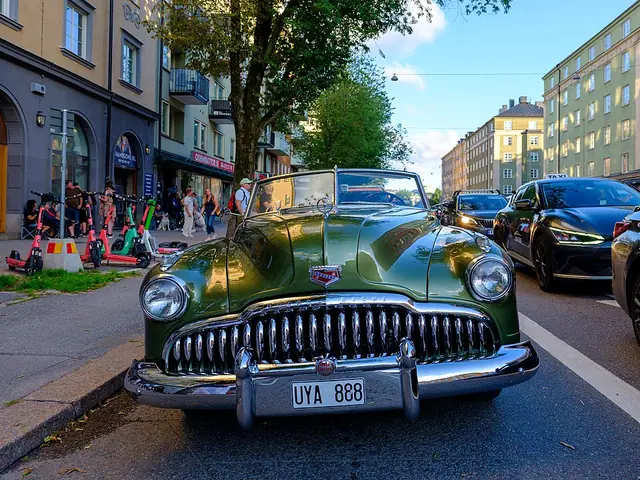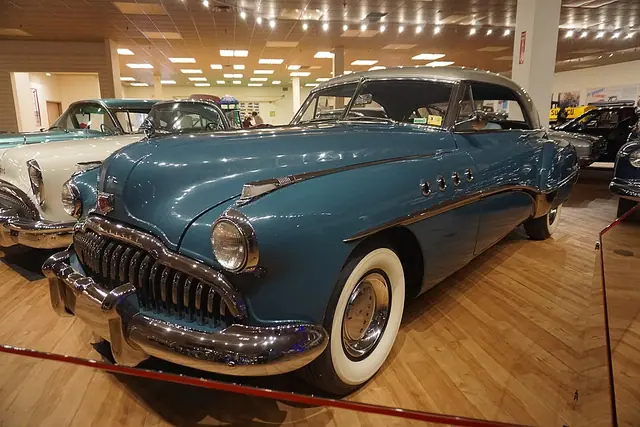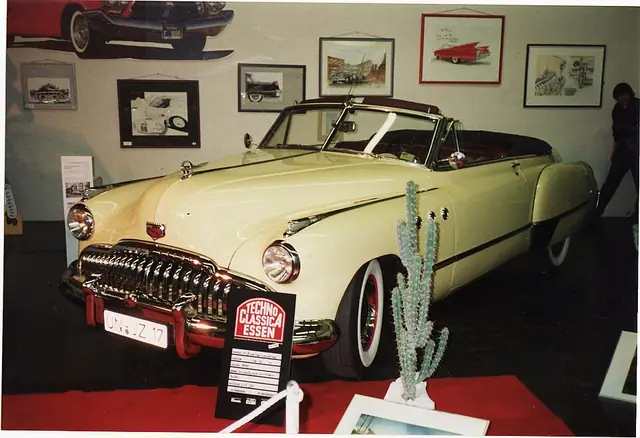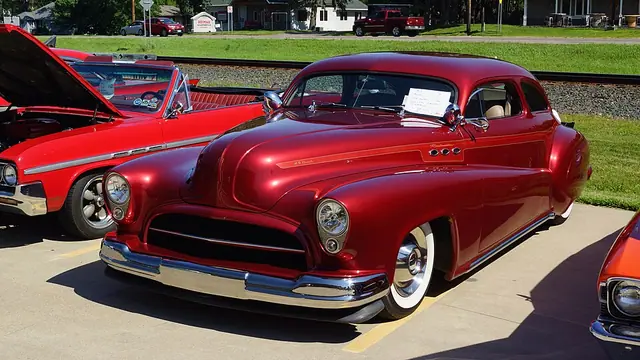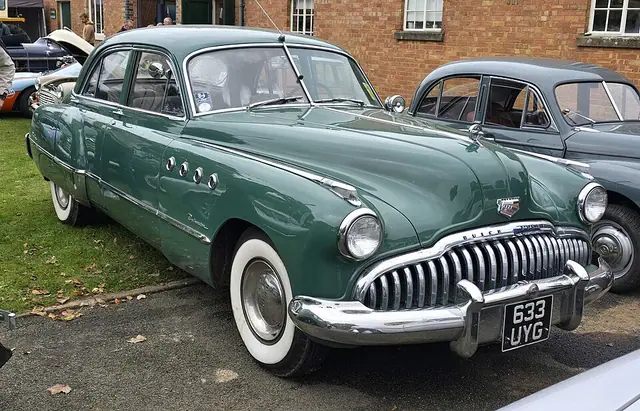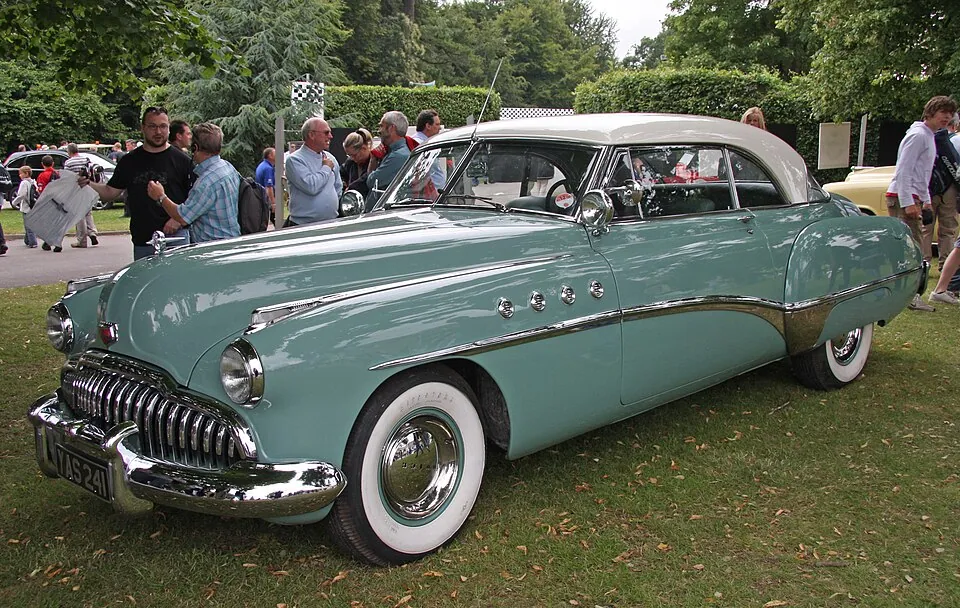
The 1949 Roadmaster introduced two details that became Buick trademarks for decades: the round VentiPorts on the front wings and the chrome Sweepspear line. Its Riviera version was, together with Cadillac's Coupe de Ville, one of the first production pillarless hardtop coupés, and a 1949 convertible became a film star in "Rain Man" with Dustin Hoffman and Tom Cruise.
Story
From 1936 the Roadmaster was Buick's big model, and after the war also its flagship, sharing its basic body with the cheapest Cadillacs and the big Oldsmobile. The first post-war models were only lightly changed pre-war cars, but they sold as never before: in 1947 and 1948 almost 80,000 Roadmasters were sold each year, more than four times as many as in any pre-war year. For 1948 Buick offered the Dynaflow transmission as an option on the Roadmaster, the first automatic transmission for passenger cars with a hydrodynamic torque converter, which worked smoothly and without noticeable gear changes.
For 1949 the Roadmaster received its first big post-war redesign. The wheelbase and length were reduced, yet weight still rose slightly. Also new was a large, two-piece curved windscreen, which the brochure compared to the view from a railway observation car. The most famous detail came about almost by accident. Buick designer Ned Nickles fitted his own 1948 Roadmaster with four yellow bulbs on each side of the bonnet, wired to the ignition distributor so that they flickered in time with the cylinders firing and recalled the flames from a fighter plane's exhausts. Buick boss Harlow Curtice was delighted and ordered that all Buick models for 1949 get such ports, without the bulbs: the Roadmaster four on each wing, the less powerful Super and Special three each. The brochure claimed that the VentiPorts ventilated the engine bay, which may have been true at the start of the year, but during 1949 they became purely decorative.
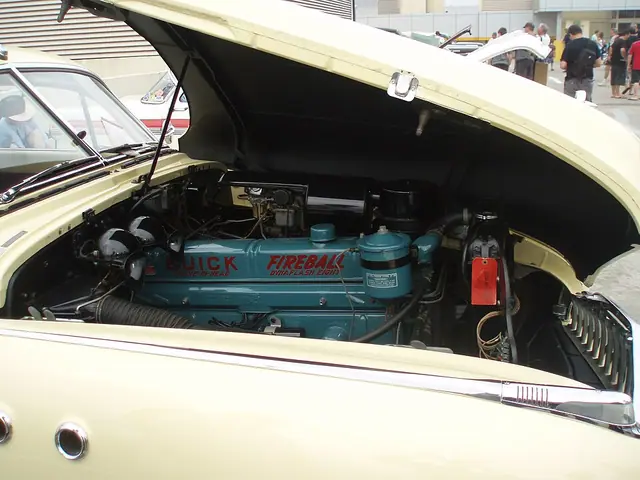
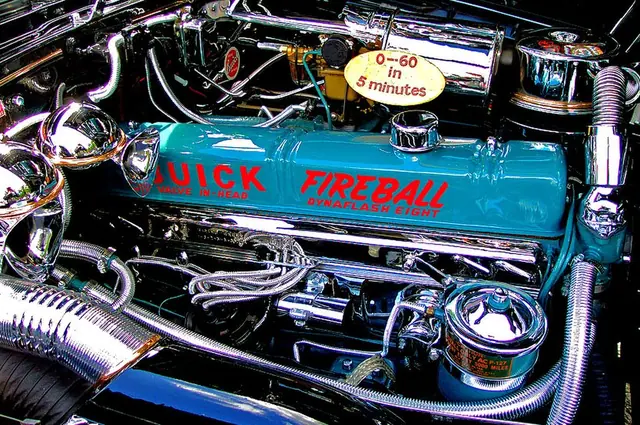
Under the bonnet was the 320 cubic inch overhead-valve "Fireball" straight-eight, whose slightly raised compression lifted output to 150 hp. From 1949 the Dynaflow was standard, and the Roadmaster reached about 177 km/h. Body styles included the Sedanet fastback coupé, a four-door saloon, a convertible and the wood-sided Estate station wagon. In mid-year came the Roadmaster Riviera, which, together with Cadillac's Coupe de Ville and the Oldsmobile 98 Holiday, was among the first production hardtop coupés. It was made by welding a steel roof onto the convertible body, so it had no centre pillar, and it had electric windows as standard. The Riviera was also offered with the chrome "Sweepspear" side trim, which dropped from the front wheel almost to the sill and then curved around the rear wheel. 4,314 Rivieras were sold, and 88,130 Roadmasters in total, the best result in the model's history and 27 per cent of all Buicks, even though the Roadmaster cost only slightly less than the cheapest Cadillac.
The 1949 Roadmaster convertible also found fame in film. In the 1988 film "Rain Man", Charlie Babbitt, played by Tom Cruise, inherits from his late father only rose bushes and a classic 1949 Buick Roadmaster convertible, over which he had once fallen out with his father, and he drives it across America with his brother Raymond (Dustin Hoffman). Two such cars were used for filming, and one had its rear suspension reinforced to carry a camera and cameraman. After filming, Hoffman bought the unmodified car, had it restored and kept it for 34 years, and in January 2022 it sold for $335,000 at a Bonhams auction in Scottsdale, Arizona. The camera car was bought by director Barry Levinson and restored by Wayne Carini of the television series "Chasing Classic Cars".
In 1950 the Roadmaster got a grille with big "teeth", and the Sweepspear became standard. In 1953 came a new V8 engine, popularly known as the Nailhead, and the luxurious Skylark convertible, built in only 1,690 examples, and the Roadmaster remained in production as Buick's flagship until 1958. The Roadmaster name returned in 1991 on a large saloon and station wagon built until 1996.